


10 most jarring style switches in music history

It can take most bands a lifetime to find a style of songwriting that they’re comfortable with. Even though most artists have their sound refined before most people have ever heard of them, no one can claim to have their music down to a science, and some of the biggest acts in the world tend to discover their musical identity midway through their careers. Having a signature can get boring, though, and acts like The Beatles and Radiohead found it more found to tear down their trademarks.
Throughout music history, acts have been known to toy with their sound repeatedly to keep themselves refreshed. While some artists may have started incorporating bits and pieces of their favourite songs into their repertoire, classic artists made for stunning switches that no one saw coming. One day they were one style of band, and suddenly they were a completely different act the next day.
Then again, no style switch tends to be an overnight thing. Although many acts have been known to switch things up for the hell of it, some of the best examples come from new members coming into the fold, bringing with them bold new reinventions that led to the rest of the band adapting around them.
Even though there were a billion ways for drastic switches to go wrong, the fans were more than willing to listen along, following their favourite bands throughout the years as they turned their sound inside out. Instead of resting on their laurels, these artists found a second career by going in a different direction. It’s one thing to have a sound that works, but it’s more fun to see what you’re capable of.
10 most jarring style switches in music history
10. Power Corruption and Lies – New Order
It would take a small miracle for any of the members of Joy Division to pick up instruments again. Having to come to grips with the loss of Ian Curtis, the surviving band members decided to soldier on, forming the beginnings of New Order as the ‘80s were dawning. Instead of carrying on making the same type of music as their old band, things got a lot more interesting once synthesisers were brought into the mix.
Across Power Corruption and Lies, New Order ushered in the sound of the ‘80s with ease, making songs just as pretty as they were artistic. While some of the instrumentation would become the sound of the times once synth-pop began, there was never any flashiness involved in the band’s playing, almost using the instrument as an extension of their angst throughout the project.
Even with the more robotic side of their sound, the music never suffered for it, with Peter Hook’s phenomenal bass playing being just as prevalent in the final mix as it was on old Joy Division tracks. Most bands would never recover from what New Order had gone through, but they turned their tragedy into one of the most glorious second acts in rock history.
9. Licensed to Ill – The Beastie Boys
There’s a good chance every adolescent male has gone through a phase where they convinced themselves that the Beastie Boys were the best band in the world. Off the strength of Licensed to Ill, the loveable smartasses from New York built their first hits on the sounds of old-school hip-hop like Run-DMC and Public Enemy. Although rap was their bread and butter, it wasn’t where they started.
On the first handful of Beasties projects, the band began life as a hardcore punk band influenced by the likes of Minor Threat. Across their first handful of EPs, each member had a stab at making music influenced by acts like Bad Brains until they discovered that a sampler and a few microphones were their true calling to the big time.
Even when they started making hip-hop, they still weren’t satisfied, using the rest of their career to get almost psychedelic with their use of samples and fusing them with rock instrumentation on Paul’s Boutique and Ill Communication. The Beastie Boys were always more than just one genre, but they never forgot that punk rock ethos throughout every switch they made.
8. American Idiot – Green Day
For a while in the 2000s, Green Day were dangerously close to becoming yesterday’s news. While the afterglow of Dookie was still fresh in everyone’s minds from the ‘90s, the band’s last handful of releases wasn’t cutting it in terms of record sales, with their folksy Warning being one of their lowest in terms of chart success. Just when the rest of the pop-punk scene was looking to leave them in the dust, Billie Joe Armstrong found his calling going back to militant punk rock.
Inspired by the atrocious practices of the Bush administration, Armstrong sculpted American Idiot as a direct retort to the mindless flag-waving mentality. Although the same hallmarks of Green Day were still intact, there was a more mature approach to songwriting, including using varied instrumentation across its runtime.
The real gamechanger came in the more episodic songs, with ‘Jesus of Suburbia’ expanding well beyond nine minutes to tell the story of a fictional kid who leaves home for the big city. Green Day may have been ancient by rock and roll standards but their ability to refine their songs wasn’t something that was going to turn up on any Sum 41 record.
7. After Laughter – Paramore
At the start of the 2010s, Paramore was already operating at half capacity. Despite making one of their strongest albums on Brand New Eyes, the tension in the studio led to them losing two band members and being reduced to a trio for their 2013 self-titled record. While that record gradually nudged them into more pop-friendly territory, no one was ready to get an ‘80s nostalgia bomb on the next project.
Riding the wave of retro sounds, most of After Laughter comprises some of the most glistening backing tracks heard in their catalogue on ‘Hard Times’ and ‘Rose Colored Boy’. Even in this sugary style, everyone still had their chops intact, with Taylor York playing some of his most intricate lines on ‘Told You So’ and Zac Farro keeping things almost funky behind the drum kit.
As if to keep the album from sounding too poppy, Hayley Williams’s lyrics are also some of the most morbid of her career, with the title itself referring to the solemn feeling that brings a person back down to Earth when they stop laughing. Although they had the emo label follow them for most of the ‘00s, Paramore did the impossible by making a sad album that makes the listener feel good while listening to it.
6. Highway 61 Revisited – Bob Dylan
As the ‘60s were starting to become iconic, Bob Dylan felt like the next spokesman for young people. Armed with an acoustic guitar and a song in his heart, Dylan’s first iconic songs painted him as an update of Woody Guthrie, crafting songs that were crafted for the world to hear. No one ever wants to have that much power over a generation, and Dylan realised that the best way forward was to shake off his folk roots.
Once the rock and roll revolution began kicking in, Dylan was inspired by acts like The Beatles to pick up an electric guitar on Highway 61 Revisited. Although there were some occasional electric sounds on Bringing It All Back Home, this was Dylan drawing a line in the sand, ensuring his audience that he wouldn’t coax on his laurels as an acoustic guitar-toting troubadour.
The messages may have been different, but Dylan’s way with words didn’t change a bit, writing songs that had much more to do with how people twist his messages in ‘Ballad of a Thin Man’. A version of Dylan without the folk aesthetic may have been hard for some fans to swallow, but one listen to ‘Like A Rolling Stone’ will tell every listener what they need to know. Dylan wasn’t selling out…he was just going to dominate another medium.
5. Station to Station – David Bowie
When talking about David Bowie’s work, it’s hard to imagine him fitting comfortably into any one genre. While most people know him for his glam rock aesthetics in the ‘70s, Bowie had made it a habit of putting on different musical costumes whenever he went into the studio, making glam music in one decade, pop the next and even electronic music in the ‘90s. However, the first major switch came when he conquered the world Ziggy Stardust created.
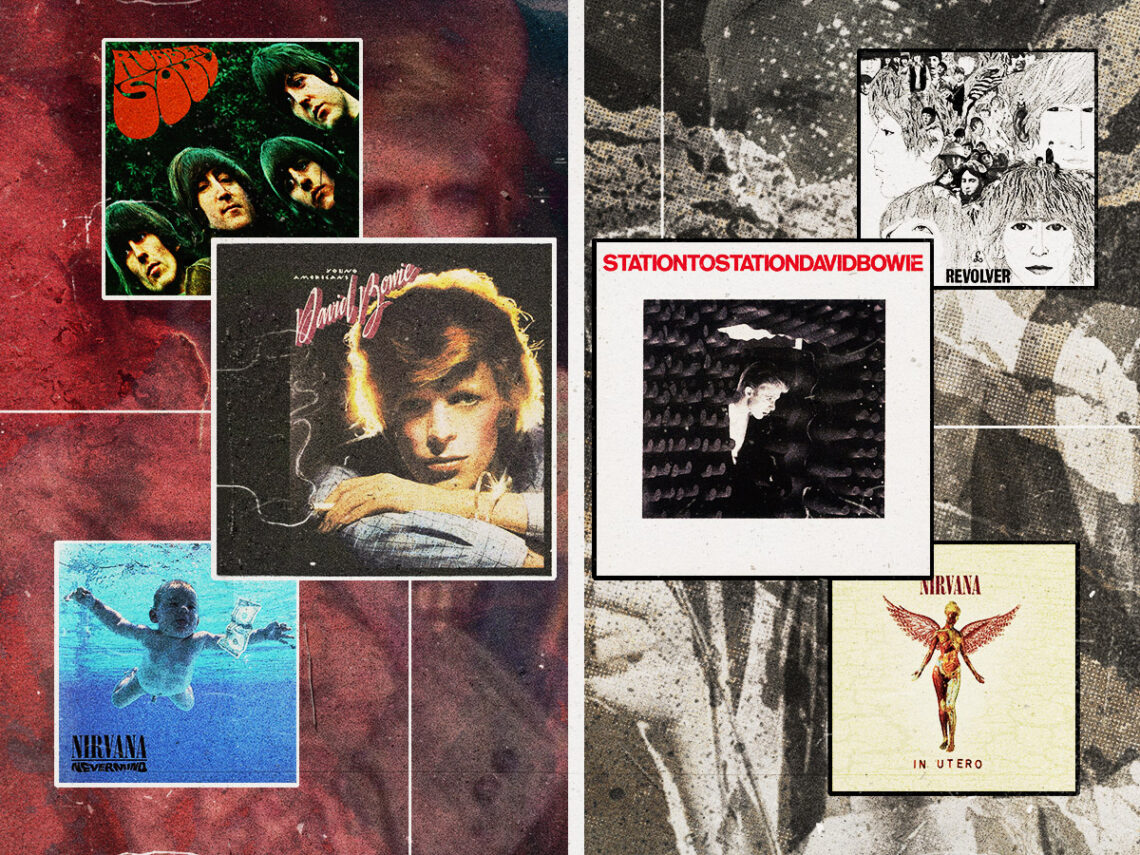
Coming out of the glam-rock ‘70s, Bowie had become invested in some of the new sounds coming out of Germany at the time. Moving to Los Angeles to soak in the seedy side of California, Bowie created another masterpiece on Station to Station, playing songs with structures more in line with Kraftwerk and Neu! Than with T Rex.
Even though opening up the album with a ten-minute opus about ‘The Thin White Duke’ was already daunting, Bowie still found time to keep his audience’s attention on pop-friendly songs like ‘Golden Years’. While not reaching Berlin yet, this was the unofficial start of Bowie’s interest in krautrock, making some of his most forward-thinking albums after this, like Low and “Heroes”.
Most genres are meant to suit a certain breed of musician, but given his track record, Bowie could have made an album of country and bluegrass and still come out looking like the coolest person in the room.
4. Kid A – Radiohead
By the end of the ‘90s, it suddenly felt like rock and roll was important again. Since most of the hopes and dreams of the genre were crushed by the death of Kurt Cobain in 1994, Radiohead became the unintended saviours of rock in 1997 with OK Computer, painting a dark picture of what the future could be like if humanity isn’t careful. Then again, Radiohead had just conquered rock and roll, so why not find another genre to call their own?
Being sick to death of the constant melodic songs the band were making, Thom Yorke began stripping their songs down to their rhythmic essence, all while incorporating ambient synthesisers into the mix. Once Kid A dropped in 2000, fans knew they weren’t getting Ok Computer Part 2. It was a chilling look into the sounds of electronic music on songs like ‘Idioteque’ and ‘Everything In Its Right Place’.
As fans started to acclimatise themselves to the album, this quickly became Radiohead’s second magnum opus, even eclipsing OK Computer in how varied its instrumentation is, like the scattered horn section on ‘The National Anthem’ and the lavish orchestrations on ‘Motion Picture Soundtrack’. If OK Computer was the warning about what apocalyptic future we were in for, Kid A was a look at the aftermath of what that dystopian future gave way to.
3. Fleetwood Mac – Fleetwood Mac
If most fans of Fleetwood Mac were to describe their sound, it’s hard to find a better description than ‘organic’. Throughout their glory year, The Mac made some of the most rustic pop music of the ‘70s, inspired by the real-life drama between each band member. Even though their rock, country, and pop blend was irresistible at the time, no one could have guessed that the same band was a blues outfit.
Prior to their classic output, Fleetwood Mac had been one of the staples of the blues rock scene, with legendary guitarist Peter Green penning some of their greatest tracks like ‘Oh Well’. After a myriad of guitarists dropped out of the slot, the inclusion of both Lindsey Buckingham and Stevie Nicks completely changed their sound, with Nicks’s spectral aura turning up on songs like ‘Rhiannon’.
Just because the album was a success doesn’t mean that the band was happy, though, turning against each other on Rumours before putting out one of the best-selling albums of all time. To paraphrase a remark that one of their producers made about their sound, it might have been further away from the blues but a lot closer to the bank.
2. In Utero – Nirvana
So how does one top one of the definitive albums of their generation? Although Kurt Cobain didn’t want to bring about the alternative rock revolution with Nirvana and Nevermind, he was heralded as one of the kings of the rock scene. It wasn’t something he was completely comfortable with, leading to him resenting the album that made him a star. Since he had already made some of the biggest hooks of his career, Cobain decided the next record was where fans would hear Nirvana as he intended it.
Whereas Nevermind benefited from some of the most pristine production of the time, the band’s choice to work with Steve Albini made every song feel like a punch in the face, especially with the roar of Dave Grohl’s drums. Although Cobain still had a knack for writing fantastic hooks, there was a much more dour mood this time around, with songs that had wounded beauty (‘Dumb’) or sounded like the sound of his own sanity snapping in half (‘Scentless Apprentice’).
While Cobain was reportedly happy with how the album came out, it didn’t do anything to fill the hole he had inside, leading to him passing away the year after the album’s release from a self-inflicted gunshot. Fans might have appreciated the change in their style, however, In Utero is a good case study for what was going on in Cobain’s mind towards the end.
1. Revolver – The Beatles
When talking about The Beatles’ ascent to the top of the musical food chain, nearly everyone tends to bring up Sgt Peppers. After becoming one of the fixtures of the rock genre, the band’s choice to abandon the road led to Paul McCartney’s suggestion to make their mid-’60s masterpiece based around a fictional band. While Sgt Peppers certainly has its place in rock history, Revolver is the true moment where everything fell into place.
Not making songs with the intention of playing them live, every session for Revolver became a workshop for different song ideas. With every member operating at the peak of their powers, each track is a different musical venture, from George Harrison’s funky jab at the British government on ‘Taxman’ to the psychedelic folk that John Lennon sang about in ‘I’m Only Sleeping’.
Amid the pop songs, there are also a fair bit of tracks that redefined different subgenres of rock in minutes, like Paul McCartney moving his songwriting into the classical world with the track ‘Eleanor Rigby’ and John Lennon embracing the avant-garde with the closer ‘Tomorrow Never Knows’. Even with the rock scene reinventing itself every few months, Revolver proved that The Beatles were still miles ahead of any of their competition.

Never Miss A Beat
The Far Out Beatles Newsletter
All the latest stories about The Beatles from the independent voice of culture.
Straight to your inbox.