


The 10 best movies with no music

Music is often regarded as one of the absolute keys to making the most of any movie, with theme tunes, accompaniments, and motifs regularly becoming every bit as iconic as the productions in which they appear.
Similarly, a bad score can irreparably damage the rhythm and flow of any given scene, but it’s infinitely more difficult to craft a compelling narrative without any music at all. That being said, there have been many exceptions to the rule, but stripping the soundscape back to its bare essence is one of the riskiest gambits a filmmaker can make.
While there’s been no shortage of films that have foregone an orchestral composition in favour of relying entirely on pre-existing songs to populate the running time, the bolder and more experimental choice is to restrict music to almost complete nothingness and allow the narrative to do all of the heavy lifting.
When it works, it really works, and the following ten titles are proof enough that wall-to-wall scores, soundtracks, and needle drops are far from being a necessity when it comes to creating a memorable motion picture.
The 10 best films with zero music:
10. Cloverfield (Matt Reeves, 2008)
While there is technically music playing in the opening scene of Cloverfield during the party scene, it’s barely perceptible as director Matt Reeves utilises the handheld camcorder to focus on confessional-style pieces straight to the camera that help establish the core characters, with the clinking of glasses and muffled voices of other guests taking up the lion’s share of the external soundscape.
That makes it all the more chilling when the viral monster movie spills out onto the streets of New York City, with not a single note heard until the credits start rolling. As well as aiding in the immersion and sense of realism found footage always strives to attain, it enhances the boots-on-the-ground atmosphere that makes the audience feel as though they’re right in the thick of the chaos as all hell breaks loose.
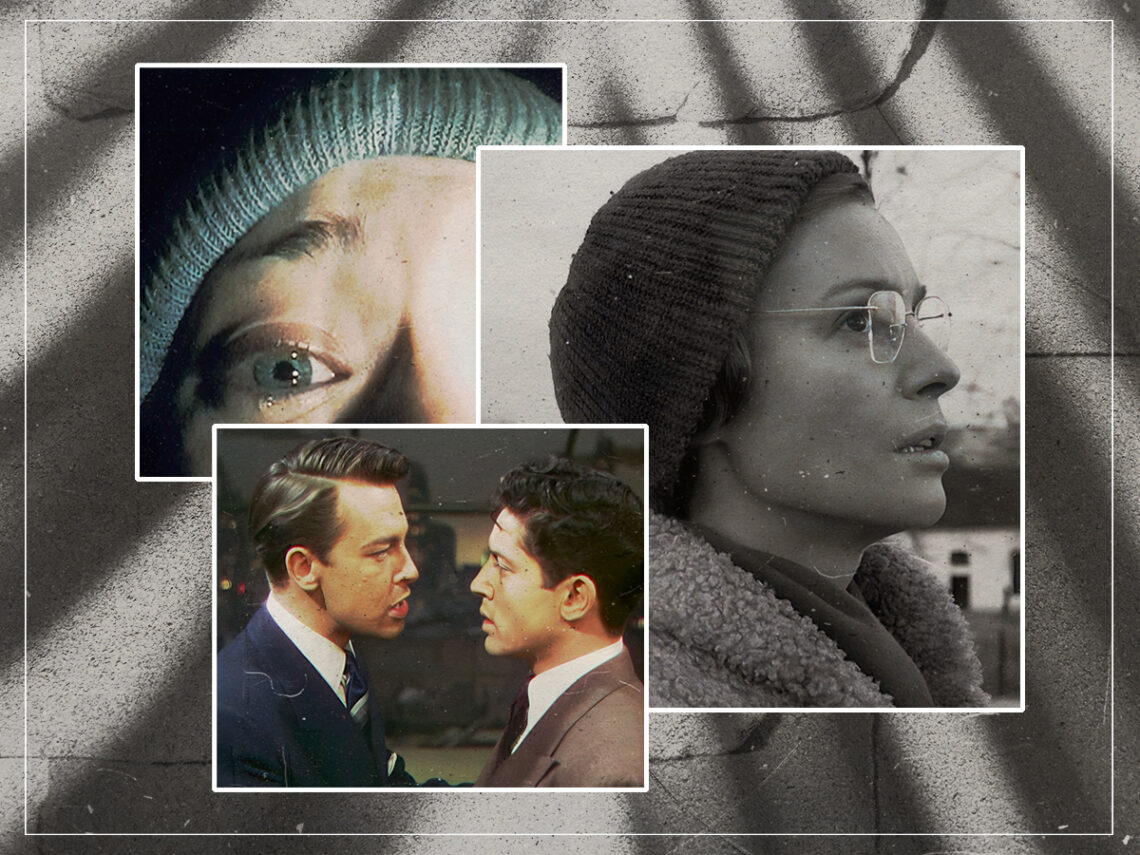
9. The Blair Witch Project (Daniel Myrick and Eduardo Sánchez, 1999)
More than just a hit movie, The Blair Witch Project was a milestone for independent cinema, becoming one of the most profitable films in history and laying the groundwork for grassroots marketing campaigns using the internet to infiltrate the minds of their prospective paying customers months before release.
As well as the budgetary limitations playing their part in the absence of either score or soundtrack, The Blair Witch Project benefits immeasurably from its large stretches of silence. Maintaining the illusion that this was the documented footage of a very real incident, the unnerving lack of anything beyond panicked breathing and the off-camera rustlings of things that may or may not even be there – all punctuated by the occasional blood-curdling scream – deepens the frantic terror being experienced by the three protagonists.
8. Rope (Alfred Hitchcock, 1948)
Alfred Hitchcock was always known for experimenting with the possibilities of cinema, but the legendary director’s decision to abandon the musical accompaniments that had become integral components of his work caused much consternation during its initial release.
With the story unfolding in real-time and designed to play as one single continuous shot for its entire 80-minute running time, the distinct lack of a score – or even any diegetic music – makes it all the more jarring when Farley Granger’s Phillip very briefly tickles the ivories to puncture the foreboding veil of mystery, with mere seconds doing more to inform the viewer of the character’s mindset than any recurring motifs could hope to accomplish.
7. M (Fritz Lang, 1931)
A suspenseful serial killer thriller, Fritz Lang’s M is so accomplished on virtually every narrative, performative, and technical front that the almost complete lack of anything even resembling music can often go completely unnoticed, a testament to a master working at full capacity.
The old saying claims “silence speaks volumes” for a reason, with the manhunt for Peter Lorre’s child murderer undeniably gripping without having to puncture its excruciating tension for the sake of a few notes. There is one motif to be found, though, but even that’s portrayed in the most unexpected manner as Lorre’s Hans Beckert hums Edvard Grieg’s ‘In the Hall of the Mountain King’ to signal his presence, which Lang performed himself because his leading man couldn’t whistle.
6. Winter Light (Ingmar Bergman, 1963)
Gunnar Björnstrand headlines Ingmar Bergman’s existential drama as a crisis-stricken priest who faces up to his fracturing faith by helping a suicidal fisherman and a former mistress contend with their own problems. Equal parts restrained and bleak, the filmmaker’s decision to disavow music works wonders for its constant sense of unease.
A subtle exploration of humanity’s complicated relationship with religion, the silence is every bit as profound as it is impactful. Relying on the performances to drive the intimacy and complexity of its thematic undercurrent, Winter Tale is stark and unsettling as it draws the audience into witnessing the layers of its principal players slowly peeled back until they’re laid almost completely bare.
5. Network (Sidney Lumet, 1976)
It almost completely passes people by that Network doesn’t have a score or a soundtrack, even if it continued to be a recurring practice of director Sidney Lumet’s work in the likes of 12 Angry Men and Dog Day Afternoon, but foregoing it for a movie set in the fast-paced and frantic world of television was arguably the boldest choice.
Creating a disconnect between the characters and their world, everyone associates television with blaring music, catchy jingles, and a constant stream of advertisements. Instead, Lumet keeps the focus completely on the characters as they navigate the highs, lows, ups, and downs of a constantly-moving operation, with Peter Finch’s legendary monologue that finds him threatening to kill himself live on air opening the eyes of the unscrupulous executives to the potential of ratings-grabbing sensationalism.
4. Beyond the Hills (Cristian Mungiu, 2012)
At its core, the story of two young women who grow up in an orphanage together before taking separate paths when one of them seeks solace in a convent as the other prepares to emigrate to Germany would seem to be the ideal place for sweeping musical cues that underscore the themes of friendship, closeness, and ultimately distance.
Instead, Cristian Mungiu maintains the illusion of realism and restraint to keep the story trained exclusively on Cosmina Stratan’s Voichița and Cristina Flutur’s Alina, regardless of where they might be at any stage in the narrative on either a personal, spiritual, or emotional level. Even when it edges ever closer into supernatural territory during the third act, the naturalistic camerawork and utterly convincing performances render it entirely believable based on what preceded the seemingly outlandish plot development.
3. Caché (Michael Haneke, 2005)
Few filmmakers in the modern age have tackled the psychological thriller from as many fascinating angles as Michael Haneke, with Caché evolving far beyond the parameters of a deceptively simple premise – by his standards, anyway – that sees a happy couple become increasingly convinced they’re being stalked.
Far from being a standard whodunit, though, the ambiguity seeps out of every major player in the story as well as Haneke’s shot composition, leaving the audience to question the veracity of virtually everything that unfolds on-screen. The lack of music only exacerbates that feeling, with undivided attention required from the first to last frames in order to even try and figure out where the truth really lies.
2. Once Upon a Time in Anatolia (Nuri Bilge Ceylan, 2005)
There’s no shortage of movies to have co-opted the ‘Once Upon a Time’ prefix, but Nuri Bilge Ceylan’s incendiary drama might just be the most unheralded, with a murder confession leading to the hunt for the body of its buried victim uncovering many more truths beyond.
The sounds of nature and the whisperings of vast landscapes provide the only real audio-visual substance outside of the dialogue, with the chronological unravelling of the narrative one of the few cinematically conventional paths that it follows. About as real as filmmaking gets, the 157-minute epic never overstays its welcome in spite of the sparse sum of its parts.
1. A Separation (Asghar Farhadi, 2011)
Winner of an Academy Award for ‘Best Foreign Language Feature Film’ and a nominee for ‘Best Original Screenplay’, Asghar Farhadi wrote, directed, and produced a stunning film that ticks many of the boxes standard for the divorce drama but paints almost all of them in an entirely new light.
Payman Maadi’s Nader refuses to leave Tehran, forcing Leila Hatami’s Simin to sue him in an effort to dissolve their marriage and create a better life abroad for herself and their daughter, with an incident involving the newly-hired carer for his ailing father throwing another excruciating spanner in the works.
Sattar Oraki might be credited as the composer despite sitting out the entire story, but when the credits roll, it becomes clear why his services were required as Farhadi signs off with a gut-wrenchingly powerful segue into its only source of music as the credits begin to roll.
