


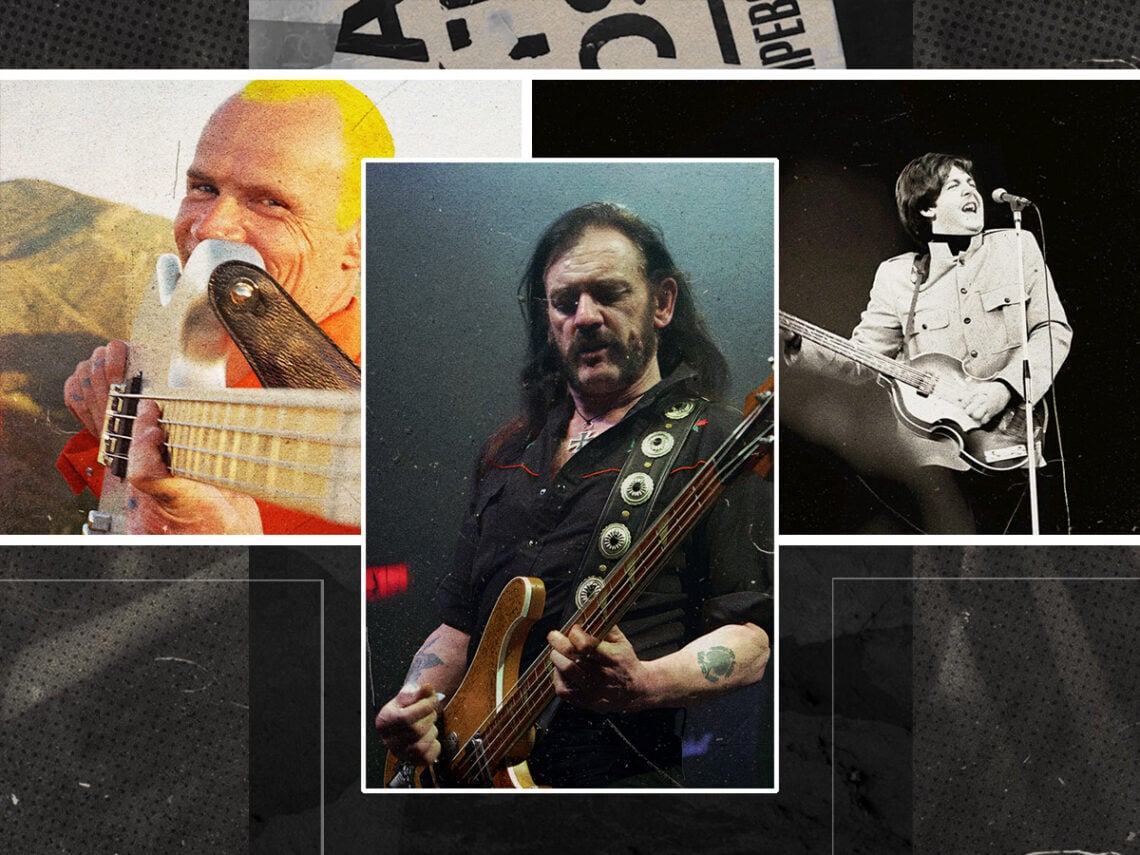
10 bassists that overshadow the guitarist

When talking about the great instrumentalists in rock history, fans must talk about the guitar player first. No matter how hard the drummer might try to stick out or the singer can belt to the rafters, there’s a certain X-factor about the six-string that has become the benchmark of rock swagger in most people’s eyes. Then again, acts like Metallica and Rush have proven that bassists have just as much control over the group.
Every time these bands are brought up, the main draw tends to be from the people holding down the low end. While the bass has never been considered anyone’s favourite instrument in the band, a handful of the most extraordinary talents that the rock world has ever seen have come from the lower register, having a certain charisma that their jangly counterparts don’t possess.
From a compositional standpoint, though, the bass player has much more power than most realise. Since they are responsible for the sonic space underneath it, the bass provides the trusty anchor in most phenomenal bands, either giving a stable pulse or digging into the best grooves of all time alongside the drummer.
Whether it was their charm or their ability to create the most interesting melodic parts of the song, each of these bass players has become a mainstay of the rock genre and practically outshines the guitar player every chance they get. The guitar might be the foundational element of rock, but it’s not surprising how much can be done with a bass and a solid groove.
10 bassists who overshadow the guitarist:
10. Nikki Sixx – Mötley Crüe
Towards the end of the 1970s, the California rock scene was in for a shakeup. Thanks to the massive influence of Van Halen, bands began popping up left and right, trying to create their own version of glam hard rock that could compete with Eddie Van Halen’s brand of shred. While every other band wanted to make another run-of-the-mill anthem, Nikki Sixx was looking at the bigger picture.
From the minute he put together Mötley Crüe, Sixx was concerned with becoming one of the biggest bands in the world, taking the theatricality of Kiss and combining it with the fury of punk rock bands like the Sex Pistols. Though Mick Mars would give the band a bluesy edge, Sixx’s ability to write rock anthems was unmatched by his peers, whether it was pulling from his own experiences on ‘Kickstart My Heart’ or creating dark pictures in the listener’s mind like ‘Shout at the Devil’.
Then again, Sixx let his nefarious habits get the better of him, leading to one instance where he was declared dead after a heroin overdose before being revived by paramedics. Although Mötley Crüe could have easily been just another hair metal band, Sixx would never rest until they became big enough to compete with their idols.
9. Steve Harris – Iron Maiden
Half the reason why Iron Maiden has gotten to where they are comes from their spectacle onstage. From the minute that the band was started back in the late 1970s, they were concerned with bludgeoning the audience over the head with the most furious metal music ever conceived by man. Though Bruce Dickinson might be able to wail like a madman every time he opens his mouth, the real Maiden fans know that Steve Harris is the one steering the ship.
Throughout each era of Maiden’s career, Harris has been responsible for writing their most essential tracks, from the stirring sounds of ‘Number of the Beast’ to the relentless gallop of ‘Run to the Hills’. While Harris does have a certain precision in his attack, the fact that he doesn’t use a pick practically makes him superhuman over the past few decades.
Using only two fingers to get his signature clacking sound, Harris’s way of attacking the bass has been foundational to legions of future metal bass players, from Frank Bello of Anthrax to David Ellefson of Megadeth. Though Maiden has been able to take various sonic detours throughout their career, nothing is off the table as long as Harris is the one guiding the band through it.
8. Peter Hook – Joy Division/New Order
In the dying days of punk’s first wave, a sonic hole began to form between the punks and the start of new wave. With the Sex Pistols being a long-faded memory and The Clash moving further away from traditional punk, acts like Joy Division brought a slightly darker flavour to what unsophisticated rock and roll could be. Though there were plenty of guitars to spare, Peter Hook’s melodic approach to bass practically lept out of the speakers.
In both Joy Division and New Order, Hook’s signature sound came from the huge sonic space he got out of four strings. Instead of using his bass as a support role, Hook was looking to play chords on the bass, making for a sonically rich tone that filled out most of the sonic landscape on tracks like ‘Love Will Tear Us Apart’.
Although the guitars swiftly got replaced by synthesisers in New Order, the band knew that Hook’s bass was the main draw, giving him a prime spot in nearly every hit they had on albums like Power, Corruption, and Lies. Even when he’s guesting on tracks like Gorillaz’s ‘Aries’, Hook’s unique playing style is something that most fans could latch onto the second they hear it.
7. Roger Waters – Pink Floyd
Coming out of the 1960s, there were a lot of questions surrounding whether Pink Floyd should even continue without Syd Barrett. After bringing in guitarist David Gilmour to fill in on A Saucerful of Secrets, Barrett’s fragile state of mind started to crack under pressure, leading to the band asking their lead songwriter to step down over health concerns. While Gilmour would become the group’s shot in the arm, Roger Waters turned them into rock legends.
Picking up right where Barrett left off on songs like ‘Set the Controls for the Heart of the Sun’, Waters started to steer Floyd into unchartered territory, finally reaching a sound that worked on ‘Echoes’ off the album Meddle. From there, Waters would create the most biting commentary in rock and roll over Floyd’s classic period, whether it was the dissection of people going mad on The Dark Side of the Moon or talking about his struggles with stardom on The Wall.
Even though Gilmour and Waters worked as a perfect tandem during their classic run, Waters was concerned with making the biggest songs have a semblance of humanity behind them, evident by the stark difference when he left on albums like A Momentary Lapse of Reason. Whereas Gilmour’s approach to the rest of Floyd’s career got the job done properly, Waters was the one setting up a scene in the listener’s mind than writing a decent song.
6. Lemmy – Motörhead
From day one, Motörhead were never designed to be a heavy metal outfit. Even though they might have influenced the biggest metal acts in the world, Lemmy stood by the fact that his band of rock and rollers were just a loud rock band. Though it’s easy to spot the tonal similarities between Motörhead and classic rock and roll, some mystery element came into play whenever Lemmy strapped on his bass.
Starting with guitar first, Lemmy eventually got tricked into playing bass during a gig with the psychedelic outfit Hawkwind. After dropping the acid-soaked rockers for heavier fare, Lemmy assembled one of the ultimate rock and roll powerhouses, leading the charge by playing chords on his bass and favouring the higher side of the neck to play his signature licks on ‘Ace of Spades’ and ‘Overkill’.
Although Lemmy may have been known for his signature style of music, his songwriting talents became too much for just Motörhead, eventually contributing songs to artists like Ozzy Osbourne and Joan Jett. In terms of his place in rock history, though, Lemmy deserves a spot next to Keith Richards as one of the few musicians who lived by his own rules until the day he died.
5. Sting – The Police
In the late 1970s, it was difficult to put the sound of The Police into perspective. Even though the punk wave had started, the power trio were influenced by every style of music under the sun, dipping their toes into reggae, progressive music, and punk, depending on which song they were making. Although most bands can sound confused under those conditions, the common thread was Sting’s immaculate gift for melody.
Outside of Andy Summers’s chord extensions and Stewart Copeland’s virtuosic drumming, Sting created the glue that combined every element. Since he handled both bass and vocals, Sting was responsible for both the low end and the melody, usually playing off different melodic fragments, whether that was Summers’s guitar licks in ‘Message in a Bottle’ or leaving space for Copeland to take over on ‘Walking on the Moon’.
When it comes to the melodic side of things, though, Sting knows precisely what he’s doing, having a shared understanding of music theory and knowing the right notes that can make a melody heartwrenching. Even though The Police’s singles can seem unconventional in spots, Sting has relied on his ear to lead him towards the right notes.
4. Cliff Burton – Metallica
Anyone who dares to play in a band like Metallica must compete with James Hetfield. Even though Kirk Hammett may have been able to infuse blues into his metal guitar playing, Hetfield was the rhythmic machine ploughing everything forward with a picking hand that sounded like a machine gun. Though Cliff Burton may have come from a different world than Hetfield, his approach to bass is still being felt by Metallica today.
Originally working in the LA band Trauma, Burton could carry the entire show with his distorted bass. Never one to overplay, Burton served every Metallica track with the most intricate bass work of the 1980s, from the nasty-as-hell tone on ‘Fight Fire With Fire’ to the pure beauty on the back half of the instrumental, ‘Orion’.
Outside of metal, Burton was also known as a sucker for classical music and would infuse different parts of his roots into Metallica tracks, whether that was teaching Hetfield how to play guitar harmonies or quoting different classical pieces in his melodies, like the interpolation of ‘Come Sweet Death’ for the Master of Puppets track, ‘Damage Inc’. No offence meant to Hammett, but if Metallica had decided to become a three-piece, Burton could hold his own as a lead bass player.
3. Geddy Lee – Rush
Any avid fan of Rush knows the power that every member puts into a tune. Since there are only three people onstage, each player has to hold up more than their usual weight in the group dynamic, or else everything will fall apart. Though Neil Peart has been the benchmark of drumming ever since he joined the band in the late 1970s, Geddy Lee has always kept up with the percussion god on the bass.
While Alex Lifeson has been one of the most adventurous guitar players in rock history, Lee has practically been playing lead bass his entire career. Being influenced by giants like Chris Squire from Yes and The Who’s John Entwistle, Lee’s signature tone comes from his raw way of hitting the bass, crafting little melodic lines that any other band would use as a signature guitar part.
Even when Lee moved behind the keyboard for the band’s 1980s albums, the bass never went anywhere, coating it in effects before returning to the raw sound of rock grandeur during their final years. Alex Lifeson might have a firm grip on his instrument to compete with legends like Jimmy Page, but Lee is one of the most technically accomplished bassists in modern music.
2. Flea – Red Hot Chili Peppers
90% of what makes the Red Hot Chili Peppers work comes back to the groove. Since they had cut their teeth in the world of funk rock in the 1980s, their emphasis on returning to the downbeat on every song has steered them through the best albums of their career, like The Uplift Mofo Party Plan and Blood Sugar Sex Magik. Though the band have had more than a few guitarists come through their ranks, the beat has never changed as long as Flea held down the low end.
While originally starting on the trumpet, Flea would eventually pick up the bass after getting into punk rock bands as a kid. Though he had the opportunity to play in the hardcore punk outfit Fear, Flea’s love of bass players like Bootsy Collins and Larry Graham brought him back to the Chili Peppers, writing one iconic bass line after the next on tracks like ‘Give It Away’ or ‘Can’t Stop’.
Even with that punk rock fury behind him, Flea has never lost his will to explore, using different techniques throughout his career to keep himself fresh, whether it’s the chordal work going on in a track like ‘Hard to Concentrate’ or going back to the signature slap sound on recent tracks like ‘Dark Necessities’. While other bassists spend years trying to reach a certain level of playing, Flea’s sense of rhythm is something a musician feels in their bones before they even pick up an instrument.
1. Paul McCartney – The Beatles
For the first few years of The Beatles’ existence, there was a lingering question about who would play the bass. Since Stu Sutcliffe wasn’t the right fit, it was Paul McCartney’s responsibility to pick up the Hofner four-string before the Fab Four launched themselves into superstardom. While McCartney was used to playing general root lines throughout his career, his knack for melody with John Lennon started to creep into every bass line he wrote.
Despite bass being thought of as the lesser of the guitars, McCartney made up for it with his signature charisma and songwriting genius made for magic every time he and Lennon wrote a tune together. Regardless of being on the low end, McCartney was responsible for half of the band’s iconic hits, from the early days of ballads like ‘And I Love Her’ to the singalong jubilation of ‘Hey Jude’.
When dissecting the man’s bass playing, McCartney also knew how to create a perfect melody to accompany any track, whether it was on one of his songs like ‘Paperback Writer’ or working alongside his bandmates’ material like the rollicking groove on Lennon’s ‘Dear Prudence’. From ‘Come Together’ to ‘Something’ to ‘Taxman’ to ‘Hello Goodbye’, you could throw a dart at any random Beatles song and still find genius lines McCartney has hidden in the background.

Never Miss A Beat
The Far Out Beatles Newsletter
All the latest stories about The Beatles from the independent voice of culture.
Straight to your inbox.