


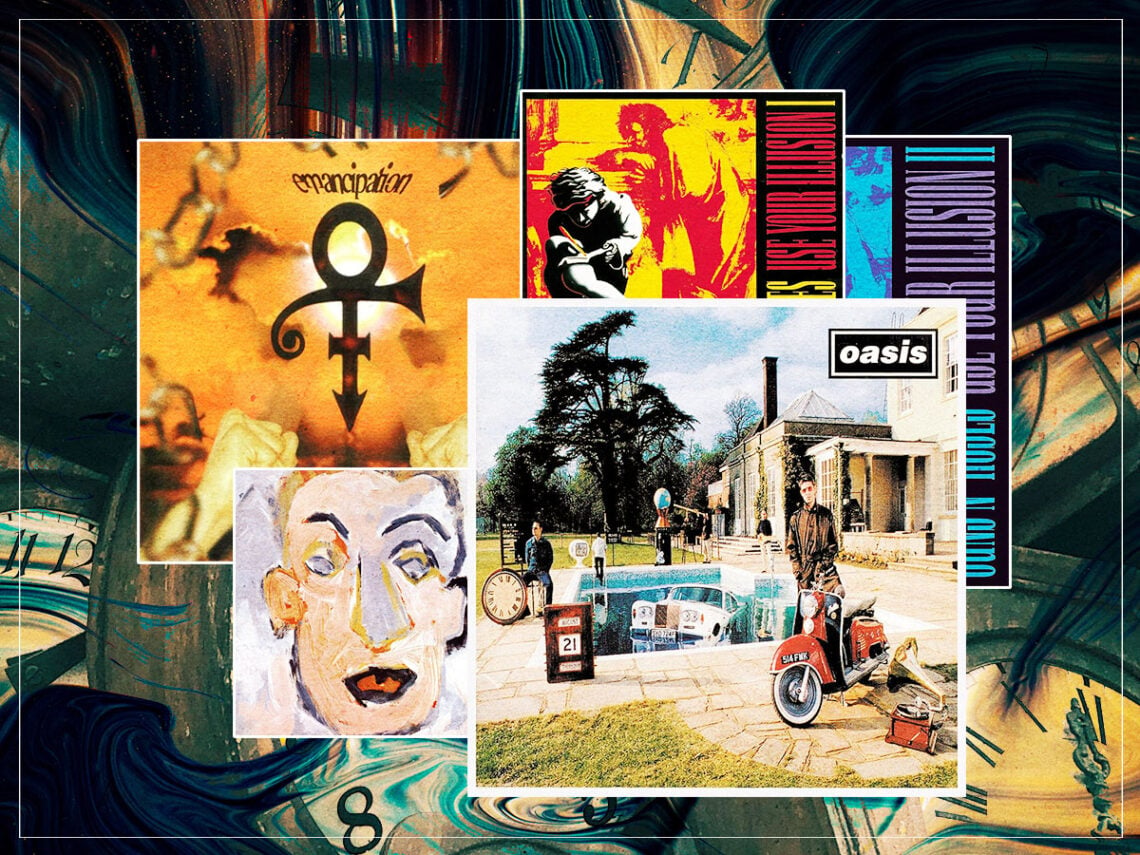
From Oasis to Bob Dylan: 10 classic albums that are way too long

Rock and roll is not a genre known for wasting time. Although there are a handful of mega releases from famous acts across rock history, the standard of “don’t bore us, get to the chorus” is key to making any great album work. Once acts like George Harrison and Oasis began staying too long at the party, things started to go downhill quickly.
While there might be a few great moments across these mammoth records, the long runtimes can often feel fatiguing the further down the record. Even though there might be hidden gems on the record’s back half, it’s hard to concentrate after going through a handful of boring tracks that somehow made it onto the final record.
Then again, an album doesn’t need to have many songs to qualify for a list like this. Even though an album might have a reasonably solid track listing, the runtime also tends to bog down what would otherwise be a decently packaged record, turning what could have been great songs into an absolute slog the longer they continue.
That’s not to say that every album that drags along is terrible from back to front. Since the medium has expanded its horizons, artists have made bold strides to make their albums a cinematic experience, resulting in the most ambitious projects ever made. It looked like every one of these artists wanted to join that company, but along the way, the quality control got thrown out the window.
10 albums that are too long:
10. A Different Kind of Truth – Van Halen
The David Lee Roth-era of Van Halen usually knew how to keep things nice and punchy. Even though the band played more notes than any other act could keep up with, they never wasted a second on their albums, with their best material rarely straying past 30 minutes on a full album. Although Roth knew how to keep everything in check, the band’s final hour does tend to feel a bit bloated by comparison.
Since the runtimes started expanding with the inclusion of Sammy Hagar in the band, that bad habit turns up repeatedly on A Different Kind of Truth. Though songs like ‘She’s the Woman’ and ‘Chinatown’ still sound incredible to hear after years in the vault, the massive runtimes make the tracks feel longer than they are, especially when they are made up of the group’s most lacklustre ideas on tunes like ‘You Are’.
When Van Halen stayed too long at the party, that gave the listener more time to point out their flaws, including Roth turning in questionable vocal performances throughout the album like the promotional single ‘Tattoo’. Even though A Different Kind of Truth is far from the best that Van Halen had to offer, most fans are happy that this is the record they closed out their career on instead of Van Halen III.
9. Mojo – Tom Petty and the Heartbreakers
Tom Petty and the Heartbreakers were about to experience a sea change at the end of the 1990s. After losing drummer Stan Lynch and Petty getting mellower on Wildflowers, the sounds of Echo and The Last DJ mark a drastic shift towards serious material, focusing on Petty’s divorce and his issues with the music business, respectively. Even though the Jeff Lynne collaboration Highway Companion got things back on track, Mojo proves there can be too much of a good thing.
Looking to pull from the blues legends that they loved as kids, much of the album comprises The Heartbreakers trying on their best heavy material. Although there are many fantastic riffs throughout the record, the main problem is the lack of diversity throughout the track listing. Even though the blues will never go out of style, having 15 tracks of the same thing tends to get monotonous on the ear, leaving decent songs like ‘First Flash of Freedom’ sounding neutered.
While Petty does switch it up on the back half with the beautiful ballad ‘Something Good Coming’, it tends to feel like too little too late, almost as if he’s trying to make up for lost time that could have been spent away from the Elmore James impressions. Though The Heartbreakers have never made a bad album, the amount of tracks on Mojo could have benefited from a handful being cut.
8. Emancipation – Prince
Kicking off the 1990s, Prince had finally freed himself from the shackles of Warner Bros. Feeling creatively stifled for most of his career, ‘The Purple One’ could release as much music as he wanted whenever he felt like it, going on a tour de force of musical excellence after changing his name to a symbol. Though Sign O’ The Times may have felt like a lot of Prince to take in, Emancipation is where fans saw a bit too much of the music legend than they bargained for.
After being stifled for that long, Prince’s bid for freedom is one of the biggest slogs from any mainstream audience, featuring over three hours of new material. Though there is nothing on the record that comes close to below average by Prince’s standards, the main problem was that there was too much of it all at once.
Even though Prince was a phenomenal musician, his need to release everything he could makes the listener do the dirty work, acting as Prince’s de facto editor as they try to cherrypick the songs that stand out above the rest. Somewhere inside Emancipation is a perfect Prince record, but it’s hard to consider an album a classic if it goes past the length of most feature films.
7. Load/ReLoad – Metallica
When Metallica came off the road in the mid-1990s, they could justifiably say they conquered the world. Even in the age of grunge, the thrash legends’ crossover into lighter material on The Black Album made for one of the most commercially successful metal albums released at the time. Once they returned to the studio to follow it up, there was only one rule: don’t make The Black Album: Part 2.
Influenced by the sounds of stoner metal and alternative music, both Load and Reload feature songs that are more commercial than Metallica used to make in the past. Although there are a few bids for mainstream success like ‘King Nothing’ and ‘Until It Sleeps’, there’s no reason for this amount of songs to be spread across two separate projects. Since they had more creative freedom, tracks like ‘Carpe Diem Baby’ and ‘Bad Seed’ ended up cutting it, even though they were far and away the weakest songs the group would put out in that decade.
Even though the band boasted that their CDs were meant to be as long as possible upon release, producer Bob Rock should have sat them down and asked them to edit them into one solid project. While Metallica superfans were shellshocked at their favourite heavy band giving in to the alternative revolution, the band could have made an equally strong masterpiece to The Black Album had they kept their quality control in check.
6. Self Portrait – Bob Dylan
Towards the start of the 1970s, Bob Dylan was reaching a position where he was almost too big to fail. After being known as a humble folk songwriter, his transition to rock struck a nerve with every mainstream music fan, propping up Dylan as the voice of their generation and hanging on every word that came out of his mouth. There were no stakes for any new Dylan project, and Self Portrait puts that theory to the test.
Throughout Dylan’s “experimental” project, he turns in a handful of fantastic cuts amid questionable tracks like ‘Blue Moon’ and ‘The Boxer’. Although it’s Dylan’s choice of which songs to cover, there are times during the listening process when any casual fan will ask themselves if they’re listening to musical genius or garbage. Then again, that might have been the point.
Since Dylan had been put on that high of a pedestal, this warts-and-all approach to crafting an album felt like seeing the intimate version of Dylan, much more fallible than the figure blown up by the media. Then again, it’s a testament to Dylan’s talent that even if this album were paired down a bit, it would still be a cut above most other songwriters’ best material.
5. Use Your Illusion – Guns N’ Roses
There are only a handful of rock bands that have been able to rise to the top as fast as Guns N’ Roses did. Though they spent most of their salad days slumming it on the Sunset Strip, their rise to stardom with Appetite for Destruction was enough to leave their competition in the dust, making Poison look like The Partridge Family with a touch of distortion. While the band could easily have wowed their fans again, Axl Rose had other plans for the group’s sound when cutting Use Your Illusion.
Wanting to bury the album that made them stars, Rose’s vision for the follow-up included the most ambitious material the band would ever create. Although there were still street-wise rock songs sprinkled throughout the track listing like ‘Perfect Crime’, much of the album revolves around piano and orchestration, primarily spread out across nine minutes at a time like ‘November Rain’ and ‘Estranged’.
Although fans look back on the album with love these days, it wasn’t hard to see that the band would implode fast after this record, as Rose led the group with an iron hand that became too insufferable for the rest of the group to deal with. It’s better to burn out than to fade away, but if Guns N’ Roses had decided to spread their ambition across years of records, they could have easily turned into the hard rock equivalent of The Rolling Stones.
4. Sandinista – The Clash
All good punk rock knows that it’s pointless to waste any time. When listening to albums by Ramones or Sex Pistols, the name of the game was to make the most aggressive songs possible and get out before the audience even knew what hit them. The Clash were no different initially, but their experimentation got the better of them post-London Calling.
Although the group’s magnum opus took more than a few twists and turns throughout its double album runtime, fans weren’t equipped for a triple album’s worth of material. While there are more than a few songs on Sandinista that can go toe-to-toe with any Clash classic like ‘The Magnificent Seven’, the final product is way too much for any fan to take in in one slog, especially when hearing the more feeble attempts at reggae halfway down the record.
Then again, this may have been the only way that every group member could get their say in the matter, with the next album, Combat Rock, featuring multiple compromises that ultimately contributed to the group’s demise. While The Clash could have easily turned into one of the longest-lasting punk bands of all time, Sandinista has the feeling of getting too much too soon, which could have been avoided had they spread out the album over different projects.
3. The Devil Put Dinosaurs Here – Alice in Chains
In the early 2010s, it looked like Alice in Chains had done the impossible. Even though there was no band without Layne Staley after his tragic passing in 2002, including William DuVall for their comeback album Black Gives Way to Blue was way better than anyone expected, boasting that same dreary sound that has become synonymous with Seattle. Things were looking up, but that sort of success led to a bit too much ambition on The Devil Put Dinosaurs Here.
First forming in the mind of Jerry Cantrell while undergoing recovery from surgery, a handful of the album’s songs deserve to be put alongside AOC classics, like ‘Stone’ and the acoustic lament ‘Voices’. When looking at the runtimes for each song, though, there tends to be a problem, as great four-minute songs get stretched out into six-minute exercises for maximum riffage.
Although the band had toyed with dabbling in the sludgy side of themselves with Staley on their self-titled record, their choice to stay in the doldrums for most of the record doesn’t make for a re-listenable album experience once fans have taken it in once. All of Alice in Chains’ heroes have benefited from going heavier every once in a while, but there’s a fine line between getting heavy and sounding painfully boring.
2. Be Here Now – Oasis
After What’s the Story Morning Glory, there’s a good chance the Gallagher brothers could have sneezed and gotten a hit out of it. Following their mammoth gigs at Knebworth, Noel Gallagher knew that they had done everything they had set out to do, going from indie darlings to one of the biggest bands in the world in a matter of months. They had called their shot as one of the best of the decade, and Be Here Now was the moment where Noel could prove that Oasis was worth sticking around.
Although half of Be Here Now consisted of songs that Noel had already been working on during the Morning Glory sessions, the massive influx of cocaine led to him making drastic errors in the mixing stages. Not having the proper judgement of quality, the massive amount of overdubbing and the constant sound effects in every song make for a fatiguing listen whenever listening to the record in full.
Despite the unnecessarily long runtimes, there are also a handful of tracks on the record that should have never seen the light of day to begin with, like the romantic squib ‘The Girl in the Dirty Shirt’ and the ridiculous psychedelic pastiche ‘Magic Pie’. Be Here Now may have marked the end of Oasis’ relevance in the mainstream, but if they had tightened up those runtimes and added in a few of their stellar B-sides, they might have owned up to their claim as the 1990s answer to The Beatles.
1. All Things Must Pass – George Harrison
It feels dirty trying to correct anything that The Beatles ever did. Ever since the band decided to call it a day, fans have put their music on a pedestal as the greatest rock music ever made, with each song being a masterpiece on its own. While both John Lennon and Paul McCartney made the lion’s share of the classics, George Harrison was sitting quietly, waiting for the right opportunity to strike.
After falling apart due to business, Harrison finally had the chance to make his own solo album, which ballooned into a massive triple album experience. Having been stifled for so long, nearly every song on All Things Must Pass is among the best Harrison would ever write, from the spiritual ‘My Sweet Lord’ to the jaunty fun of ‘Awaiting On You All’. While Harrison may have been the most successful ex-Beatle at first, the insanely long runtime does tend to drag it down ever so slightly.
Consisting of a double album’s worth of material and a bonus disc of jams made with his chums at Apple, there comes a point where Harrison’s victory lap starts to become dull, as fans wonder how long the jams will go on for or how many ways Harrison can find an excuse to sing about God. There’s no denying that Harrison is a phenomenal songwriter, but if he had reserved a few songs for future projects, we might have been spared the more dreary material on Gone Troppo a few years later.
