


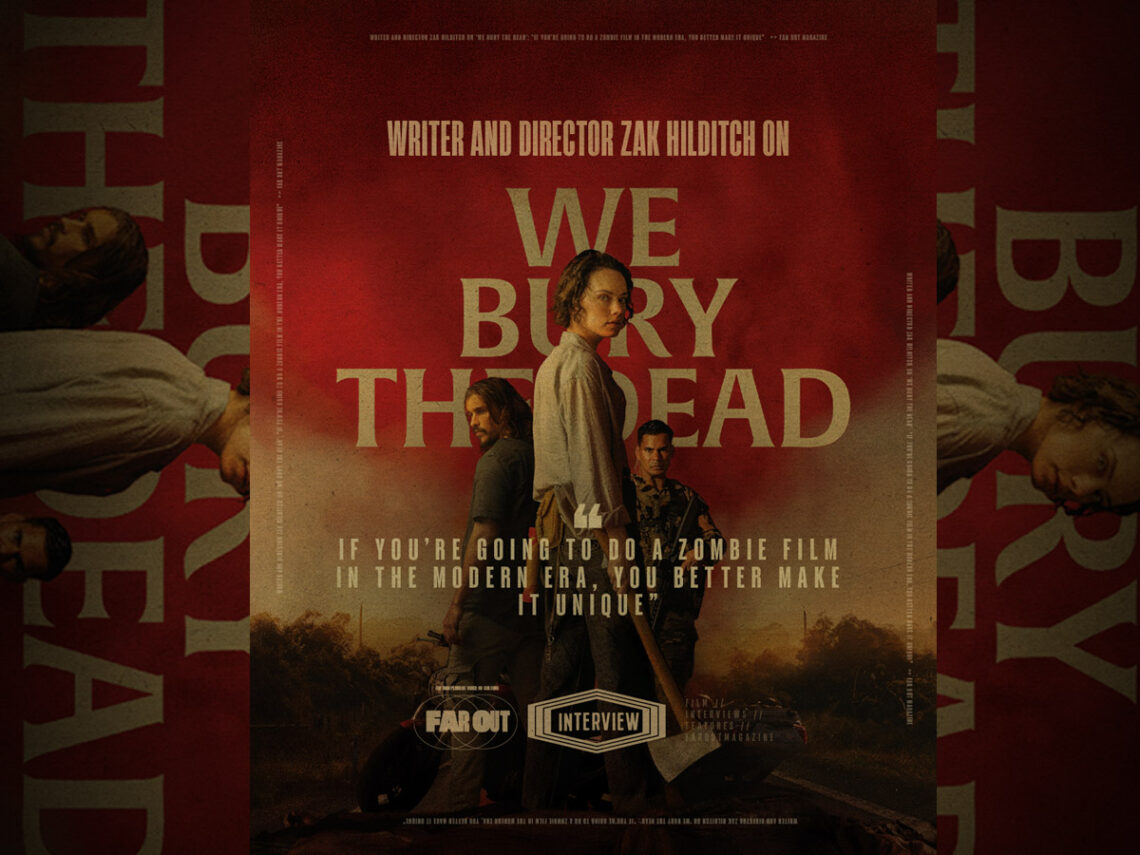
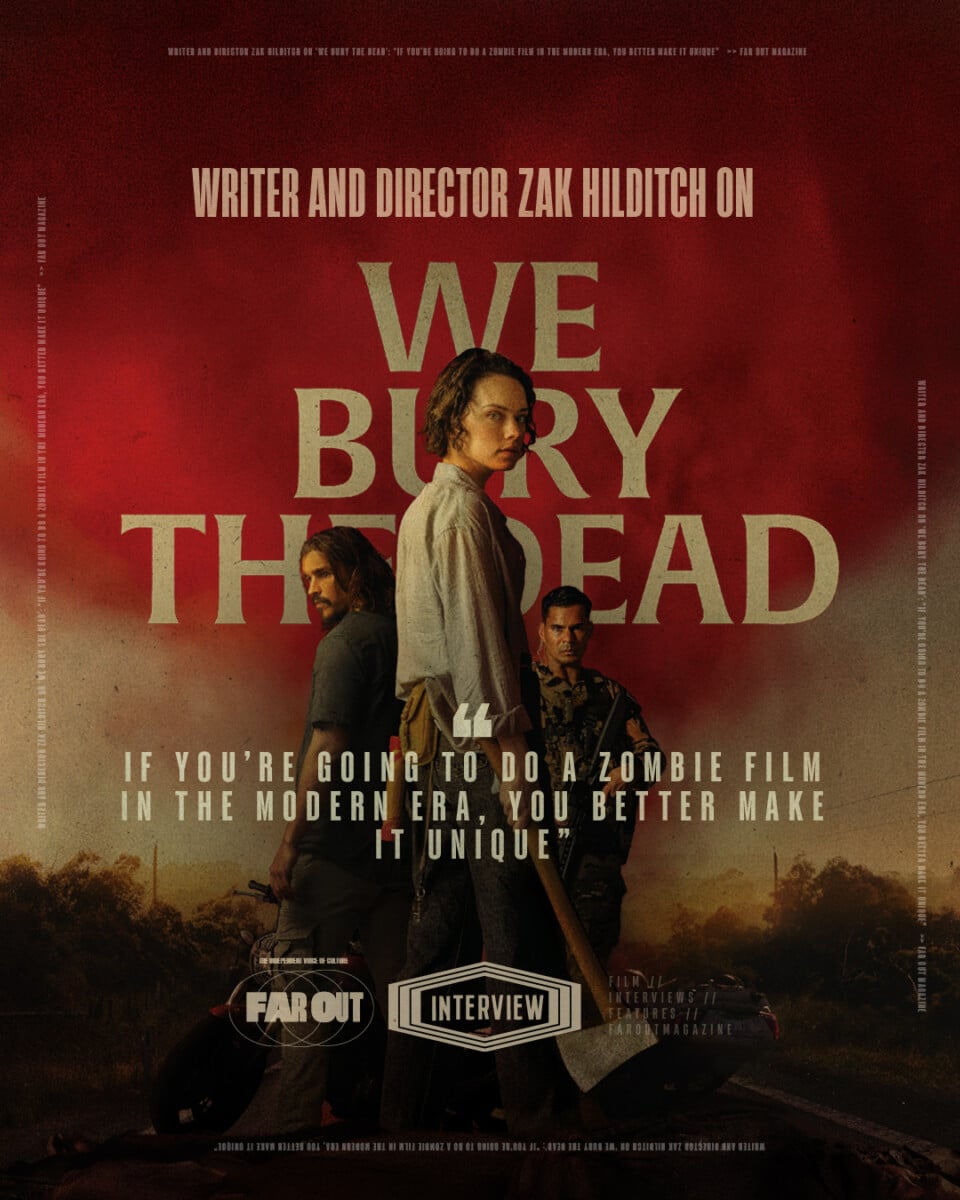
Writer and director Zak Hilditch on ‘We Bury the Dead’: “If you’re going to do a zombie film in the modern era, you better make it unique”

It becomes harder with each passing year to put a fresh twist on the zombie movie, but writer and director Zak Hilditch’s latest feature, We Bury the Dead, has as much in common with a character drama as it does with the subgenre pioneered and popularised by George A Romero.
When the United States accidentally detonates a weapon off the coast of Tasmania, 500,000 people are killed in an instant, at least for a while. It turns out that many of those who died in the initial blast have reawakened, or “come back online” in the film’s parlance, but they’re far from human.
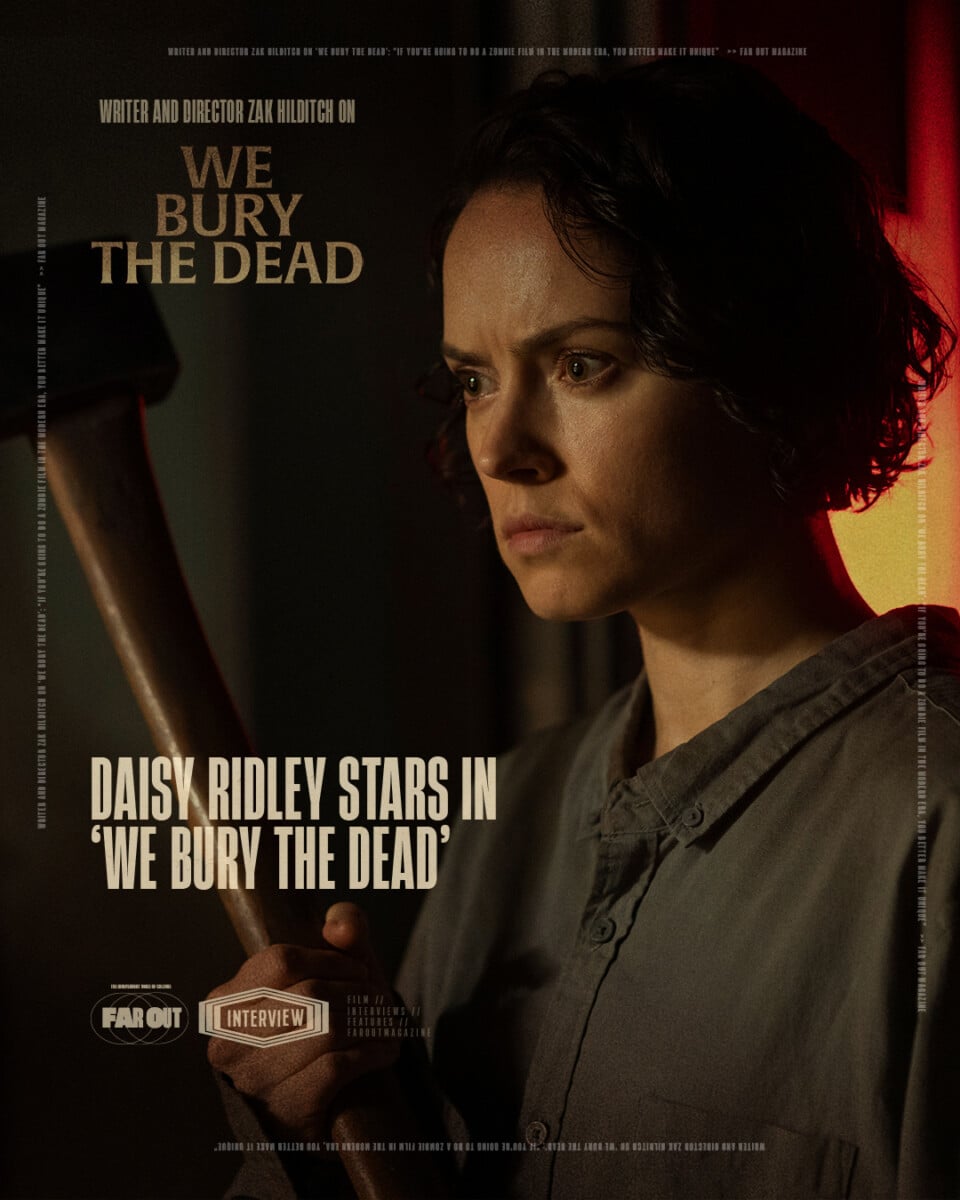
In desperate need of volunteers to help in the clean-up effort, which involves disposing of a lot of dead bodies, Daisy Ridley’s American physiotherapist, Ava, only has one goal in mind: her husband, Mitch, was at a work retreat when the bomb went off, and even though she realises that the only outcome is him being either a dead body or a reanimated dead body, she needs to find a sense of closure.
Yes, We Bury the Dead is a zombie flick, but it’s also a meditation on grief, loss, and unfinished business, putting a different, melancholic, and poignant spin on a familiar premise. Ahead of its digital release on February 2nd, Hilditch spoke to Far Out about his latest work, which he’s been sitting with for a while.
Production wrapped in early 2024, the world premiere was held at South by Southwest in March 2025, and it was released in the United States on January 2nd, 2026, where it broke records by scoring the highest-grossing opening weekend in the history of distributor Vertical, and that’s only the half of it.
“It’s been a whirlwind, just thinking that we wrapped almost two years ago,” Hilditch admitted. “We shot, like, February, March of 2024. Actually, because we didn’t have any money, we couldn’t edit forever. We couldn’t do VFX forever. We couldn’t mix forever; there was a ticking clock. And so the movie was basically done by November 2024, and we did have a cheeky preview.”
That “cheeky preview” came at the Adelaide Film Festival in late 2024, but the “second part” of rolling out the film was when it hit him. “We actually shot and finished the film relatively quickly, given the scope of what we were trying to achieve,” Hilditch said. “But basically, because we didn’t have any cash, and I hadn’t really travelled for five years, you know, Covid and all of that.”
Because his last two pictures, the Stephen King adaptation 1922 and the original story Rattlesnake, were Netflix originals, he “didn’t really get to do any festivals,” which was a shame. “Doing it the old-fashioned way was why I got into this caper in the first place, to travel with your film and go to festivals, be in different cultures, and watch my film live in different cinemas with audiences and talking to people afterwards.”
Not that he’s disparaging the streaming service. “Don’t get me wrong, Netflix is amazing,” Hilditch clarified. “So many people get to watch your film at the same time, but you’re not involved in any of that. So selfishly, the part of me that’s like, ‘Yeah, but the old-fashioned way, where I have to get on that flight, and I go to this hotel’, and doing all that again was just so much fun.”
Like every director, Hilditch compares each film to “being your baby,” and with this one, he’s been nurturing it for two years, which has been “really rewarding and fascinating”. However, it did lead to a cosmic coincidence, tied to another high-profile pair of zombie movies that didn’t exist when he started working on We Bury the Dead.
No modern entry to the genre can outrun the shadow of Danny Boyle and 28 Days Later, and this one is no different. Hilditch previously confessed that the latter’s DNA runs “rampant” through his latest, and it’s also one of his all-time favourite movies. In a twist of fate he couldn’t have predicted, his zombie movie was sandwiched in the release schedule between 28 Years Later and its sequel, The Bone Temple.
“I mean, that’s fucking crazy,” he acknowledged. “Like, movies are so hard to make, especially one this level, that it’s a fucking miracle upon miracles that we even got greenlit, so me and the team, we weren’t even aware that there was a 28 Years Later. It was just so far away, like us even shooting the movie and getting it done, that you don’t really focus on those things.”
It was only after We Bury the Dead‘s premiere that he found out Boyle’s follow-up even existed, on his first trip to the States in five years to “schmooze with producers and whatnot”. Not only did he find out about 28 Years Later, but his movie’s distributors played a blinder by rolling it out in America in the first week of January.
“Bless Vertical’s cotton socks,” Hilditch quipped. “Did they thread the needle in the US of exactly when to come out, just before Bone Temple, which really worked for our opening weekend! We kind of crushed it. We had no expectations to do a theatrical release in the States. To do a wide theatrical release in the States is just unbelievable. When we were doing theatrical, I thought it’d be like 50 screens and call it a day.”
Of course, that wasn’t the case. We Bury the Dead debuted on over 1,000 screens, with Hilditch admiring that it was “really, really cool to see them give so much of a shit about this movie”. It paid dividends, although he’s aware that it’s “wild to then be embroiled in all of the zombie-fest of 2026”.
Back to the film itself, though, which came from a personal place. When his mother passed away, the filmmaker found himself packing up her belongings in his childhood home, contemplating that there’s nobody around to tell anyone how to deal with something like that, planting the seed of an idea about a character moving through rooms on a search for catharsis.
“I could have written the very first draft someone more like me, but I guess the theme was so heavy at the time that I needed that security blanket and one or two degrees of separation,” he explained. “Where, again, my love of intimate kitchen sink dramas with themes smashed against big genre backdrops. I thought, ‘OK, well, who could I explore that is very different to me, but ultimately is going through grief?'”
That said, even he was surprised how that person turned out to be an American physiotherapist searching for their husband. “It was definitely a very removed way for me to do something very personal, thematically,” Hilditch continued. “And then, within that, I felt confident to infuse bits of myself into that journey. But I honestly couldn’t, couldn’t tell you.”
The image he had in his head was “definitely going room to room in a house, much the way I’d gone through my own childhood home that my mum lived in at the time she died,” and the discoveries he made along the way served as the inspiration for Ridley’s character, who needs to find closure of her own.
One thing We Bury the Dead also avoids is the scourge of many apocalyptic movies: exposition and over-explanation. The catalyst is explained at the very beginning and remains only on the periphery of the story, with Hilditch always planning to keep his focus on the micro, using the macro as a backdrop to explore the themes he wanted.
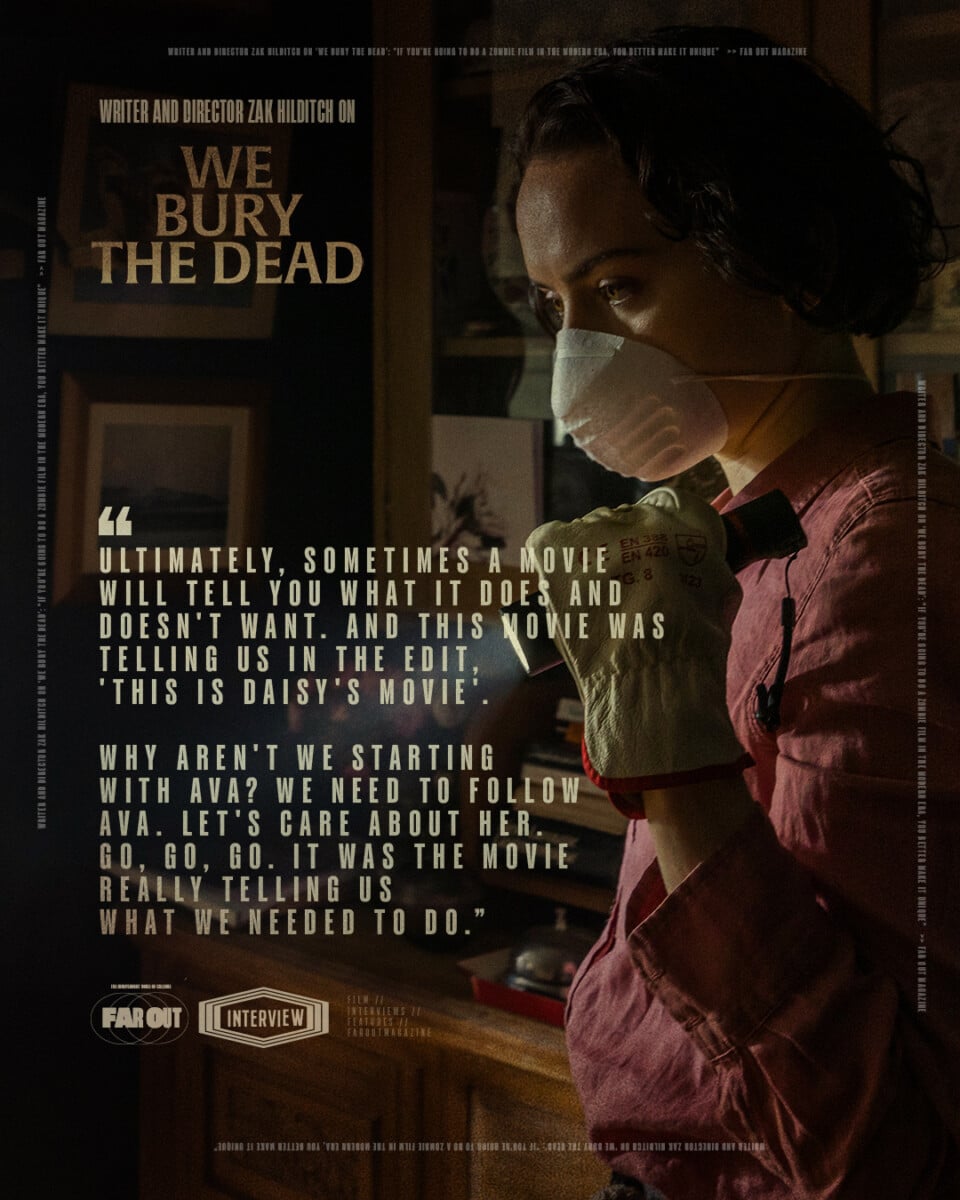
“We shot scenes that didn’t make the finished film, but I did show more of the event,” he pointed out. “And, ultimately, sometimes a movie will tell you what it does and doesn’t want. And this movie was telling us in the edit, ‘This is Daisy’s movie’. Why aren’t we starting with Ava? We need to follow Ava. Let’s care about her. Go, go, go.”
To do that, the film opens with flashbacks to her wedding day, which are sprinkled throughout the runtime to fill the audience in on her mindset, as long as they didn’t break Hilditch’s rules: “Whenever you flash back to her, you better be telling the story at the same time. And the only way an audience is going to understand that and feel like they’re in safe hands is if it’s in order.”
“It was the movie really telling us what we needed to do. Sometimes you’ve just got to down tools and really listen to your movie, and it will reveal answers like that. I love movies about ordinary people dealing with the extraordinary.”
Zak Hilditch
He could have made her “a scientist who knows exactly why only some of the zombies come back,” but he didn’t want to. Instead, “She’s just a woman from America whose husband happened to be over in the thing, and, yeah, she’s a physiotherapist, and that’s the tools that she’s got.” Not your usual lead in a movie like this, but for Hilditch, “It’s so much more interesting for me watching characters who are not adept at the thing they’re facing and having to find ways and tap dance their way through it.”
As well as a zombie film, We Bury the Dead is also a character study, an exploration of grief, a road movie, and occasionally a two-handed drama, sometimes in the space of the same scene. Again, though, Hilditch didn’t dictate which way he was taking the story; the story dictated which way it was taking him, or, as he put it, he was “letting the story come out of my pores.”
“It’s like, ‘OK, now she’s here, and this is what’s going on, and she’s got to get over there. What would she do? Who’s the worst person she could now meet, who’s the most unlikely ally she might form an alliance with?'” was how he summed up the approach. “Sometimes when you’ve got a character and a situation, where they’ve got to get to, you have a lot of fun with rug-pulls.”
On the other hand, he occasionally found himself “being fooled in a certain way with all the films I’ve seen, all the things I love watching, all the things I’ve written in the past, the ones that have been made, the ones that haven’t, all informing this particular one on the page,” making it quite the smorgasbord.
Instead of fighting it, Hilditch was happy “letting it come out of me in a way where I was able to fulfil my love of a little bit of everything, as long as it was all of a piece, and all made sense, because we’re following Ava’s story, and she just happens to have found herself in this chaotic situation,” allowing We Bury the Dead to plant itself in several different worlds at once.
One thing he didn’t want to do was fall into cliché, avoiding any notion of “being too prescriptive and too, like, ‘Oh, well, it’s page 60, and I’m doing a zombie film, we better have the scientist character now’; I don’t give a fuck about movies like that.” He was all about putting his own stamp on the genre, “As long as it was being truthful to her story.”
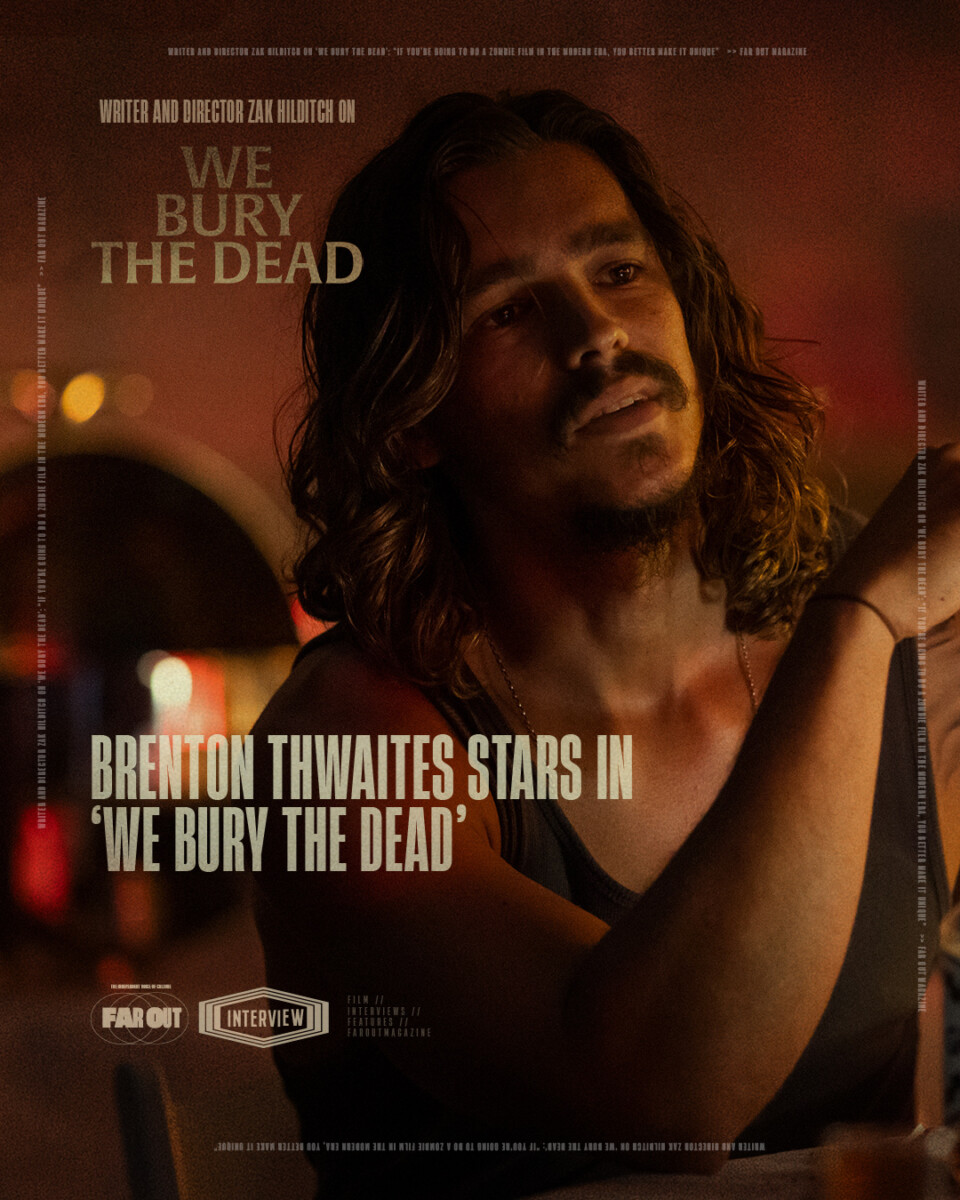
Another recurring theme is unfinished business. Whether it’s Ava and Mitch, Brenton Thwaites’ fellow volunteer Clay and his estranged family, or Mark Coles Smith’s soldier Riley and his wife, or even to dance around spoilers, a zombie who doesn’t need his camper van anymore. It’s a universal concept, and one Hilditch was eager to explore.
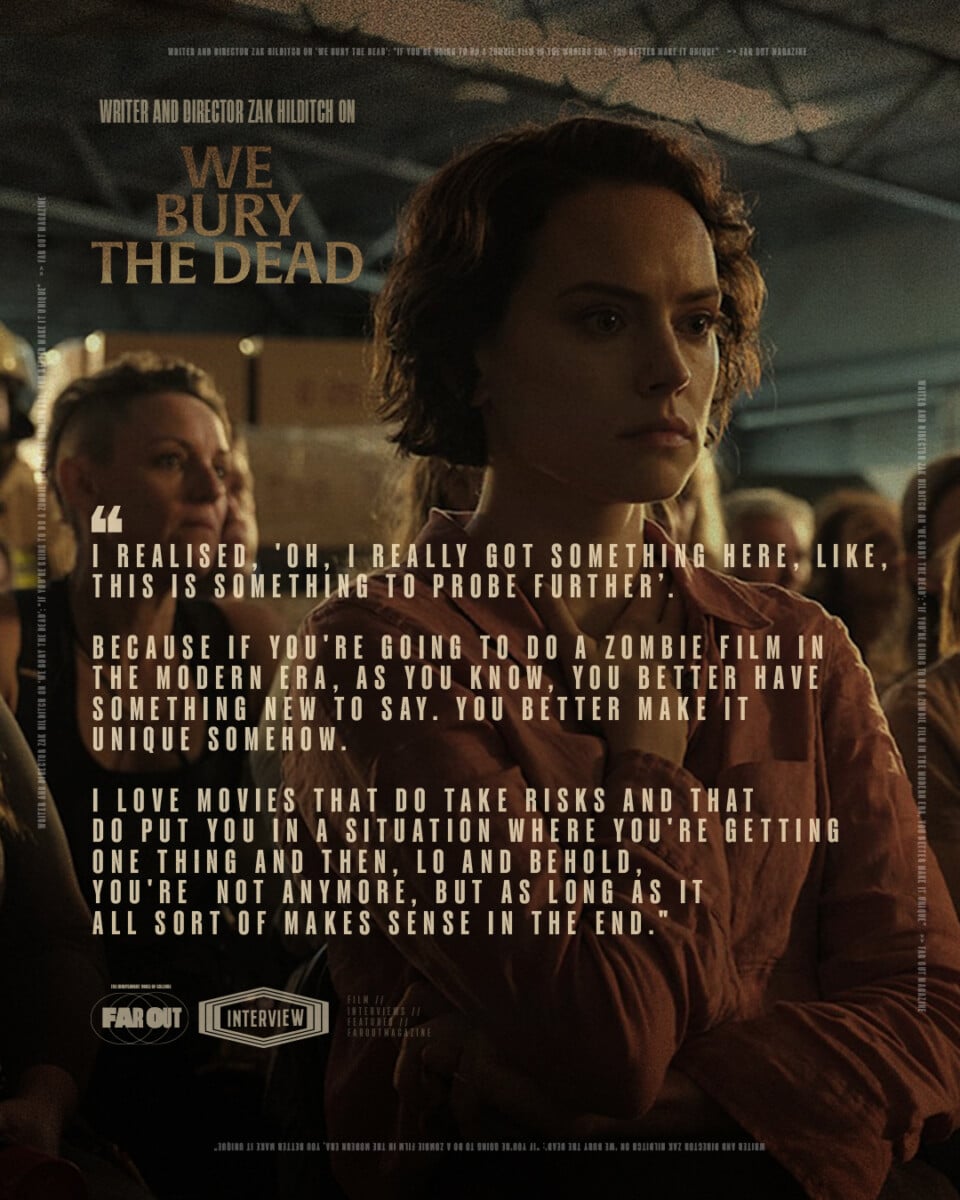
“I realised, ‘Oh, I really got something here, like, this is something to probe further,'” he said of the overlap between the movie and its themes. “Because if you’re going to do a zombie film in the modern era, as you know, you better have something new to say. You better make it unique somehow. I love movies that do take risks and that do put you in a situation where you’re getting one thing and then, lo and behold, you’re not anymore, but as long as it all sort of makes sense in the end.”
“The theme is what I was hanging on to with unfinished business and grief, and that helped me get through all of that, because as long as I was being truthful to that, it was allowing me this unique look at zombies in a way I’d never seen on screen before.”
Zak Hilditch
Like he said, it’s hard to make zombies feel new again, but We Bury the Dead manages it. If you’ve got an aversion to hearing people grind their teeth, then this is not the movie for you. It’s a unique sonic identifier that sets Hilditch’s undead apart from the pack, but it’s not an easy thing to listen to, even if the director loves seeing the audience’s reaction.
“As Riley says, the longer they go on, the more agitated they become. I thought, ‘Well, what does that sound like?’ And it’s teeth grinding, and we’ve heard teeth grinding in a bunch of zombie stuff before, but to make it such a point of reference in this movie, to use it as cues, to use it as like things that she was reacting, even on the page, it became such an important thing,” he expounded.
Alas, there were downsides. “I didn’t realise, like travelling to all these different countries and watching the film, the universal language of people not being able to handle that sound! It’s been pretty, pretty amazing to be there, live in the room. It’s been pretty great in the most gruesome possible way.”
Another aspect of We Bury the Dead that sets it apart is that it doesn’t have an antagonist. The closest thing is Riley, but even at that, he’s in the exact same boat as Ava because he’s also grieving and can’t find the closure he needs. They go about it in different ways, though, with Hilditch comparing a chilling scene at an isolated house to being ripped from another film entirely.
“It became like a completely different movie, which I loved,” he beamed. “And it just felt like we were now making this Hitchcockian thriller with creaking floorboards and candlelight. And I was like, ‘How?’ And even the crew was like, ‘How is this now the same movie?’ And I was like, ‘Yeah, isn’t it pretty great?’ And I just love that. From the beginning of the film all the way to that point, you’re thinking, ‘How did she get to here?'”
Hilditch’s belief was that “as long as I was being truthful to the decisions she was making, I knew we were going to be alright.” It was a “tense four days” shooting that particular exchange, but it also provided some of his favourite moments from the film, with the director echoing our sentiment that Riley and Ava are effectively two sides of the same post-apocalyptic coin.
“Mark hadn’t really been given the opportunity to play the baddie before,” he offered. “Hopefully, I’m not spoiling the movie too much, but yeah, he absolutely relished that as well. If you look at his version of the movie, there could have been a movie just about Riley, about a guy who’s dealing with his own grief in his own way, just as Brenton’s character is as well, and that’s what I love about the trio.”
“They’re all dealing with the same event, and they’re all dealing with a level of grief, but they’re completely making different choices,” he elaborated. “And that was a very important thing from the writing of it as well, of getting this bigger canvas crammed into the film without it feeling too overcrowded or too on the nose, allowing me to explore that same thing, through different voices.”
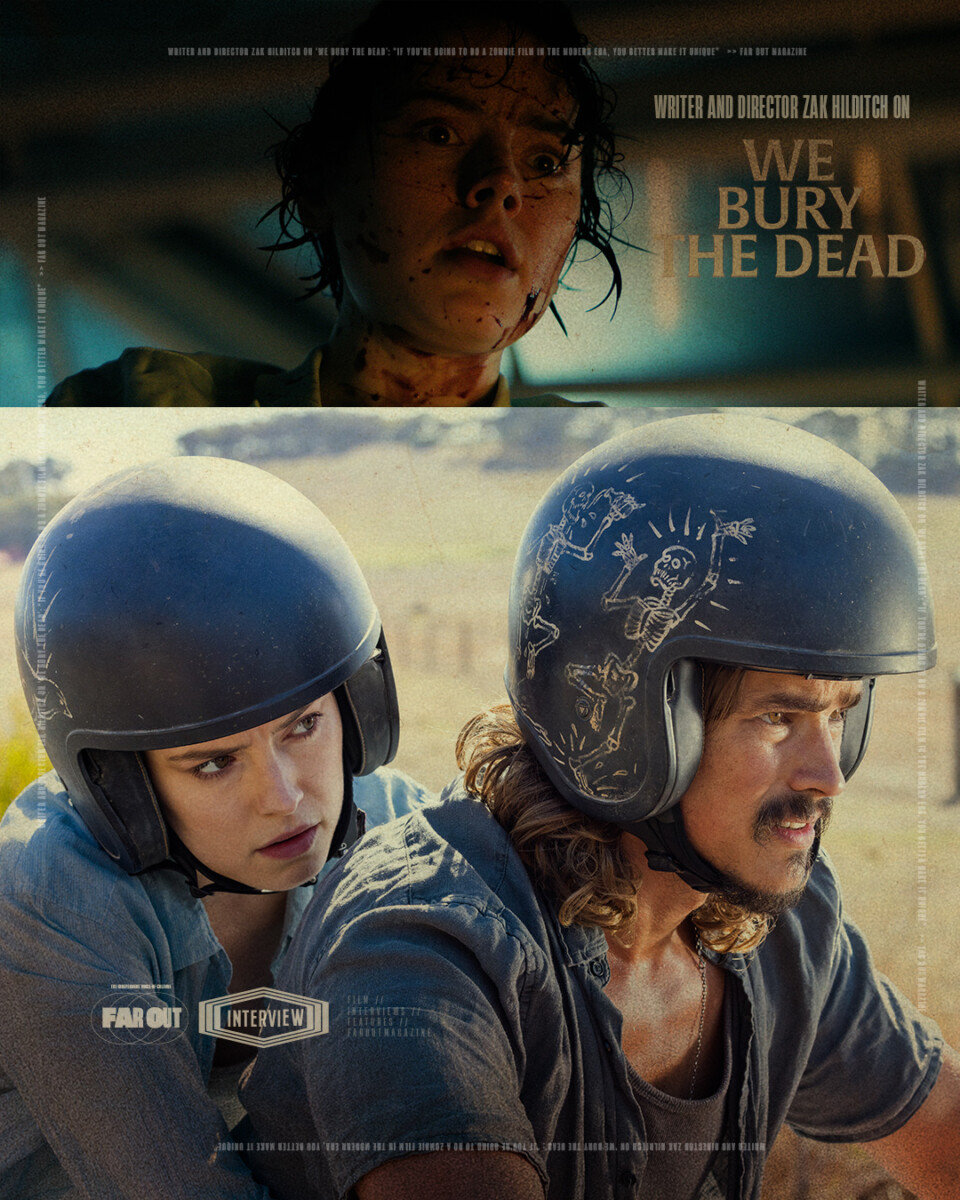
We Bury the Dead was shot in 25 days without having a lot of money to work with, but it features plenty of expansive backdrops, location shooting, road closures, upturned vehicles, abandoned buildings, and more, with one nerve-shredding scene standing out for Hilditch as a highlight of the entire production, when Ava finds herself scrambling through an abandoned bus to escape the clutches of a rampaging zombie.
“I intended that that was always going to be a oner, because there weren’t a lot of options,” he said. “But also, I wanted to do a oner at an unexpected point in the film with her, with her fighting the zombie there. And that was one where we probably went into overtime that day because we had to, but it was just losing that light, and once it’s gone, there’s nothing you can do. We can’t come back and overturn the bus again. So it really is just like everyone having to be on top of their game.”
Fortunately, the crew “managed to just get through by the skin of our teeth,” with Hilditch calling it “probably one of the most uniquely stressful” moments of the shoot, “Because it was all the elements converging to stop us from making the movie we were hoping to,” but they managed to pull it off.
With We Bury the Dead, his atmospheric page-to-screen chiller 1922, and the sci-fi thriller These Final Hours, the filmmaker has made a name for himself by telling intimate personal stories in a heightened genre space, but while there are certain sandboxes he still wants to play in, there are others he knows he may not be ideally suited for.
“You know, the only thing not in my arsenal at this point are probably kids’ films and rom-coms,” he joked. “But I don’t discriminate from one to the next, really, just the ones that happen to have gone happen to be those films with those big genre idea sort of backdrops, which allow me to tell more intimate stories at the coalface of them. But yeah, there’s many things that just haven’t gone.”
“This was hard enough to get up, you know, a Daisy Ridley zombie movie, let alone just getting drama up these days. I don’t know how anyone does it, but I’d love to know what the secret formula is!”
Zak Hilditch
Going back to one of his previous films, 1922 was one of the most acclaimed Stephen King adaptations of recent years, and there have been a lot of them. The man himself praised it, saying the period-set horror was “super creepy” and that after watching it, “it won’t leave my mind,” which Hilditch understandably and proudly wears as a badge of honour.
“I sought out 1922 when I was waiting to hear about funding for These Final Hours, just as a way to take my mind off the stress of, like, ‘Is These Final Hours going to get its money or not?’ And we did. But I read 1922 as just a bit of escapism, having been a King, not a hardcore King fan, but I love me some King. And I remember seeing the cover to Full Dark, No Stars, and thinking, ‘Oh, wow, that’s such an evocative cover’. I was like, ‘Now that is the most badass title ever’. So I got it, opened it up, and read the first story, 1922 and I was absolutely transported away from all my money troubles with These Final Hours.”
After he made These Final Hours, and after several false starts with other projects, he returned to the idea. “I just asked the question, like, ‘Did anyone get the rights to that?’ No one knew what it was. No one cared about it. It’s like they couldn’t give it away. It would have been impossible to get that story, the rights to it, now, but I just got in at the right time.”
King had watched These Final Hours and “really loved it, so I was off to the races.” He was given six months to write a script that he approved, and another six months to get it set up. “Thank god Netflix came in at the 11th hour after everyone and their mother told me to get fucked,” was how Hilditch neatly put it. “It was not horror enough. It was not drama enough. It wasn’t scary enough. It was period. What is this? What the fuck is going on, Netflix?”
Thanks to the streamer and producer Ross Dinerstein, Hilditch got “just enough money to pull that one off.” It was the director’s first non-Australian picture, and with Thomas Jane “living that character” of Wilfred James and Molly Parker having “crushed it” as his wife, Arlette, it became a “special experience” even before the icing was added to the top of the cake.
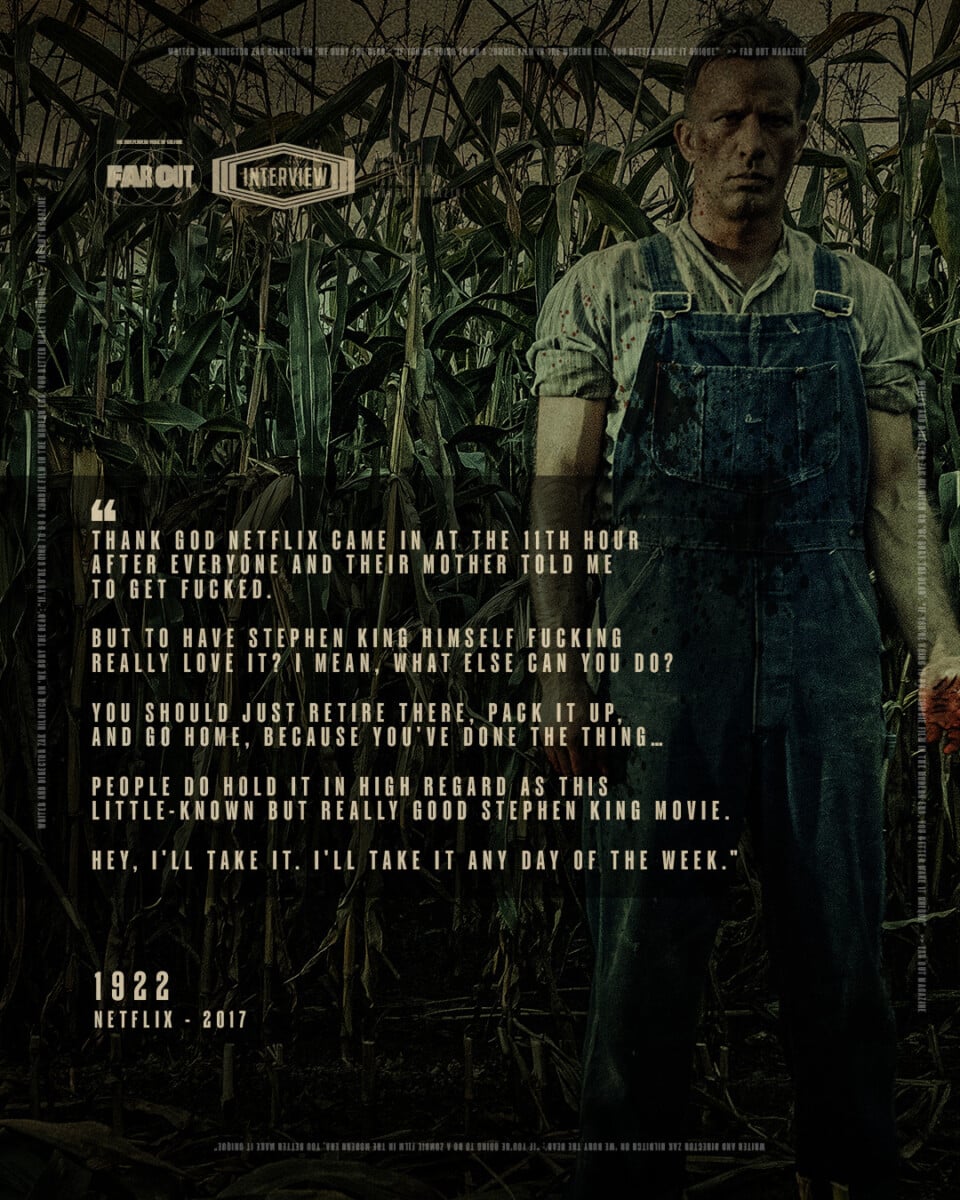
“But to have Stephen King himself fucking really love it? I mean, what else can you do? You should just retire there, pack it up, and go home, because you’ve done the thing.” He’s kidding, obviously, with Hilditch appreciating “that it found an audience on Netflix and that it does appear on all these lists, and people do hold it in high regard as this little-known but really good Stephen King movie.”
“Hey, I’ll take it,” he added. “I’ll take it any day of the week.” From movies he’s made to movies he’s always dreamed of making, Hilditch rounded out his conversation with Far Out by revealing that if there was such a thing as a dream film he’d love to make, he set his sights as high as possible by outlining his dreams of emulating a master who made something that defined his youth.
“Gun to my head, it would probably be A Clockwork Orange,” he declared. “Simply because it was the film that, when I saw it, absolutely warped my brain from the opening shot, the music, just everything about it, the fact that, when I saw it, it was a banned film. And, you know, after Stanley Kubrick died, it was finally released on cinema screens. I’d heard so much about it. Just the build-up. But then it absolutely delivered.”
Despite Hilditch calling it “the one that I hold near and dear as the one that absolutely just kind of changed everything for me as a filmmaker,” our suggestion that few titles can be deemed 100% safe from a remake these days was met by an answer from someone who knows they wouldn’t dare set foot on sacred ground. “Oh boy, yeah,” he replied. “Wouldn’t be scolded for that one at all!”
