


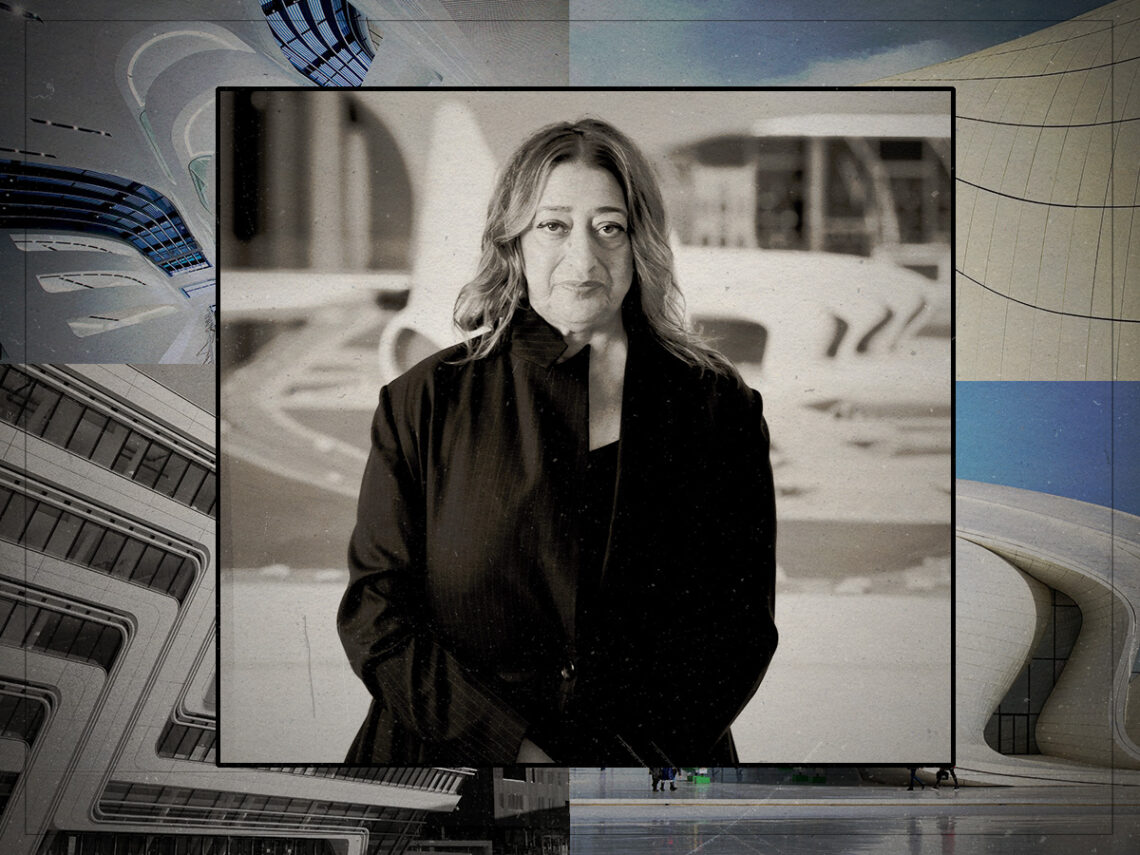
The architect of a changed world: Zaha Hadid’s futuristic buildings

The late Dame Zaha Hadid was widely recognised as one of the best female architects of our time. Architecture has historically been considered a very male-dominated artistic discipline, and today that is no less apparent. However, the Iraqi-British architect broke records that proved otherwise. She was the first woman ever to win the internationally recognised Pritzker Prize and the RIBA Stirling Prize, which is the UK’s most prestigious prize for architecture. These are only a few reasons why she was honoured with the DBE title for her outstanding contribution to the arts.
Her upbringing in Iraq, in a family of highly educated individuals, allowed her the freedom to travel around the world, take inspiration from a variety of architectural styles, and then pursue her studies, supported by her parents.
In the 1960s, Iraq placed a huge focus on nation and identity building, and thus there was a boom in architectural advancements to which Hadid was undoubtedly exposed. This continued with her four walls with her father, who worked as a prominent politician. Therefore, she was familiar with the changes that were provoked by cultural revolutions from a very young age. Additionally, Hadid was greatly inspired by the geological nature of Iraq and the unique characteristics pertaining to landscapes and cultures in the Middle East.
For example, the Arabic calligraphy with its fluid lines, and the rivers Tigris and Euphrates. This gave her the nickname “Queen of curves” for the undulating effect she was able to create in her building designs.
The rapid evolution of technology during her adult years played a major role in her career, as it was intrinsically connected with her personal advancements in architecture and engineering. It meant that she could be much more experimental with her designs, liberating her building projects from the previous, more rigid rules of geometry to embody a whole new expressive identity.
This is evident in one of her most famous buildings, the London Aquatic Centre. This was built solely for the 2021 London Olympics and was dismantled shortly after. It contained three pools and could seat over 15,000 people. This architectural project is an example of parametricism because Hadid used technology to exceed the potentiality of regular building materials, such as concrete, glass and metal, making them look malleable. This required a huge amount of technical engineering skills, and her success in doing so drew attention to her craft.
The undulation of this building mimics a wave of water as a reflection of the exact purpose of the building. Unlike previous Olympic aquatic centres, Hadid’s bestows biomorphic beauty. It isn’t just your bog-standard swimming pool facility in a glass box; rather, it fully embodies the sport itself, inviting us in. This is because Hadid wanted to destroy the elitist notion that beautiful spaces like operas and museums are reserved for a certain class of people. She placed an important emphasis on the act of experiencing a space, not just containing something inside, but also the outside of it.
The fluidity captured in the building was also supposed to reflect the chaos and flux of modern life and the booming dynamism of London culture as a melting pot of perspectives. Its organic forms were also meant to be as easy to deconstruct as they were to put together, to ensure environmental friendliness, adding again to the harmony of the building alongside nature.
But the project wasn’t all that easy. It cost a whopping £269million to build, which many people criticised. However, the fact that the British government gave such resources to Zaha Hadid shows just how much they trusted her and how important she was to the UK, both as an architect and as a citizen.
