


‘Zack Snyder’s Justice League’ review: A triumphant return

This may be Zack Snyder’s comic book masterpiece, but it also represents something greater still. Fashioned as a type of rebuttal to the studio executives who once denied the director his vision, Snyder has finally stepped from the sidelines to deliver the sprawling, superlative mythology he feels DC fans deserve. The project is essentially his love letter to the many Twitter followers who championed his work, and this cut rewards them with a dazzling requiem that earns the protracted four hour time that would never have been greenlit in 2017. Not since The Dark Knight has a superhero film carried this much gravitas to a source material once pencilled at pre-adolescent males, or put so much emphasis on the individual arcs of a committed ensemble of custodian players. And without Joss Whedon and his penchant for sight gags – not to mention Whedon’s blatant disregard for women – the feature walks down a more spiritual path, as each of the heroes searches within themselves as a means of absolving themselves from density, distraction and death. The change in tone makes for a much grander viewing experience, and the original cut-by contrast feels embarrassingly submissive as a format.
Zack Snyder’s Justice League began as a sideline, completing a desired fantasy to restore what its director did not have the emotional energy to stomach in 2017. Having lost his daughter in the midst of filming, the mercurial director acquiesced to grief and left the project to the hands of it’s new co-writer. As such, the ambition that fuelled the script made way for a grotesquely misconceived cut that failed to ignite the critical recognition the series needed to move forward. Around the same time, rumours started to spread of the cast’s mistreatment, culminating in two of its star players distancing themselves from the work and others voicing favour for a cut thought to be hidden, with the other scripts piling on Snyder’s desk. Those voices, riding on the back of an inexplicable turkey, found greater support on the internet as a torrent of Twitter followers led their way to this superior cut. Out of courtesy to the woman he lost during the original, Snyder closes this adaptation with a dedication to his beloved Autumn.
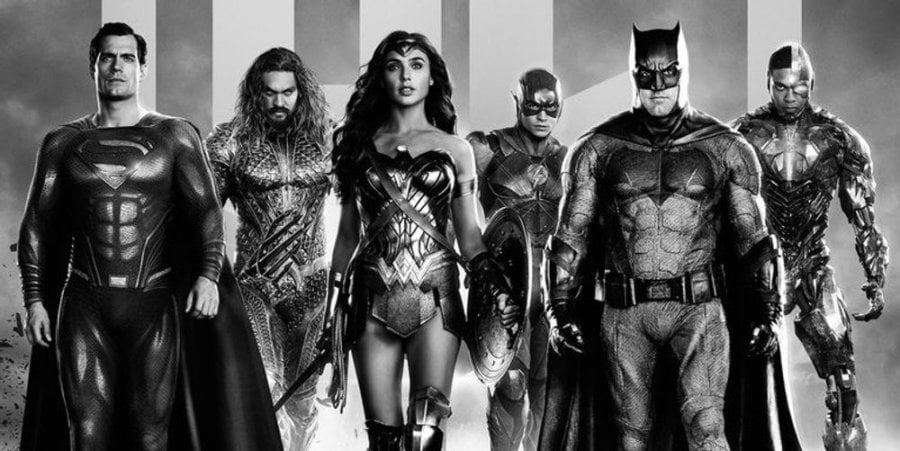
Combining new threads with the stories unveiled in the original, the film presented as a seven-part serial-uses the running time to capture its stars plunged headfirst into a web of disharmony and devolution. The opening credits circles on a Superman (Henry Cavill)), struck by the many sins he devoted his life to cleanse, before the camera turns to Cyborg (Ray Fisher), a car crash survivor haunted by the vehicle that robbed him of his bodily flesh. Following this opening processional, the film turns to a millionaire abandoning his material wealth for a snowier terrain, while Diana Prince (Gal Gadot) posits herself as a conservator of peace by restoring many of the statuettes once thought lost to war. What connects every one of these desolate wretches is their thirst for redemption, a salvation Aquaman (Jason Momoa) craves in his travels between earth and sea. Only Flash (Ezra Miller) seems grounded in his reality, content in his desires to work as a dog walker, before Bruce Wayne (Ben Affleck) visits him in the home that tidily doubles as his lab and lounge.
As a narrative, this set upholds an intellectual, as well as emotional, resonance, but Snyder ties these six persons together with an acidic aesthete that circles around the individual quests with a composite of sepia-tinted backdrops. Dismissed in the past as a mere “MTV stylist”, the director holds true to the comics that channelled his creative muse from the gladiatorial 300 to the probing, pensive Man of Steel. And in each character, he creates tenable failings, inviting everyone from the leads to the villains to echo their inner torment. Steppenwolf (a mellifluous Ciarán Hinds) is less the torchbearer of a movement and more the slave to a master who beckons him to deliver a promise. Commissioner Gordon (a sanguine J.K.Simmons) is less the brooding, belligerent policeman of the original and rather the confidante and comrade to a cause that could very well save his planet. And then there’s the inhabitants of Themyscira, the insular islanders once again tasked with saving the gender they once prohibited from their place of sanctuary.
Each supporting actor has a purpose in an impasto that revels in tiny detail, earmarking a tapestry that only grows stronger with every added passenger who helps nourish the world it holds. Although the film is based primarily on the material that hung in Snyder’s house, the Wisconsin-born storyteller elected to bring one more onboard. Thrown into the middle of an apocalyptic fantasy sequence, Jared Leto emerges as The Joker posterity had supposedly binned. He’s no Joaquin Phoenix, but Leto is having a blast, calling out Batman as the arrogant, anarchic miscreant he has supposedly spent his life fighting. The scene – like the film itself – is rich with metaphor; everyone who stands on this planet serves both as its saviour and executioner. Though filmed during the pandemic (Miller committed to his segment via Zoom), the silhouette harkens back to the opening as a band of eco-terrorists take their opportunity to set the earth back to a more primordial time. Complete with their bombs and brigades, the bandits foreshadow the return of a sentient being even more powerful than anything they hope to achieve. Beneath the graves they plunder sits an ubermensch that could just as easily suppress the earth as he could save it. And then, in a “Knightmare”, that fury emerges to unite every knight and joker in their quest for survival.
With a timbre this thick, the movie calls to attention the European masterworks that showcase a changing continent in the face of tremendous upheaval. Like Otto Mezzo, this cut wraps its viewers on the triumphs that await the most deserving; like Heimat, this chronicle laces its story through a series of crisp, kaleidoscopic composites; and much like Kieślowski’s superlative Trois Couleurs trilogy, the arcs that drove the heroes through times of grief, union and war hold tremendous pathos in their shared synergies. Snyder has curated an arthouse piece that more than holds its own in the lexis of esoteric cinema; that it shouldn’t seem so experimental until the closing moments is in keeping with the graphic format that once compelled him to build an entire universe.
Whether this will be Snyder’s last foray into the DCverse (the official word is that Whedon’s original is canon, but Empire duly put Snyder’s version in their poll of DC movies) is not as compelling a question as how much of an imprint this entry will hold on the franchise. And yet, the film – a superlative achievement on almost every level – is better served outside the sphere than within it. Snyder is currently working on a project that will reunite him with his other love, zombies, and may return to the comic book industry sometime in the near future. In many ways, he doesn’t have to. With this cut, he’s shown shadings once thought impossible for a Graphic Movie, completing a vision that is equal parts heroic and human in its resolve. Bravo!
