


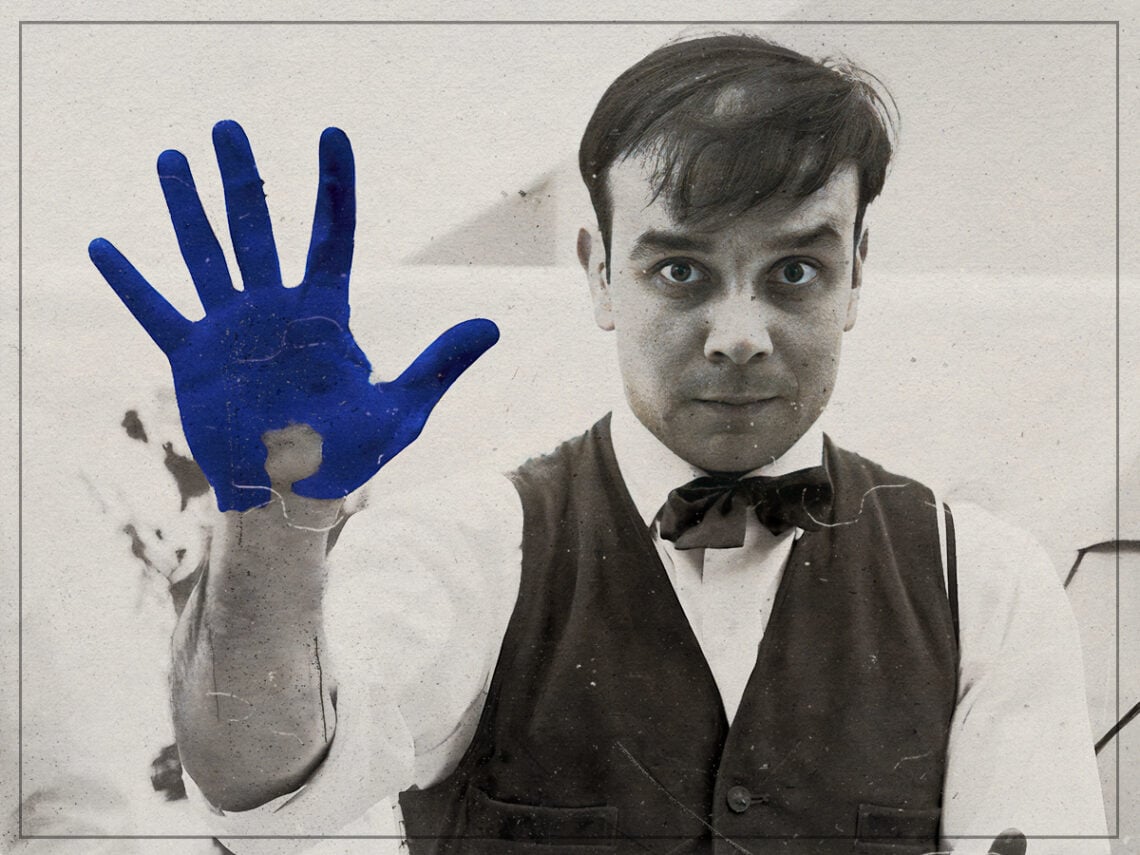
Yves Klein: the artist who invented a colour

When Yves Klein was 19, he lay on a beach in southern France with two friends. As they watched the sunlight bounce off of the waves, they decided to divide the world between the three of them. What was little more than a silly game to pass the time went on to crystallise Klein’s most significant offering to the art world. One friend decided he’d take the animal kingdom and the other plants. As the ocean lapped at the shore, Klein dawdled.
Instead of gazing outward, Klein looked up to the sky. That year, 1947, France hit a record temperature of 37.6 degrees. It was scorching, the sky impossibly clear. Klein turned to his friends with a decisiveness that came to define his body of work. “The blue sky is my first artwork,” he said. Klein sensed that many people associated the colour blue with resigned sadness, but in reality, the sky and sea were always blue beacons of expansiveness, intuition, and freedom.
Years later, Klein sent off a Soleau envelope. In France, sending off the sealed envelope was proof of a new invention or idea, and for Klein, it was a pigment. In 1960, he registered a new paint formula he’d created alongside Parisian art supplier Edouard Adama. It was called International Klein Blue (IKB).
To make IKB with maximum impact, they’d used a matte synthetic resin binder. Without any gloss or sheen, the binder suspended the colour, meaning the dazzling pigment Klein conceptualised retained the intensity of its shade. The resin used was made up of polyvinyl acetate, sold under the name “Rhodopas M”. Collaborator Adam sold the binder as “Médium Adam 25”.
The shade of IKB is striking, aided by Klein’s thick application on canvas. It was a deep blue, almost like the kind you find on ornate china plates, except more potent. Klein used a lot of ultramarine pigment, one of the most vivid shades of blue you could find.
The colour itself was a revelation, but there were more patents to come. The same year he posted the Soleau envelope, he patented a method that removed the need for him to physically use it, opting instead to have models covered in the colour roll on canvases. His idea was to make people his paintbrushes, distancing himself even from the need to create.
In 2016, one of his models, Elena Palumbo-Mosca, spoke to the BBC about the surreal experience of becoming not a muse, but a tool. “I was not a paintbrush, because, in spite of all, I did use my brain,” she said. “I was not a brush, I was a person who co-operated – he called us his collaborators, in fact.”
The kind of depersonalisation Klein wanted to establish in his art was mirrored in the experience of the models. “The expression ‘living brushes’ sounded great,” said Palumbo-Mosca. “But it was not too kind to the person who was doing the work with Yves [Klein]”.
