


Yukio Mishima: the man above David Bowie’s Berlin bed

There’s a misconception about David Bowie that Keith Richards fell right into when he said, “It’s all pose. It’s all fucking posing.“ The Rolling Stones rocker even added, ”He knows it too.” The paradox presented by Bowie, is how can someone be both a character and truly sincere? In Spain, they have a word for the purity of art at its pinnacle: Duende.
This word was defined by poet and (perhaps) purely platonic love interest of Salvador Dali, Federico Garcia Lorca, as exalted emotion unearthed from within, “a mysterious force that everyone feels and no philosopher has explained. The roots that cling to the mire from which comes the very substance of art.” Can this profound upswell truly be channelled into the conduit of a preconceived character?
There are those who would say that with manufactured character comes artifice, a fugazi of the real thing, but the obvious rebuttal is that art is merely about creativity unleashed, and creativity doesn’t care if a mask helped to spawn it. As Bowie said himself: “I was never unaware of my strength as an interpretive performer, but writing a song for me, it never rang true. I had no problem writing something for, or working with Lou Reed, or writing for Mott the Hoople. I can get into their mood and what they want to do, but I find it extremely hard to write for me.”
Continuing: “So, I found it quite easy to write for the artists that I would create. I did find it much easier having created this Ziggy to then write for him. Even though it’s me doing it! I was able to distance myself from the whole thing, but it can become very complicated, you’re fucking fabric with time there. It did bring a sort of sack-full of its own inherent problems.”
Those problems came the fore in quite a horrific way prior to Bowie absconding to Berlin. After years of failing to make it in music in the 1960s, when success did start to come his way, Bowie felt a tremendous sense of rock ‘n’ roll ”inadequacy”. But Ziggy was even beyond the proverbial rockstar, a Godhead epitome of pop culture idolatry, almost inseparable, by design, from Jesus Christ himself, right down to Bowie’s act of calvary in sacrificing his ‘Starman’ at the height of his pomp, to allow him to expand towards new muses.
Alas, as John Updike once wrote, fame can become a “mask that eats into the face.” Bowie inhabited his characters right down to their pitfalls, and found it impossible to divorce their masks off-stage. As a result, when he transitioned to his darkest creation, The Thin White Duke, he developed a cocaine addiction measurable by the tonne, a bizarre diet of bell-peppers and milk befitting of a cable TV documentary, an unwavering obsession with the Third Reich, he thought his pool was possessed by the devil, and he thought his friend, Deep Purples’ Glenn Hughes, was a witch. You’d find it hard to say that such sincere madness was “all pose“ or the product of facile pantomime.
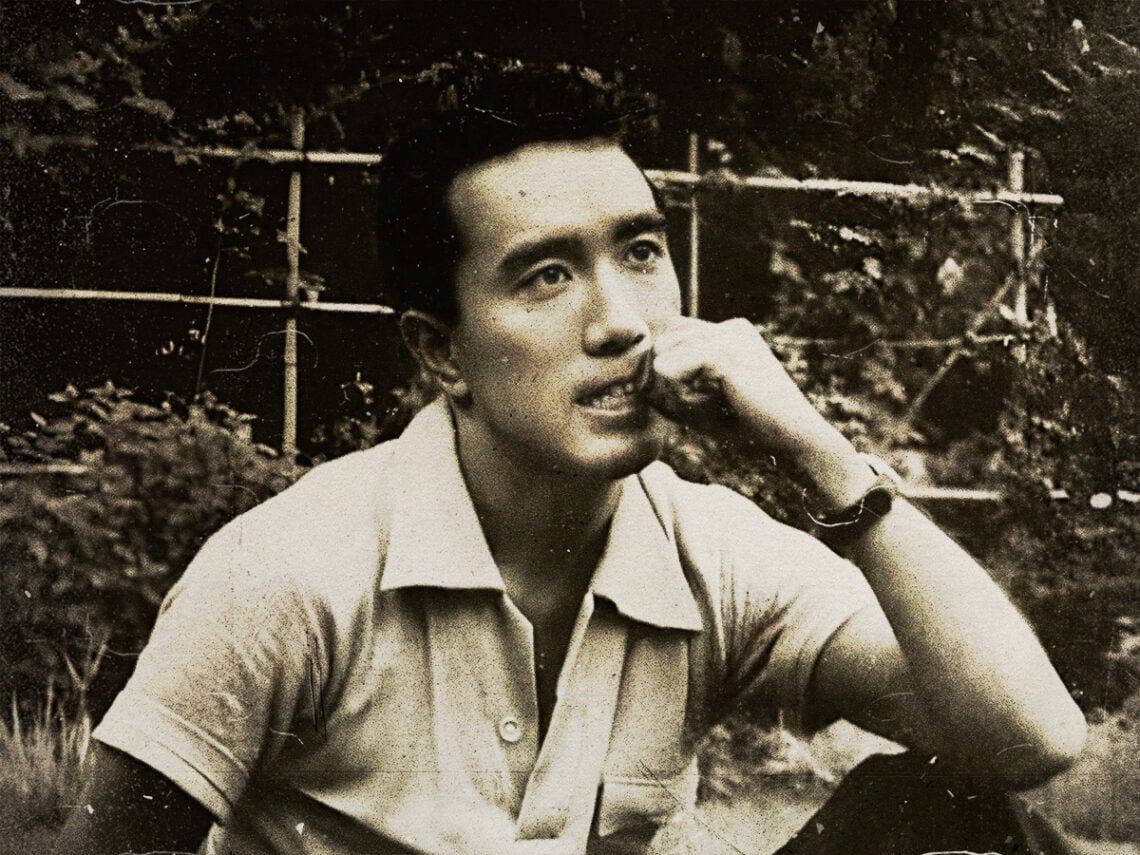
Plagued by this tortured disposition, he fled form this mask, and along with his friend Iggy Pop, relocated from “insidious“ Los Angeles to Berlin. It was here, after Edgar Froese of Tangerine Dream helped him to find his own place, an unassuming ground floor apartment at 155 Hauptsrasse, that he attempted to settle down. By day, he tried to avoid the pitfalls that had led him to West Berlin in the first place, holing up in cafes reading magazines and eating endless sausages, before eventually succumbing to Isherwood’s now-decrepit underground and racing around the abandoned streets in Iggy Pop’s car. Finally, returning home, for a few hours sleep under a giant portrait of the Japanese novelist, actor and nationalist civilian militia, Yukio Mishima.

This love for Mishima, and the kinship of ‘the mask‘ that they shared, perhaps offers the finest insight into how Bowie viewed his own character art. I recently spoke with the expert on all things Japanese culture, Roy Starrs of the University of Otago in New Zealand, who explained: ”In the mediaeval Japanese Noh theatre, the actor spends some time before he goes on stage staring at the mask he is about to put on, which may represent either a male or a female character, since both were played by male actors.”
Continuing: ”This ritualistic moment of contemplation resembles a Shamanistic rite of spirit possession, in that the actor intends to shed his own identity and take on the identity of the character he is about to portray. Mishima was fascinated by this profoundly mystical form of theatre – he even wrote ‘modern’ Noh plays himself – and one might say that he lived his life accordingly, continually shedding his ‘own identity’ and very consciously putting on one mask after another, as if no single role could ever quite satisfy him.”
Concluding: ”If anyone were to ask, ‘what then was his own true identity?‘, I would refer them to Mishima’s autobiographical novel, Confessions of a Mask. That paradoxical title says it all: the gay sadomasochist he presents therein for popular consumption as his ‘true self’ was only to be regarded as another mask. If that ultimate mask were ever removed, one would find perhaps not any permanent or solid identity but that creative emptiness out of which, the Buddhist philosophers tell us, all phenomena arise. Bowie, of course, was a very creative shapeshifter himself, so it is not surprising that he understood all this about Mishima and valued him as one of his very favourite writers.”
The parallels between the concepts that fascinated Mishima about the masks of Noh theatre and Bowie’s rock ‘n’ roll equivalency, from the androgyny of male gender fluidity to the sense of spiritual possession and inception of a creative void to be filled, couldn’t be more stark. For Bowie and Mishima, masks represent a chance to extend beyond the norm. As Bowie said, ”I’ve always had a repulsive need to be something more than human. I felt very puny as a human.” The same could absolutely be said for Mishima, albeit the heights to which he took this repulsion are immeasurable by most standards in history.
Who was Yukio Mishima?
In an article on the death of James Dean, Mishima opined: ”The beautiful should die young, and everyone else should live as long as possible. Unfortunately, 95 percent of people get it backwards, with gorgeous people lingering into their eighties and hideous fools dropping dead at 21. Life never goes as planned; and we, the living, are cast into its comedy.”
”Greek mythology tells of how Achilles was forced to choose between a long life void of glory and a glorious young death. Without flinching, he chose the latter. Surely all but the most prosaic of men, if given the choice at the start of life, would do the same,” he wrote. While it would be far too simplistic to say that heroic immortality was the only thing that Mishima strived for in his storied life of novels, acting, bodybuilding and activism, he certainly had an external notion of how his life would be perceived in wider humanity, a character in the play of it’s comedy.
He was born in Tokyo in 1925 to a Samurai family. However, his parents placed him in the care of his grandmother, a vindictive soul who largely isolated the boy from outside contact until the age of 12. He was sickly, longed for social interaction, and sort solace from the brutal existence imposed by the family’s iron-fisted matriarch in theatre and literature. He soon exhibited his own brilliance in an artistic capacity and was published anonymously in magazines while still at school.
However, he longed for the physical enjoyment that other kids revelled in, an enjoyment that he had been sheltered from in his youth. Thus, when World War II arrived, and Mishima was drafted, he was one of the few naive souls excited by the proposition of adventure and glory, oblivious to the reality of horror. This misguided dream was dashed when he failed his physical examination on account of his frail frame. He would forever be devastated by this embarrassing blow. He felt deprived of his own true fate.
As he would later note regarding the rite of passage he viewed war as: “What I wanted was to die among strangers, untroubled, beneath a cloudless sky. And yet my desire differed from the sentiments of that ancient Greek who wanted to die under the brilliant sun. What I wanted was some natural, spontaneous suicide. I wanted a death like that of a fox, not yet well versed in cunning, that walks carelessly along a mountain path and is shot by a hunter because of its own stupidity.”
When this didn’t come, he poured his soul into his works. His fame grew, and this inspired a prolific output from the young writer, delving into various fields of the arts. Yet, he was always hungry for more, always wanting to surpass his former achievement and strive for some new level of societal transcendence. Being just another star was a pursuit devoid of originality.
Thus, around this time, perhaps driven by his former shame, he began to engage in bodybuilding and martial arts meticulously. As he had previously bemoaned: “I lacked, in short, the muscles suitable for a dramatic death. And it deeply offended my romantic pride“. Another factor behind this, could have been his developing sense of traditional nationalism. He became a political extremist, opining that post-war Japan had lost its Samurai identity. So, he formed his own para-military group to serve as a symbol of his political ideology beyond the pages.
Eventually, these two elements would collide. His bodybuilding became a token of his desire to be beautiful in death. On the morning of November 25th, 1970, Mishima and four members of his para-military group, entered the self-defence force in Tokyo. They took the commander hostage, and thereafter, had him assemble the garrison in the square below his office. Mishima went out onto the balcony and addressed the soldiers below. As ever, he was immaculate and spoke with the profound mix of beauty and brutality that he said typified Japan, but even more so his writing; he called for the soldiers to join him in a coup, eviscerate the submissiveness that had befallen them, and usurp the US-backed state by restoring the supremacy of the Emperor.
A hush soon arrived at derision. Then Mishima calmly went back inside, told his followers, “I don’t think they heard me.” Then he knelt down, unravelled his uniform, and committed seppuku, the first to do so since the days of war. The act of seppuku is something he had written about previously. The ancient suicide method is defined as: “self-disembowelment by a short sword followed by decapitation with a long sword at the hands of a trusted acquaintance.“ This was the end of Mishima’s odd existence. He was 45.
In the days that followed, he dominated global discourse. In The New York Review, the Japanese philosopher Hide Ishiguro, mused: “Some thought he had gone mad, others that this was the last in a series of exhibitionistic acts, one more expression of the desire to shock for which he had become notorious. A few people on the political right saw his death as a patriotic gesture of protest against present-day Japan. Others believed that it was a despairing, gruesome farce contrived by a talented man who had been an enfant terrible and who could not bear to live on into middle age and mediocrity.”
However, it could be agreed by all parts, that just like the end of a novel, this had been prognosticated and design as part of Mishima’s engineered narrative, a life lived and ended as a work of romantic fiction with the poised notion of the ego’s legacy at its core. As he had told his wife, perhaps in a moment of despair that signified how his dreams could never be surmounted in mortality, “even if I am not immediately understood, it’s OK, because I’ll be understood by the Japan of 50 or 100 years’ time.”
In the years that have followed, it has, naturally, became impossible to separate the man from this brutal end. But his final chapter must be viewed as an obscurer, a moment of madness, separate from the way he entangled art and reality prior, using the vessel of the mask to embody in a more rounded sense, the nature of his existence within society at large. It is merely that he donned one with a toxic obsessiveness that he failed to shed. He is an extreme example, but when it comes to his work alone, the art beside what became a tortured reality, he embodies the way some creatives use the mask not as interplay, but to reveal something that they want to impart on society.
This is the key to Bowie too, that many, like Keith Richards, have misunderstood. Every artist is, in some way, a character. The act of art is about reaching a level of exultancy, escaping the norms of everyday existence, filling the white walls of simply ‘being’. There is not that much difference between Mick Jagger pouting and parading around with an affected attitude, to Bowie taking that a step further and assimilating a message he wants to extol to society into a mask and fulfilling that with the escapism of creativity.
As Mishima would put it, the mask can, in fact, become the true vehicle to Duende: “The process in which a writer is compelled to counterfeit his true feelings is exactly the opposite of that which the man of society is compelled to counterfeit his. The artist disguises in order to reveal; the man of society disguises in order to conceal.”
David Bowie’s favourite Yukio Mishima book:
The Sailor Who Fell from Grace from the Sea – Yukio Mishima
