


Yalla: the Uzbek band that introduced the USSR to folk-rock

In the wake of 1960s hippiedom, when a revolution in rock and roll coincided with the resurgence of singer-songwriter folk, folk-rock was an utterly unavoidable cornerstone of the Western airwaves during the 1970s. Behind the Iron Curtain, though, musical expression of any kind was not so simple.
Music, like virtually all forms of culture and society, was placed under the watchful eye of the Soviet state during the Cold War, with Westernised sounds like rock and roll, blues, and jazz deemed a threat to the communist way of life. Record labels, like the Melodiya, were state-owned and could therefore only release music that the state deemed acceptable, which was invariably classical compositions and traditional folk music from across the USSR. Nevertheless, rock and roll still found its way East.
Through a complex and, in many cases, dangerous network of bootleggers, smugglers, and rock rebels, audiences in the USSR were able to hear the likes of The Beatles, Elvis Presley, and Bob Dylan through scratchy bootleg recordings, endlessly copied reel-to-reel tapes, and even flexi-discs disguised as postcards. Unbeknownst to the state, then, the American folk-rock boom of the late 1960s wasn’t far off taking root in the Soviet Union.
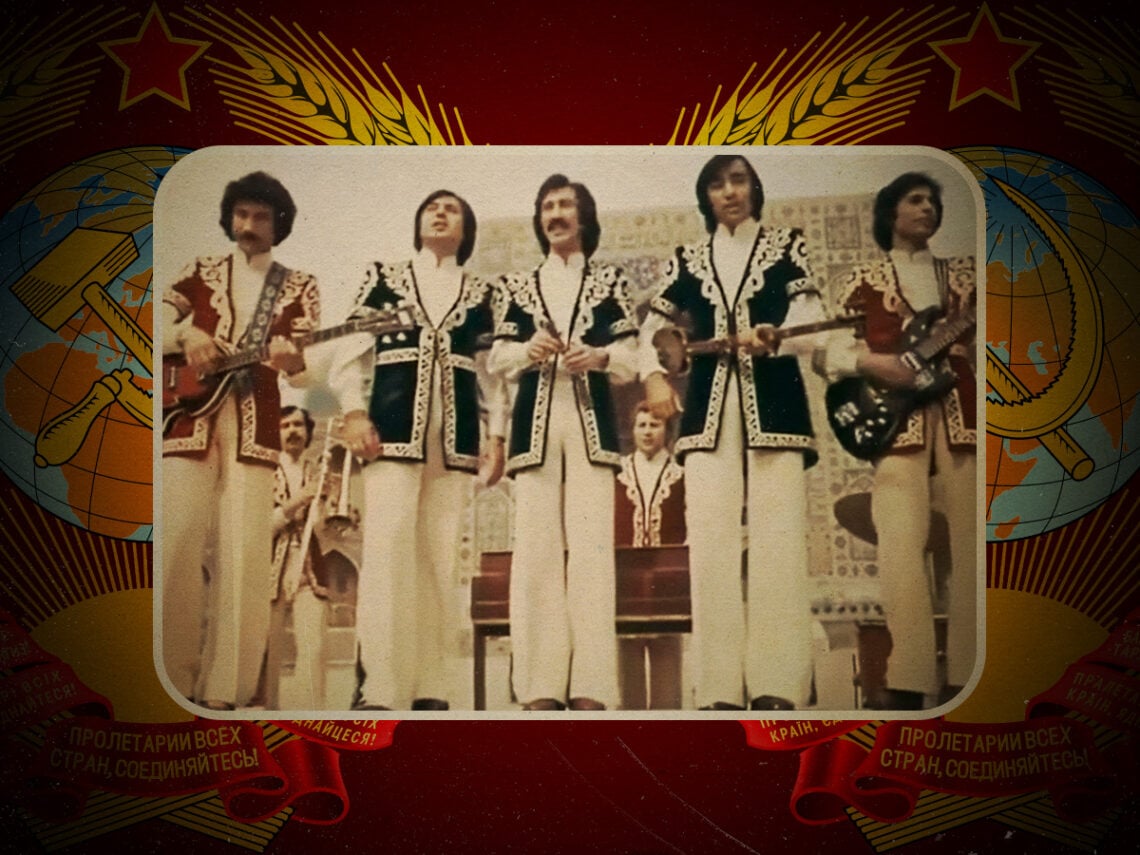
In particular, that era-defining sound found a home in Uzbekistan, thanks largely to Yalla. One of the defining Uzbek outfits ever to grace the airwaves, Yalla. Originally formed in 1973 and led by Tashkent’s finest, Farrukh Zokirov, Yalla united a kind of Westernised rock sound with the traditional folk stylings of their Uzbek heritage, owing largely to Zokirov’s mother, who was herself a folk singer.
Despite the state’s blanket disapproval of rock music, Yalla’s incorporation of irrefutably Uzbek influences, paying homage to the folk traditions of their homeland, seemed to endear the group towards the Soviet state. So much so, in fact, that it was the state-owned Melodiya label that began releasing their material, with early singles arriving in the mid-1970s, followed by the debut album Три Колодца (Three Water Wells) in 1982.
That album quickly established Yalla as one of the most successful, lauded groups in the entirety of the USSR. While there is certainly a case to be made for the fact that audiences had fewer rock-adjacent records to choose from at that time, thus inflating the notoriety of the Uzbek band, it is also rather hard to deny the musical quality of Zokirov’s band. On the title track of that 1982 record, for instance, the band struck an infectious middle ground between cheesy 1980s mainstream rock and folk authenticity.
Given that Uzbek folk music isn’t and wasn’t often heard on the mainstream airwaves, particularly outside the nation itself, Yalla were essential both in modernising those sounds and exposing them to widespread (albeit largely limited to the Eastern Bloc) audiences. With that in mind, it is no surprise that the band ended up outliving the Soviet Union itself.
Zokirov himself is still active in Uzbekistan’s cultural realm; in fact, he served as the deputy minister of the Ministry of Culture and Sports during the early 2000s. Meanwhile, Yalla’s final album, Фалакнинг Феъл-Афъоли, arrived in 1991, while Uzbekistan was in the midst of declaring its independence during the downfall of the USSR.
Since then, though, multiple compilation albums and ‘greatest hits’ records have kept Yalla at the very pinnacle of the Uzbek rock scene, as well as being perhaps the nation’s best-kept secret.
