


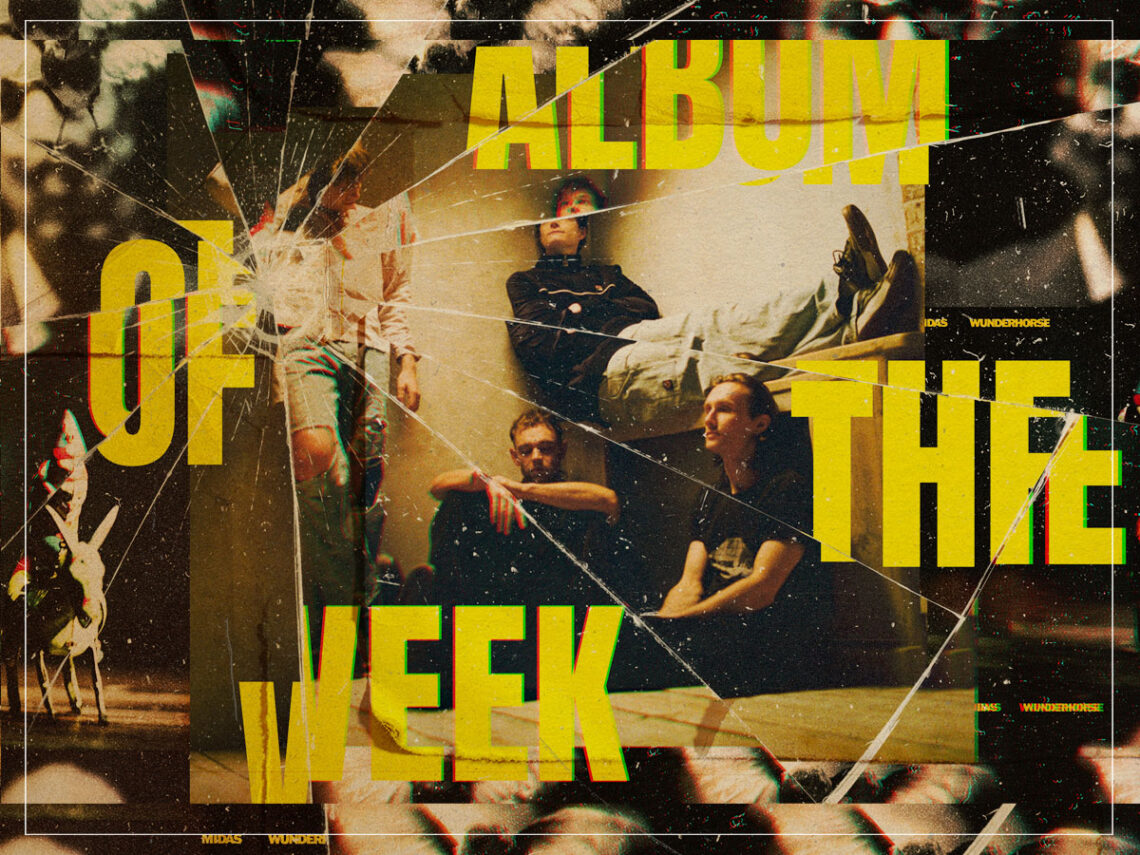
Wunderhorse – ‘Midas’ album review: proof of the power of a band

THE SKINNY: People talk a lot about the idea of the ‘tricky second album’. After the debut captures the world’s attention, all eyes turn to the artist. While the first could be made in peace, the sophomore effort is heavy with expectations and pressures, demanding evolution but not too much. For most artists, the debut feels like their purest creation. But for Wunderhorse, their second album, Midas, is a return in the form of a reinvention.
The story of the band begins with just Jacob Slater. Once a frontman of a London punk band, it was a classic case of a bright young thing totally burning himself out with the lifestyle. After moving away and slowly getting his songwriting spark back, his debut album Cub was the result of that rejuvination. But really, it feels like he didn’t truly get his energy back until this sophomore release, which marks the first one made with his bandmates, guitarist Harry Fowler, drummer Jamie Staples, and bassist Peter Woodin, as they were added as official members. Wunderhorse is no longer an artist; it is a band, and this album makes it evident.
It is a band album on every level; from the references weaved into the work, the decision to record in the hallowed halls of Pachyderm Studio where Nirvana made In Utero and the pattern they fell into of starting each day by listening to some other classic album by another classic band. But mostly, this is an album that is completely and purposefully dedicated to letting them be a band.
After the burn out and loneliness Slater had experienced in music, Midas feels like a recovery. While the album is full of introspection and expertly crafted lyrics that are heavy with emotion and poetry, the build of the record is one that refuses to hold itself back with thinking. When it came to recording the album’s opening number and title track, their producer Craig Silvey simply hit play on a tape machine, capturing what the band treated as just a practice but ended up being the final and explosive production. That one tale is the perfect explanation for this record: the best things come without trying. Rock requires energy, and allowing a band to simply play as a band, as they would on stage, with no pressure or thought beyond that momentary performance, is always going to capture that energy best.
In that way, Midas was not only an antidote to Slater’s own earlier disillusionment with music, but is a vital antidote for the world’s. Sure, guitars and rock never went anywhere, but as the realm of grassroots music becomes tougher to navigate, an album like this, that’s laced with the balm of live music and serves as a reminder of the power a great band can have, feels very necessary.
In short, Midas is a triumph on all fronts. It is anthemic enough to level the band up to bigger stages, intimate enough to allow fans to develop their own relationship with it, and interesting enough to cement Wunderhorse’s status as an act to keep an eye on and respect. It is a great rock record made with exactly the same energy behind all of history’s great rock records, as Slater, the band, and their listeners return to the root of it all.
For fans of: Citing a gig as one of your all-time favourites even though you can only just about remember it.
A concluding Greek mythology-based cliche: “As the title suggests, everything they touch is turning to gold.”
Midas track by track
Release date: August 31st 2024 | Producer: Craig Silvey | Label: Communion
‘Midas’: Once in every while, a guitar song comes out that is so laced with energy, so gripping, and so electric that it feels like the whole world unanimously agrees it’s golden. When ‘Midas’ dropped back in April, it was the chosen song. Months on, it’s still as great. [4.5/5]
‘Rain’: A prime example of artists getting out of their heads and refusing to overthink their work, ‘Rain’ is another stunning outpouring from this record as the band dedicated themselves to capturing tracks live and then leaving them alone. [4/5]
‘Emily’: This song could have been written now, or it could have been written in the 1990s at the birth of grunge. Recording in the same studio as Nirvana and PJ Harvey, the influence of legends seemed to linger around Jacob Slater as he unleashed this track that bubbles then boils over with emotion. [4.5/5]
‘Silver’: The album’s lyrical best is delivered right here. A tale of abuse and trauma unravelled with each simply put yet deeply poetic line, the music swells around to make a visceral nest. It would be easy for people to write this record off as being merely focused on the band’s live energy, but a track with this level of nuance shatters any and all doubt about the artistry at play here. [4.5/5]
‘Arizona’: On tracks like this, the band’s solid musical education that was getting developed and exercised each day in the studio, shines through. It’s a perfectly crafted rock song, with Keith Richards’ ethos of “solos come and go, riffs last forever” powering Harry Fowler, Kurt Cobain’s grunge wails possessing Slater in the final moments, and drummer Jamie Staples pinning it all down with just a faultless rock and roll base. [4/5]
‘Superman’: Stripping it back for a moment, a spotlight shines on Slater, the man who started it all and the force behind this project that has slowly brought back the force of passion behind his music-making. In this more intimate and isolated sound, it feels like getting a look at the core of his creative process, with the band gradually building around him as a beautiful nod to the way they’ve changed the game and the future they’re not making together. [4.5/5]
‘July’: The spirit of Nirvana vibrated right through that studio and into the band when they unleashed this wild track. Another track powered by live energy being allowed to survive in its freshest and most exciting form, Cobain and Co would be proud. [4.5/5]
‘Cathedrals’: This album will sound great in sweaty, small venues where the crowd are packed to the rafters, all locked in on the band. But ‘Cathedrals’ ensure it will also sound great on huge stages, festival fields, and future-proof paths to stadium scales. [4/5]
‘Girl’: A good old-fashioned rock and roll tune about a girl. Love songs are everywhere, but one like this feels like an art form that threatened to be lost, with Wunderhorse stepping in to save the craft of a declaration-heavy, 1960s-inspired love song that turns a greeting card message into a rock tune. [4/5]
‘Aeroplane’: Every morning in the studio, the band would listen to a classic album. One of them was The Rolling Stones’ Beggars Banquet, which they reference here both in lyrics and in sound. Bringing in the same country-twanged rock that Jagger loved but with an 8-minute long stunning and adventurous build, it seems like Wunderhorse could be coming for their crown as the greatest rock and roll band around. [4/5]

Never Miss A Beat
The Far Out New Music Newsletter
All the latest New Music from the independent voice of culture.
Straight to your inbox.