


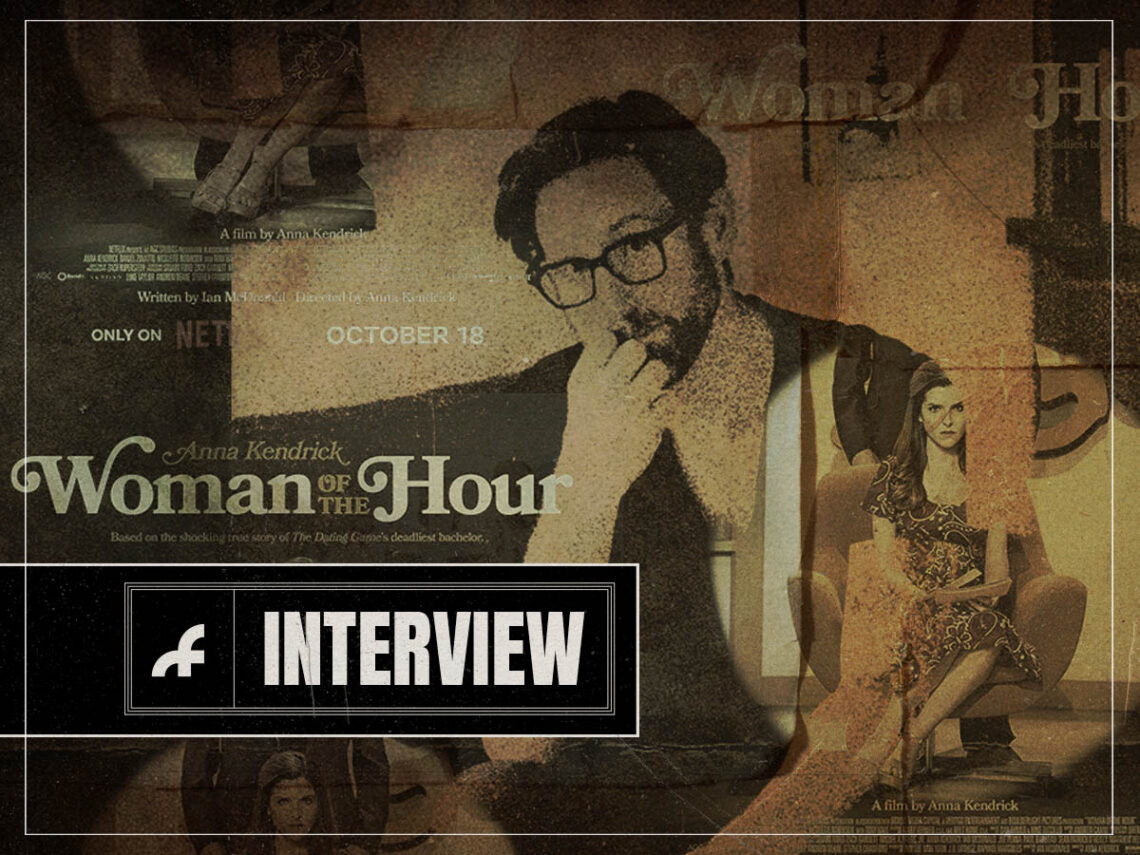
“Serial killers as people aren’t super interesting”: writer Ian McDonald on true-life suspense story ‘Woman of the Hour’

Bringing Woman of the Hour to the screen has been a labour of love for writer Ian McDonald, with his screenplay dramatising serial killer Rodney Alcala’s 1978 appearance on The Dating Game – where he won after being picked by contestant Cheryl Bradshaw – having first gained attention by appearing on the 2017 Black List, the annual roundup of the best-unproduced screenplays in Hollywood.
The film, which marks the feature-length directorial debut of star Anna Kendrick, premiered at the Toronto International Film Festival in September 2023 and finally comes to Netflix on October 18th, 2024, so how does it feel for McDonald knowing that the finish line is finally in sight?
“It’s exciting,” was the understandable admission. “I mean, it’s funny. As you said, the premiere was a year ago, but I wrote the first draft of the script almost eight years ago at this point, so it’s all a little surreal. It’s an odd thing. I wrote it, but it’s a weird thing to be taking credit for something you wrote almost a decade ago, you know? It’s exciting that it’s finally getting out there, but also, it feels a little like the work of somebody else.”
It’s been a long time coming, but the fact remains that Woman of the Hour will be available to over 200 million people worldwide at the push of a button come October 18th, with McDonald acknowledging that his latest work will be casting a much wider net than anything he’s previously done on stage or screen.
“Surreal, it’ll have a wider audience than everything I’ve ever done before combined,” he said. “It’s a little daunting and intimidating because once the work’s out there, it doesn’t really belong to you anymore. It belongs to the public. And then you’re left to go, ‘OK, that’s what they thought of it’. I mean, it is exciting, it definitely is exciting, but also definitely a little scary.”

The idea of a serial killer making an appearance – and emerging victorious – on a nationally televised dating show is almost the definition of a stranger-than-fiction story, the sort of far-fetched tale that could get a writer laughed out of the room for being too unrealistic if it hadn’t actually happened. Not only that, but having spent so long in development, McDonald was rightfully worried that somebody else could beat him to the punch.
“It’s tricky; I’m sort of in two minds about this,” he offered. “On one hand, I started writing about it because I thought the story was interesting, and I thought it could be socially useful, and I thought it could contribute to a conversation that we were having, a cultural conversation that felt important. And so, to one degree, you have to put all that stuff out of your mind because you’re focusing on the thing in front of you, and you don’t want to get too possessive of the story itself, like, ‘This is mine’. It’s not my story. It’s just a thing that happened, and I’m telling a version of it.”
“And yet, at the same time, as a screenwriter, I worked really hard on it for years,” he elaborated on the double-edged sword. “Most of those years, I wasn’t being paid to work on it. You want this thing that you worked on to find an audience because the story feels so singular and interesting. I was always worried that somebody else was going to go and make a movie about it, and then my script will become obsolete.”
That said, Woman of the Hour isn’t a beat-for-beat recreation of the events leading up to The Dating Game episode or the events on either side of it. As a writer, McDonald outlined his approach to when, where, and why to make those distinctions between the facts and his own creative voice to zero in on the story he wanted to tell.
“Because it’s a movie and it’s not a 12-hour limited series, you inherently are going to have to pick and choose what to include; there’s going to be editorialisation regardless, and that forces your hand to a certain degree,” he said. “And so then you have to decide, ‘What beats that I’m including are serving the larger narrative and the larger thematic interests of the story?’ And to a large degree, that was also the mindset behind what we chose to fictionalise. Some of what we fictionalised was simply by necessity.”
“The full episode of Rodney, his full episode on The Dating Game, just isn’t available anymore,” McDonald expounded. “You can see his particular questions, but you can’t see any of the other bachelors, either their questions or their answers, and so a lot of that we had to create from scratch, but largely, it was done in service of two things.”
The first was “trying to make sure that modern-day audiences were sharing the same emotional experiences of the characters back in 1978.” Watching Alcala’s clips in isolation, “He seems pretty darn creepy. And it’s like, ‘Oh my god, why on earth would you pick this guy?’ He just gives you the chills.”
Alcala’s demeanour on the show, “which was charming and charismatic and funny to audiences” in 1978, wouldn’t play the same way in 2024, and McDonald applied an artistic licence to the scenes set during the show “because his behaviour back then wouldn’t read that way anymore.”
McDonald’s biggest fear in recreating the Dating Game episode was that “audiences would go, ‘Oh, this woman’s an idiot,'” which necessitated the biggest changes to recreating the show. Beyond that, Woman of the Hour also explores themes that are as relevant and resonant today as they were more than 40 years ago.
Throughout the film, whether it’s by her agent, the people who work on The Dating Game, or even Alcala himself, Cheryl is regularly viewed as little more than a commodity to be used for personal gain. Some of the events may have undergone slight alterations on their way to the screen, but the message that maybe those attitudes towards women haven’t progressed quite as far as the world likes to tell itself makes the period-set dramatic thriller a decidedly modern story in many respects.

“Absolutely, a lot of superficial things have changed, but a lot of the deeper, more structural problems have remained the same,” McDonald agreed. “Obviously, the movie is about gender dynamics. It’s about the danger that comes with intimacy, and how do you know you’re picking the right person?”
“But it’s also about power dynamics,” he elaborated. “The power dynamics between the wealthy and the financially struggling, between men and women, between law enforcement and civilians, that’s another power dynamic. And so, it boils down to people in positions of power neglecting their responsibility to people without power, who are reaching out and saying, ‘My god, help me.'”
Even in the opening scenes of the movie, Kendrick’s Cheryl is being spoken about like she’s not even there by the people sitting right in front of her during an unsuccessful audition, which immediately establishes the thin line between chauvinism and misogyny.
“One of the things that I always knew I wanted to explore was that it’s about the spectrum of misogyny, and Rodney represents one end of the spectrum, the most extreme version, but that’s rare,” the writer underlined. “There’s a lot more people, like the host on the dating show and the creepy showrunner/casting directors; they’re a lot more common than he is. It’s not about serial killers; it’s about the spectrum.”
“My hope is that people will watch it because it’s very easy to look at Rodney and be like, ‘I’m not that’. But maybe you see other little behaviours sprinkled in where it’s like, ‘Oh shit, I’ve done that before’. And it makes you question your own culpability and the larger scheme of things. If we had focused only on Rodney, it would have been a movie about a serial killer instead of a movie about this spectrum of bad behaviour.”
Alcala pled guilty to five murders he committed between 1977 and 1979, falling on either side of his appearance on The Dating Game, but some have estimated that he may have killed over 100 people. Woman of the Hour zeroes in on a very specific moment in the murderer’s life, but it’s not his story.
Instead, the focus remains on Cheryl and her worldview, which extends far beyond the confines of Alcala and the show. His other crimes are used to contextualise the events that unfold, but McDonald was fully aware that the benefit of hindsight and knowing what happened to Alcala after the fact wasn’t going to be allowed to inform his storytelling.
“There’s sort of two ways of looking at that,” he initiated. “On one hand, it’s supposed to be a suspense movie, and ultimately Rodney dies in prison. He wasn’t dead when I started this, but he was in prison. And if you start with that, depending on how far you want to go, then the movie loses a lot of its suspense.”
“You can feel the horror by exploring the story through the point of view of the killer, but you’re going to feel suspense, and you’re going to feel empathy and, hopefully, identification if you explore it through the lens of either the victim or the potential victim, that’s the more interesting perspective. And also, serial killers as people aren’t super interesting. They’re sociopaths or psychopaths, and they’re motivated by pretty simplistic things. They don’t have empathy to the degree they feel sorry for anyone; they feel sorry for themselves, and there’s only so far you can go with them.”
It’s been almost a decade-long journey to bring Woman of the Hour to the screen, and McDonald has had to navigate plenty of obstacles during that time. However, it’s worth wondering if the original draft of the script – titled Rodney and Sheryl – underwent any drastic overhauls or revisions during that period.

“The ‘A’ storyline, which is Cheryl’s storyline; her as a struggling actress, her going on The Dating Game, has been pretty consistent from the beginning.” The ‘B’ storyline, focusing on flashbacks to Alcala’s other crimes, underwent the most significant alterations, as did the movie’s ending once Kendrick came aboard.
“I’m not going to go into too many details for spoiler reasons, but when Anna Kendrick signed on to direct, she had really strong opinions about the shape and movement of the script, and in particular, she was a strong advocate for keeping it as close to the actual events as we possibly could.” That meant there were “certain things from the real story that had gotten chipped away over the years that she pulled back in,” with the first-time filmmaker helping “make it the toughest, most uncompromising version of the film that it could be.”
Moving away from death and despair, and with Woman of the Hour on the cusp of arriving on Netflix, McDonald revealed he harbours aspirations of adapting a short story that hasn’t made it to the screen yet despite being written by one of Hollywood’s most prolific sources of film and television content for the last half-century.
“I grew up in Maine, the easternmost point of the US, and the home of Stephen King,” the screenwriter shared. “And when I moved to LA, I had a lot of homesickness, and so Stephen King was my comfort reading whenever I was homesick. He wrote a short story called Mrs Todd’s Shortcut, which is weird. It’s kind of like his version of The Bridges of Madison County, which sounds very odd, but it’s about lost loves, and there’s also this Twilight Zone aspect to it.”
“I always thought that it’s so sad and it’s so beautiful, but it’s also very nostalgic, and it evokes home for me in a way that not a lot of other stories do, and so I’ve been trying to get that story adapted for a while now. And it kills me because it’s there, it’s available. Nobody’s doing anything with it, and I would kill to adapt Mrs Todd’s Shortcut by Stephen King, so that’s the thing I want to do.”
With the combination of serial killers, Kendrick, and Netflix lining Woman of the Hour up for instant success on streaming, McDonald could get his wish sooner rather than later.
