


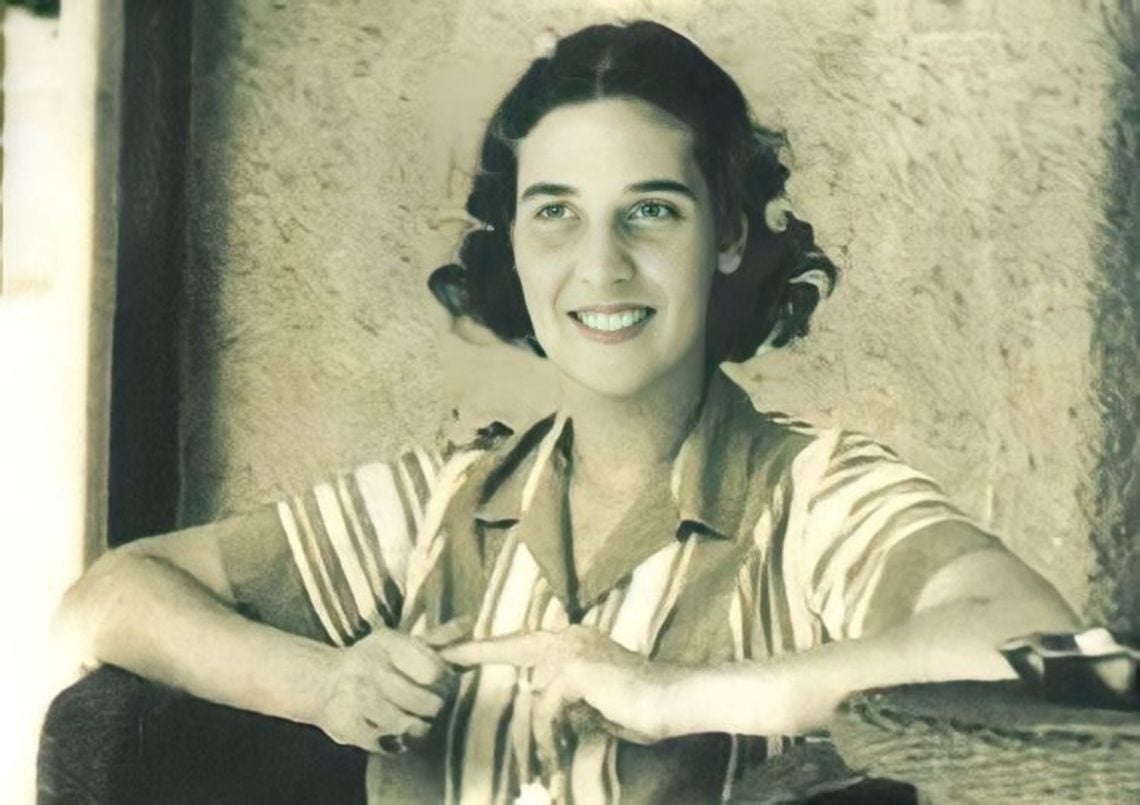
Blanche Blackwell, the enigmatic woman who inspired the James Bond character Pussy Galore

From Le Chiffre to Octopussy, both the literary and cinematic worlds of James Bond are brimming with iconic characters that help to ballast the self-confident and often ridiculous titular spy. Conceived by the author Ian Fleming, although his creations are legendary in writing, it is on the big screen in which they became etched into pop culture lore, often played by titans of the silver screen and complete with notable appearances and lines.
The life of Ian Fleming is so storied that in 2014, Sky Atlantic even made a miniseries about some of the moments that would go on to inform the creation of 007. He came across a wide variety of characters in his time, and many of these would eventually make their way into his novels and subsequent films, such as the modernist architect Ernő Goldfinger – whose work Fleming objected to – and became the basis of his most famous villain, Auric Goldfinger.
One of Fleming’s other most memorable creations came in the form of Pussy Galore. Galore originally appeared in the novel Goldfinger and then the 1964 movie of the same name. In the latter, she is played by Honor Blackman in one of the late actor’s definitive roles alongside her turns in The Avengers and Jason and the Argonauts.
Notably, in the 1959 novel, Galore’s character reflects the state of gender roles at the time and just how backwards Fleming’s views were guilty of being through today’s lens. In the book, she is the only woman in the US to be running an organised crime gang, a set of plucky trapeze artists called Pussy Galore and her Acrobats. The group then evolves into the all-lesbian, Harlem-based organisation going by the name of the Cement Mixers.
In the novel, her appearance is different to the blonde of Honor Blackman, and she has black hair with the only violet eyes Bond has ever seen, originating from the poor rural South. Interestingly, she tells Bond that she became a lesbian after being sexually abused by an uncle when just a child, which led her to a life of crime, a strangely pertinent subject for an Ian Fleming work.
Whilst her character in the book has stoked much discussion, the film version is most suspended in the collective memory. We first meet the golden-haired character when Bond wakes up in Goldfinger’s private jet after being tranquilised. When 007 regains consciousness, Pussy Galore is the first thing he sees, and the dialogue between the pair is quintessential of that early period of Bond. When the spy asks who she is, she says: “My name is Pussy Galore,” to which he responds: “I must be dreaming.”
It transpires that Pussy Galore was based on an actual figure and someone who greatly impacted Ian Fleming. This character in question was the enigmatic Blanche Blackwell, a Jamaican lady of Sephardic Jewish descent whose life is nearly as mythical as that of Fleming’s. Born in 1912 in Costa Rica but raised in Jamaica and schooled in the United Kingdom, she had a love affair with Fleming and duly, her indefatigable character courses through that of Pussy Galore.
Blackwell passed away in 2017 at the ripe age of 104, but the anecdotes about her are many, ranking amongst the most unbelievable of her generation. One of the most notable aspects of her early life was that she married Joseph Blackwell of the Cross & Blackwell fortune in 1936 and that their only son, Christopher Blackwell, who was born the following year, is one of the most instrumental figures in music history. A Rock and Roll Hall of Fame inductee, he is the founder of Island Records. Remarkably, he is partially responsible for acts such as Bob Marley and The B-52’s success stories, which is worth a piece of its own.
Another fascinating aspect of Blanche’s life was the impact on cinema’s most famous swashbuckler, Errol Flynn, the hard-partying lothario who references the expression ‘in like Flynn’. She had such an impact on Flynn that it is said that he even wanted to marry her despite them both being married at the time. They first met in the 1940s during one of his holidays to Jamaica, and he described her laugh as “like the sounds of water tinkling over a waterfall”.
As for Fleming, he lived nearby to Blackwell in Jamaica, and after they became friends, she became his mistress and muse, and this relationship would inspire Pussy Galore’s conception. The pair first met at a dinner party in the 1950s after Blackwell had returned to Jamaica after a long stint in England. At first, the two didn’t hit it off, but it flourished into a passionate and creative one after a while.
“I remember I sat next to him at dinner and he said: ‘Why haven’t I seen you before?'” Blackwell recalled her first meeting with Fleming during an interview with the Sunday Express in 2012. “I told him I was just over from England, and he said, ‘Oh good God, you’re not a lesbian, are you?'”
At the time Blackwell and Fleming’s relationship blossomed, his marriage to Ann Charteris had suffered greatly, which is said to have been significantly impacted by her negative view of the Bond novels. Charteris was often away from their Jamaican home, Goldeneye, and had her own affairs, most notably with prominent Labour Party politicians Hugh Gaitskell and Roy Jenkins.
This estrangement from Ann gave Fleming and Blackwell’s relationship the necessary space it needed, with the author affectionately labelling his muse as ‘Birdie’ for her mischievous nature and kingfisher intellect. Despite being madly in love with her, some have noted that the dilapidated guano taker in Dr. No was called Blanche because of her, a rough indication of the sort of man Fleming was and the world he represented.
“She was a sort of macho female,” Chris Blackwell explained to Vanity Fair in 2012, suggesting that his mother was an embodiment of the ultimate Bond girl. “The relationship they had, how she and Ian bonded, was that they were both into doing things: climbing these falls, going into those caves, swimming here, snorkelling there.”
One of the original girl bosses, who acutely understood how to control and sate the overtly misogynistic men of her day, when speaking to Tatler in 2017, Chris Blackwell provided one of his mother’s most brilliant quotes. He said: “She always says, ‘I love men — they make such good pets'”.
