


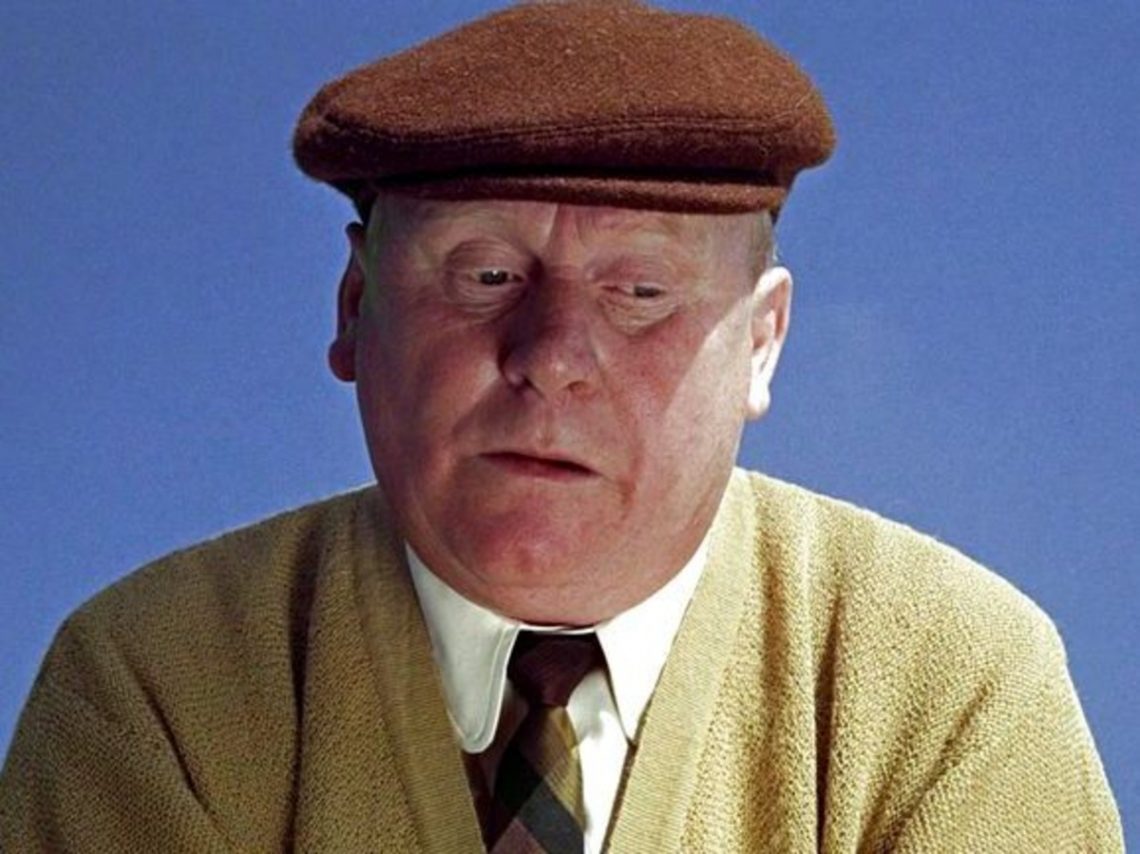
Was the James Bond villain ‘Goldfinger’ based on a real person?

Whilst the James Bond franchise is often noted for its ridiculous elements – wholly inconceivable gadgets and plots that were best displayed by 1979’s Moonraker – the series does actually have some of its origins in real life, with the exploits of its creator, author Ian Fleming, greatly influencing ideas with a host of classic characters based on actual people.
This is encapsulated by the titular agent being the embodiment of a collection of real figures. Still, one of the most glittering examples comes in the form of one of the franchise’s most lauded and notorious villains, Auric Goldfinger, who is based on one of the most significant modernist architects of all time: Ernő Goldfinger.
Famously, the villain Auric Goldfinger gave his name to the seventh James Bond novel Goldfinger in 1959 and the 1964 flick it later inspired. Although the depictions and stories of the villain vary between book and movie, both are characterised by their obsession with the metal gold, with the forename, Auric, a direct adjective of it. Although the book is one of the most lauded in the series, it is the film that remains most memorable, with the scene in which Bond is strapped to a table and threatened by Goldfinger with a laser the pinnacle of this, complete with the line: “No, Mr. Bond, I expect you to die”.
Ian Fleming and Ernő Goldfinger were neighbours in Hampstead, London, and it is said that the idea to use the architect’s name arrived at Fleming after having a discussion with his cousin on the golf course. Notably, Fleming was one of the most prominent objectors to Ernő’s pre-war demolition of a row of Victorian terraces in Hampstead in order to make way for his now-protected house at 1-3 Willow Road, which is looked after by the National Trust.
The character in the book bears some resemblance to the real Goldfinger, and understandably, he was angered at the obvious swipe at him. As a result, he consulted with his legal representatives after the book was published, considering legal action against Fleming. However, in response, the headstrong Fleming threatened to rename the character “Goldprick”. Put off by the defiant author, Goldfinger settled out of court in return for legal fees, six copies of the novel, and an agreement that the character’s first name would always be used.
As for Goldfinger’s architecture, although he started to make waves before World War II with the Willow Road houses and one in Broxted, Essex, it was out of the ashes of the conflict that he would truly cement his place in the history books.
His first significant assignments came when he was commissioned to construct the new offices for the Daily Worker and the headquarters of the British Communist Party. Then, in the 1950s, at the request of the London County Council in Putney, he designed two primary schools out of prefabricated pre-cast concrete. Unfortunately, a cottage that made up one of the schools, Brandlehow, was demolished by an unscrupulous developer. They were prosecuted in 2008 and ordered to restore Goldfinger’s building to “exactly match” its original state.
However, Goldfinger’s most iconic builds were yet to come. In the 1960s, on the site of the historic Trocadero cinema in Walworth, South London, he constructed the imposing Alexander Fleming House for the Ministry of Health, which was renamed Metro Central Heights in 1997. After that, in 1966, he then created what might be his most iconic addition to the area, the Odeon in Elephant & Castle, which has now been demolished to give way to new architectural regeneration.
While these constructions are memorable, Goldfinger’s design of residential tower blocks has endured the most. In an attempt to ease the housing crisis in Britain following the Second World War, when nearly four million houses were destroyed, the government opted to erect high-rise blocks of flats, with Goldfinger pioneering this new trend.
His most famous buildings from this era were the Balfron Tower and Carradale House in Poplar, which then acted as models for the 31-floor Trellick Tower in Kensal Town that he completed in 1972. All three are now regarded as outstanding examples of Brutalist architecture, which is now regarded as a stylish architectural mode.
At the time, as reflected by Ian Fleming’s stance, the public and post-modernist architects were negative towards Goldfinger’s work. However, this all changed towards the end of the century, when a resurgence in interest caused his work to be reapproached from a different angle. He became an icon of design, with the Trellick and Balfron Towers and Carradale House now listed as Grade II. Trellick Tower was even mentioned in the lyrics of 1995’s ‘Best Days’ by Blur, indicating how much public opinion had shifted, with the spectre of the dastardly Auric Goldfinger now just faint background noise.
