


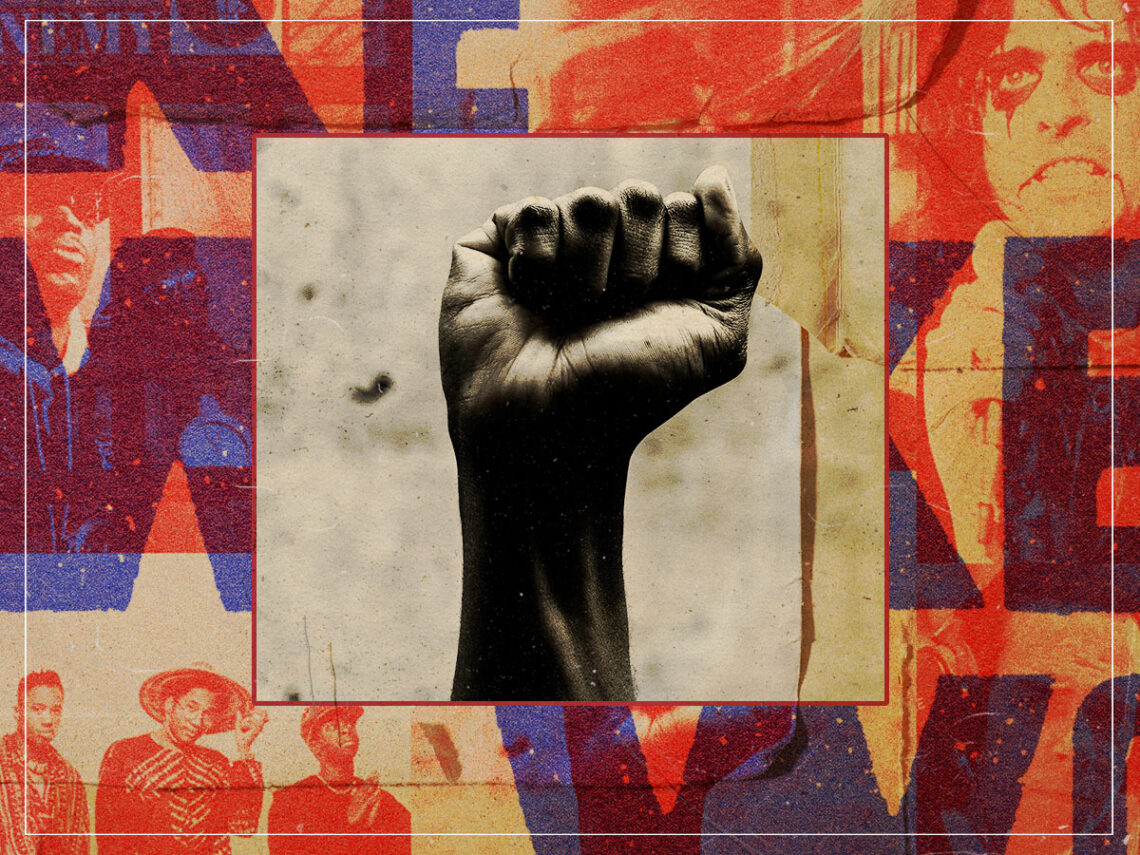
A history of “woke” in music: How a term associated with acceptance and progression became a malicious insult

The term “woke” has undergone one of the most vicious transformations in etymology. The derivation of the word may seem obvious, but it’s interesting to examine its historical transformation and how it essentially evolved from a word meaning awake and conscious to a cultural weapon used to provoke specific segments of society. In music, particularly rap and hip-hop, “woke” often echoes sentiments of bravery and strength and of those who are socially conscious and rallying for change. However, in recent years, its misappropriation has become a genuine cause for concern.
Like many socially colloquial terms, “woke” originated from African American Vernacular English (AAVE) as a way of referencing activism and social consciousness. To be “woke” was a superpower as it alluded to seeing things that others couldn’t: you had your eyes open, and you were ready to fight for the things that no longer served you or your community. Throughout the 1980s and ’90s, the rap movement gained traction, which saw the rise of “woke” and socially conscious themes being used as a reference point in the music.
While many artists, like Public Enemy, KRS-One, and A Tribe Called Quest, utilised “woke” themes as a way of promoting critical thinking and encouraging others to take in their surroundings with a more challenging eye, the rise of the internet and the prominence of right-wing figures initiated a shift that saw the term take on a more harmful edge. Historically, “woke” was a cherished characteristic that indicated authenticity and acceptance, signifying the unrelenting rawness of the rap and hip-hop industries. However, a real shift happened when the term became an appropriated term for mass groups who used it as a way of insulting the opposition.
Before it became a more derogatory term, “woke” and “wokeness” in music was – and still is – associated with left-wing progressiveness. It essentially articulates equality for all, regardless of gender, sexuality, race, religion, or class. The most basic definition of the term is to become “woken up or sensitised to issues of justice,” according to lexicographer Tony Thorne. In 1971, it was used in the play Garvey Lives!, which included the quote: “I been sleeping all my life. And now that Mr Garvey done woke me up, I’m gon’ stay woke. And I’m gon’ help him wake up other black folk.”
In the early 2000s and 2010s, “woke” still largely remained a phrase most used among Black communities until the deaths of Michael Brown and Eric Garner in 2014 sparked the global Black Lives Matter (BLM) movement. Suddenly, “woke” was a widespread term meant to shake delusion out of the masses, urging them to effectively face up to systemic racism that had long been ignored. In 2017, the word was officially included in the Oxford dictionary, meaning to be “‘well-informed’ in a political or cultural sense”.
According to Thorne, however, while the term still has its roots in leftist ideology, people who are genuinely “woke” cannot use the term anymore because “it’s been appropriated, co-opted and toxicised by the alt-right and right-wing speakers,” he said. “Those who are woke can still talk about empathy and compassion and social justice, but I think they’ve had to abandon the neat, snappy slang words and go back to explaining what they really believe.”

In music, this is heavily connected to cancel culture and the constant culture wars that pervade the industry. Thorne claims that, when the term was used by progressive thinkers, it wasn’t a word they obsessed about. Their right-wing counterparts, however, are fixated on using the term as an insult and an umbrella term to summarise their opponents. The music industry, like many other creative industries, is constantly experiencing conflict due to the opposing views of musicians and fans, depicting the modern, unrelenting contradiction of “woke”.
Those in the industry who demonstrate their “wokeness” are now at risk of facing backlash from “anti-woke” groups who believe that calling out prejudice in its various forms is nothing more than a pretence. Weaponising “woke” has led to an enormous misinterpretation of what the word means, becoming ammo for people to point the barrel of a gun at marginalised groups. Recent examples of this paradoxical shift exist in the influx of high-profile opinions on transgender and non-binary people. Alice Cooper, for instance, is someone you might strongly associate with shattering gender boundaries, considering his on-stage flamboyance and use of makeup throughout the 1970s and ’80s.
However, he also called transgender people a “fad”, claiming the gender someone is assigned at birth is the one they carry throughout their lives. Of course, this isn’t a direct link to “woke” culture, but the backlash that he faced, along with being dropped from his partnership with his cosmetics company, led many to accuse him of leading the “anti-woke” charge and causing more harm than good. Nick Cave, on the other hand, seems to occupy the opposite position, even once claiming to be accepting of transgender people in one sweeping comment about loving “all my fans.”
However, when it comes to “wokeness”, Cave’s opinion seems a little more hard-hitting. He claims to be “temperamentally conservative,” with emphasis on the small C, explaining that someone who claims to be this is “someone who has a fundamental understanding of loss, an understanding that to pull something down is easy, to build it back up again is extremely difficult”. He also claimed “woke” culture to be merciless and lacking in humility, saying that he doesn’t “agree with the methods that are used in order to reach this goal – shutting down people, cancelling people.”
Cave’s definition of conservatism makes sense, to an extent, but only because it seems so broad that it could also apply to liberals, including working-class people, or marginalised or prejudiced people, who also have a fundamental understanding of what it means to lose something and work hard to regain it. “Woke” culture may be lacking in “humility”, but some might say that people who lash out against bigotry have earned their right to be angry. The more you begin to nit-pick Cave’s response, the more it becomes clear that the musician has fallen victim to the sinister right-wing definition of the word. In essence, Cave’s social and political position aligns well with the original leftist ideology that birthed the word in the first place, but he seems to have confused authentic “wokeness” with over-righteous politicism.
This is the point at which culture has reached an impasse. Those who claim to be “repelled” by “wokeness” and “woke” culture – to borrow a word used by Cave – seem to have bought into the misconstrued version of the word. Others, who have made it clear that they undeniably oppose progressiveness, play into the manipulation of the word and urge others to follow suit. Aside from the obvious concerning implications of this, there was an issue at the outset when the word became subjected to mass usage outside of its AAVE origins.
