


Winona Ryder’s 20 best movies

“It’s an indication of how cynical our society has become that any kind of love story with a sad theme is automatically ridiculed as sentimental junk.” – Winona Ryder
American actress Winona Ryder has become a popular culture icon with her early performances in films like Beetlejuice as well as her recent works like the Netflix series Stranger Things. With several awards to her name, including a Golden Globe Award and having been nominated for two Academy Awards, Ryder has cemented her position as one of the film industry’s greats.
Born in Minnesota, Ryder made her film debut in the 1986 film Lucas. Alongside her ambitions to become an actor, Ryder has been involved in philanthropic work for the American Indian College Fund since her 20s, an organisation that sends low-income Native Americans to universities. Juggling both lines of work perfectly, she has gone on to work with some of cinema’s biggest names while merging the big screen with that of TV and, more recently, major streaming series.
In an interview, Ryder said: “I’ve learned that it’s okay to be flawed, that life can be messy, that some days you glide and some days you fall, but most importantly, that there are no secret answers out there. When you finally accept that it’s okay not to have answers and it’s okay not to be perfect, you realise that feeling confused is a normal part of what it is to be a human being.”
She added: “I’m quite comfortable looking at myself in movies, probably because I’ve been doing it for so long, since I was a kid. So I sort of watched myself grow up and go through adolescence, like, basically on camera. And also, I’m such a film fanatic. I love movies so much. And there are a couple of movies I’ve made, that I don’t even realise I’m in them. And I think they’re so good. Like Age Of Innocence (1993), and The Crucible (1996) and Heathers (1989).”
Here, we celebrate the illustrious career of Winona Ryder by revisiting some of her best film performances.
Winona Ryder’s 20 best movies
20. Alien Resurrection (Jean-Pierre Jeunet, 1997)
The fourth movie in Ridley Scott’s Alien franchise had to be a bit better than David Fincher’s disastrous previous instalment, Alien 3, and indeed it was. A newcomer to the franchise, Winona Ryder, was one of the main reasons why the fourth film in the series was able to elevate the series once more, with the actor appearing as Annalee Call, a character who reveals herself to be a synthetic android later in the movie.
Appearing alongside Sigourney Weaver, Ron Perlman and Dominique Pinon, Ryder helps to create a compelling horror thriller that does right by the franchise.
19. Celebrity (Woody Allen, 1998)
Collaborating with the influential American filmmaker Woody Allen in 1998, Ryder appeared alongside Kenneth Branagh, Leonardo DiCaprio, Judy Davis and Greg Mottola in a lesser-known drama. Creating a valuable entry in her filmography and a somewhat forgettable movie in Allen’s vast directorial efforts, Ryder shines in the movie as Nola in the strange comedy satire.
Telling the story of the fortunes of several husbands and wives whose lives change dramatically after they divorce, the movie is worth seeking out for its sheer originality.
18. Welcome Home, Roxy Carmichael (Jim Abrahams, 1990)
After having enjoyed marvellous success in the 1980s with such comedy classics as Airplane!, Top Secret and Police Squad!, director Jim Abrahams collaborated with Winona Ryder in 1990 for the drama Welcome Home, Roxy Carmichael. While the film may not be recognised as one of Ryder’s most memorable films, the burgeoning young star gives a convincing performance in the comedy role.
The strange movie tells the story of a small town preparing for the homecoming of superstar Roxy Carmichael, with a young outsider (Ryder) believing the celebrity might be her mother.
17. How to Make an American Quilt (Jocelyn Moorhouse, 1995)
Based on the novel of the same name by Whitney Otto, the curiously titled How to Make an American Quilt tells the story of a bride-to-be (Ryder) who hears tales of romance, sorrow and tragedy from a group of elders as they construct a quilt. Look past the bizarre premise, and there’s a lot to enjoy here in this romantic drama with a sprinkling of comedy, largely provided by a spritely Ryder.
Joining the actor is the likes of Anne Bancroft, Ellen Burstyn, Dermot Mulroney and Rip Torn, who form quite the ensemble cast.
16. The Iceman (Ariel Vromen, 2012)
Whilst many look to the start of Ryder’s career for her very best roles, the actor has continued her dedication to the acting craft well into her later career, appearing in the 2012 crime drama The Iceman, where she delivers an exceptional performance. Telling the story of the real-life contract killer and family man, Richard Kuklinski, a murderer who kept his real profession from all his loved ones.
Appearing alongside the likes of Michael Shannon, David Schwimmer, Chris Evans and James Franco, Ryder truly shines.
15. Looking for Richard (Al Pacino, 1996)
Al Pacino’s hybrid documentary is a fascinating anomaly in his filmography which examines the position of Shakespeare in the modern context. Through the staging of Shakespeare’s Richard III as well as real reflections on the significance of the literary giant.
Ryder plays the role of Lady Anne alongside Pacino himself as well as other big names such as Alec Baldwin. Looking for Richard was critically acclaimed and was screened at some of the most prestigious film festivals around the world where Pacino’s vision was rightfully applauded.
14. Bram Stoker’s Dracula (Francis Ford Coppola, 1992)
This particular adaptation of the iconic novel Dracula belongs to Coppola much more than it does to Bram Stoker. Featuring highly stylised cinematic techniques and wonderfully crafted special effects, the film is a masterpiece that has aged wonderfully due to its rich subtextual content.
Bram Stoker’s Dracula also boasted of a stellar cast containing the likes of Keanu Reeves and Gary Oldman, despite the fact that Reeves was severely lampooned for his inadequate performance. Ryder is wonderful as Mina Harker, a woman who is thought to be a reincarnation of Dracula’s dead wife.
13. Mermaids (Richard Benjamin, 1990)
Richard Benjamin’s 1990 comedy-drama is an adaptation of Patty Dann’s novel which tells the story of an eccentric single mother who takes her daughters to a small town in Massachusetts. Set during the ’60s, Mermaids revolves around their unconventional and quirky life.
The central casting of the film is perfect, starring Cher as the weird mom and Ryder as the neurotic 15-year-old girl who is obsessed with Catholicism. For her brilliant performance, Ryder earned a Golden Globe nomination and was awarded the Best Supporting Actress prize by the National Board of Review.
12. Great Balls of Fire! (Jim McBride, 1989)
Great Balls of Fire! is one of those rare gems that is intended to be one particular thing but ends up immortalised as something completely different. Although the film is supposed to be a biography of Jerry Lee Lewis (played by Dennis Quaid), Great Balls of Fire! is often seen as a surreal romp chronicling the hedonistic excesses of the industry.
The film was criticised by many writers for fixating on the good stuff while neglecting the dark realities of the actual history. It is mostly remembered now for being one of Ryder’s earliest performances in which she stood out, playing the role of Myra Gale Brown who married Lewis at the age of 13.
11. Reality Bites (Ben Stiller, 1994)
Ben Stiller’s Gen-X romcom has a special place in the hearts of those who connected with the subject material when it first came out and is now recognised as a bonafide cult classic that reflects the sociocultural reality of the early ’90s in America.
Starring Ethan Hawke, Ryder and Stiller, Reality Bites is about an aspiring videographer (played by Ryder) who tries to figure out the disillusionment of her generation like a young Allen Ginsberg. All these years later, it is more of a documentary about American society during that time than a simple comedy-drama.
10. The Crucible (Nicholas Hytner – 1996)
Based on Arthur Miller’s brilliant play of the same name, The Crucible is an allegorical interpretation of the Salem witch trials which compares the witch hunts to the attack on communism in the McCarthy era. Set in 1692, Ryder stars as one of the alleged witches Abigail who kills a rooster and drinks its blood, while wishing that Elizabeth (Joan Allen), the wife of John Proctor (Daniel Day-Lewis), dies.
“In a way, there is a biting irony in this film’s having been made by a Hollywood studio, something unimaginable in the fifties,” Miller wrote. “But there they are—Daniel Day-Lewis (John Proctor) scything his sea-bordered field, Joan Allen (Elizabeth) lying pregnant in the frigid jail, Winona Ryder (Abigail) stealing her minister-uncle’s money, majestic Paul Scofield (Judge Danforth) and his righteous empathy with the Devil-possessed children, and all of them looking as inevitable as rain.”
9. Girl, Interrupted (James Mangold – 1999)
Based on a 1993 autobiography about author Susanna Kaysen’s time in a psychiatric hospital in the ‘60s, Girl, Interrupted features Ryder as a directionless teenager who is rushed to Claymoore, a mental institution, after a supposed suicide attempt. Although her performance is overshadowed by Angelina Jolie’s rebellious sociopath, Mangold’s 1999 cinematic investigation of mental health is still counted among Ryder’s best works.
Ryder said, “I read the book Girl, Interrupted when I was twenty-one, and I sort of fell madly in love with it. I hadn’t read anything like that, something so brutally honest. And it’s also something that was cut with so much humour. I just found the characters so captivating, and so heart-breaking. And funny at the same time. So I just really fell in love with all the characters.”
8. A Scanner Darkly (Richard Linklater – 2006)
Based on celebrated sci-fi novelist Philip K. Dick’s eponymous 1977 novel, Richard Linklater’s 2006 effort uses rotoscoping techniques to create a truly special world that exists somewhere between euphoria and paranoia. The psychedelic visuals work perfectly to blur the distinctions between fantasy and reality, reducing everything to the status of phantoms and hallucinations. Ryder plays Donna, a woman whose abuse of the fictional drug Substance D has made her averse to physical contact.
In a 2006 interview, Linklater commented, “Technically, this is a science fiction movie but there is only one element in the whole movie that is science fiction and that’s the scramble suit–which is really more of a metaphor on identity.”
He added, “As the movie takes place in the post-9/11 world, you know, where we had John Ashcroft and guys like that kind of clamping down security, it was amazing how quick it took on that tone of government control.”
7. Edward Scissorhands (Tim Burton – 1990)
Johnny Depp stars as Edward, a creation of The Inventor (played by Vincent Price) who gave the artificial young man scissors instead of hands. This was Depp’s first collaboration with Burton and marked the beginning of a long partnership. Burton’s dark suburban fantasy explored important concepts like alienation, psychological conflicts and post-humanism in a deceptively simple and touching manner. Ryder plays Edward’s primary love interest Kim who finds herself inexplicably drawn to this strange misfit.
“One night over drinks, Tim told me about this drawing he’d made in high school of a character who had scissors for hands, and I instantly knew what to do with that image,” Caroline Thompson (the film’s screenwriter) said. “So I wrote a 70-page treatment in about three weeks and gave it to him. And that’s basically the movie we ended up with.”
6. Black Swan (Darren Aronofsky – 2010)
Aronofsky’s psychological thriller is about the dangers of obsessively pursuing something as abstract as artistic perfection. Black Swan features Ryder as Beth McIntyre, an over-the-hill prima ballerina who is forced into retirement from a New York company after she is replaced by Nina Sayers (played by Natalie Portman).
The film won five Oscar nominations and Portman won the Oscar for Best Actress. Aronofsky said, “There were advantages and disadvantages to making this film independently. And one of the advantages was that because the money really came through for a really long time… We kept having to push.”
5. Night on Earth (Jim Jarmusch – 1991)
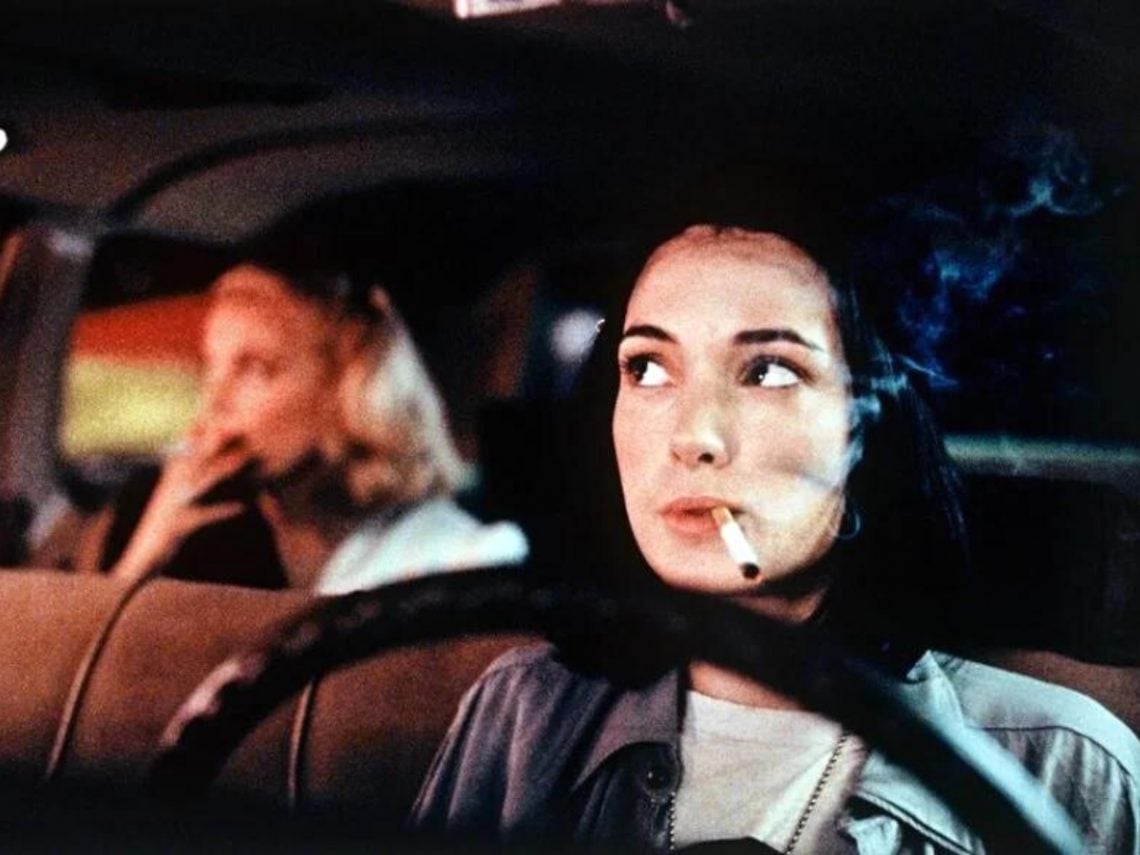
Jim Jarmusch’s innovative portmanteau comedy presents five stories, each involving a cab ride and set in a different city around the world. Ryder plays Corky, a chain-smoking cab driver who drives around Los Angeles in a 1985 Chevrolet Caprice Classic Wagon. When a Hollywood executive (Gena Rowlands) jumps into her cab, she finds herself defending her honest ambitions.
In an interview, Jarmusch spoke about the calming presence of co-star Gena Rowlands and how it helped Ryder, “When I first met her I was nervous because she’s one of my favourite actors on this planet. She is so warm and generous. She puts people at ease immediately. Winona was very nervous too, trembling. But after five minutes it was gone. Gena just has that kind of effect, that kind of warmth.”
4. Beetlejuice (Tim Burton – 1988)
Michael Keaton is fantastic as the titular poltergeist in Burton’s 1988 whimsical and nightmarish film about the undead. It is funny yet menacing and boasts a stellar cast of top actors like Alec Baldwin, Geena Davis, Winona Ryder, and Keaton. The film is a manifestation of a vision that could only come from Tim Burton’s imagination.
“The things that interest me the most are the things that potentially won’t work,” Burton elaborated. “On Beetlejuice, I could tell every day what was going to work and what wasn’t. And that was very invigorating. Especially when you’re doing something this extreme.
“A lot of people have ragged on the story of Beetlejuice, but when I read it, I thought, ‘Wow! This is sort of interesting. It’s very random. It doesn’t follow what I would consider the Spielberg story structure.’ I guess I have to watch it more, because I’m intrigued by things that are perverse. Like, I was intrigued that there was no story.”
3. Heathers (Michael Lehmann – 1989)
One of Ryder’s most beloved roles, this high-school drama stars Ryder as Veronica Sawyer who is part of an elitist clique where all the other girls are named Heather. She becomes enamoured with a rebellious student Dean (played by Christian Slater) but things take a dark turn when he kills one of the Heathers.
The film’s producer Denise Di Novi said: “Winona Ryder is so smart, very brave and unusual. She was this amazing 15-year-old if you can believe it. Winona got obsessed with the script.”
2. Little Women (Gillian Armstrong – 1994)
The fifth film adaptation of Louisa May Alcott’s classic novel, Little Women stars Ryder as the witty and ambitious Jo March. Jo dreams of being a writer and pens plays for her three sisters to perform. Ryder played a big part in making the project happen and even convinced the Australian director to come aboard. The strong ensemble cast includes Claire Danes, Kirsten Dunst and Christian Bale.
Ryder revealed, “It’s actually one of the few movies of mine I don’t turn off when it comes on because I really like it, and it was such a special experience… I was also raised on Louisa May Alcott, so I was thrilled to get this opportunity.”
1. The Age of Innocence (Martin Scorsese – 1993)
An adaptation of the 1920 novel of the same name by Edith Wharton, Martin Scorsese’s historical drama is set in 1870s New York. It follows the courtship and marriage of Newland Archer (Day-Lewis), a wealthy New York society attorney, to May Welland (Ryder) before Archer finds himself caught up in unexpected romantic entanglements. The film won an Oscar for its costume design along with nominations for supporting actress for Ryder, adapted screenplay, score and art direction.
While talking about the setting, Scorsese said, “What has always stuck in my head is the brutality under the manners. People hide what they mean under the surface of language. In the subculture I was around when I grew up in Little Italy, when somebody was killed, there was a finality to it.”
He added, “It was usually done by the hands of a friend. And in a funny way, it was almost like ritualistic slaughter, a sacrifice. But New York society in the 1870s didn’t have that. It was so cold-blooded. I don’t know which is preferable. I grew up thinking in one way, but in my own private life the past 10 years, I’ve started to appreciate the ability to say a little in certain emotional situations and mean a lot.”
