


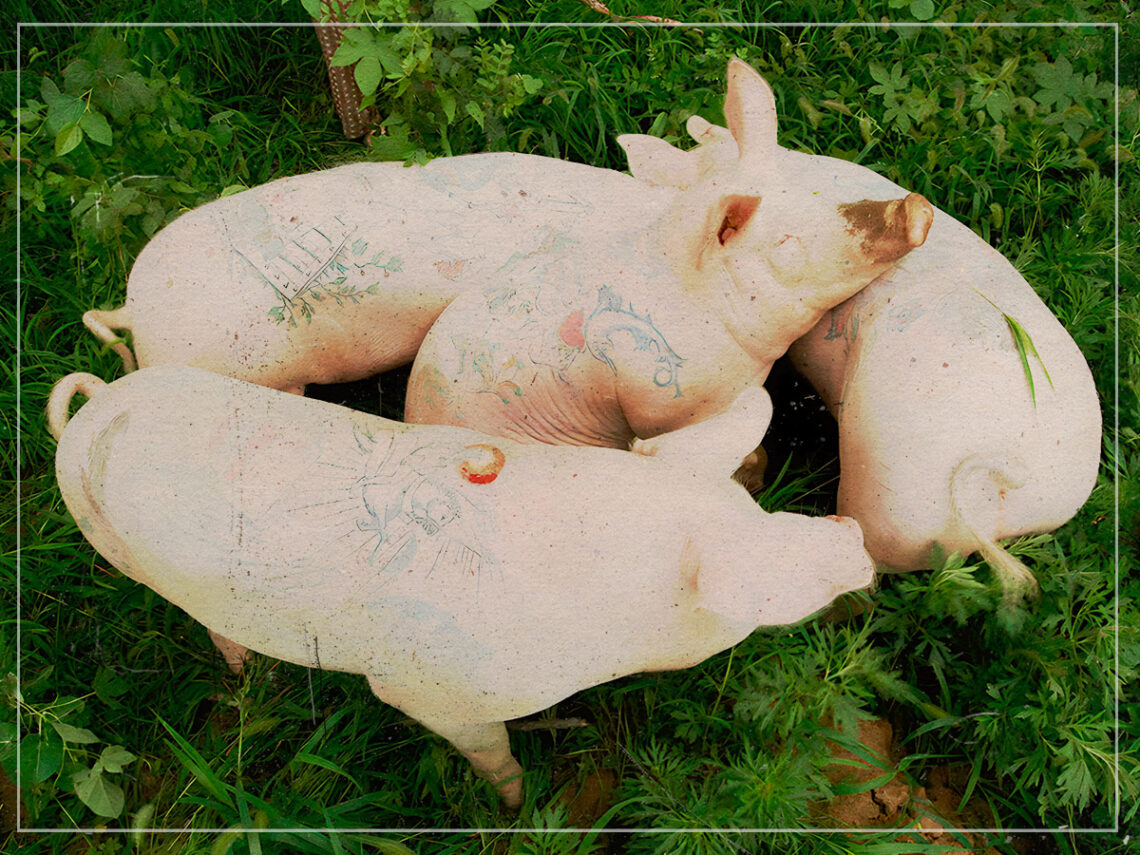
The unique cruelty of Wim Delvoye’s tattooed pigs

According to the handful of sources I’ve recently consulted on the subject, pig skin is, apparently, about as close to human skin as you can get. A few discrepancies and the smell aside, pig skin has proved to be a handy, low-commitment alternative to using a human body if you’re looking to practice tattooing. It goes without saying it’s a fairly antiquated practice, and most tattoo artists have moved on to synthetic skin by now. Conceptual artist Wim Delvoye didn’t get the memo, though, and spent the better half of the late 1990s tattooing live pigs.
Those uninitiated in Delvoye’s work need look no further than Cloaca, his infamous mechanical digestive contraption that turned food into faeces, to get a sense of his want to provoke. The tattooed pigs were no different, an obvious and unnecessary cruelty against a much-maligned animal – contrary to popular belief, they’re quite actually clean and intelligent – and not deserving of permanent branding with Louis Vuitton logos.
Of all the obvious ethical issues in Delvoye’s pig tattooing, what he actually inked on the pigs might seem insignificant, but there was a unique kind of cruelty in his choice of designer brands and Disney princesses, a girly preteen utopia forever etched on the back of a farm animal who was likely highly traumatised by the entire thing. “I prefer to show the pigs alive,” he at least assured. “In a perfect world, I would just show the Cloaca shit machines and live pigs eating and excreting together.”
Born in Belgium, Delvoye took that nightmarish goal across the world, eventually setting up a specialised “piggy bank” in China in 2004. He told ArtAsiaPacific he’d wanted to set up an “art farm” for a while, considering putting together another rendition of Cloaca, but ultimately settled on raising pigs just to tattoo and sell. Hilariously, Delvoye is a vegetarian, so any comparisons to the meat industry are sort of dead on arrival. The allusions are almost too obvious.
At the very least, animal rights activists will be relieved to know the pigs are sedated before they’re tattooed. There are at least a dozen people involved, from farm managers to tattoo artists to fly swatters. “It’s all very costly,” sighed Delvoye, who, in an effort to illustrate how spoiled his pigs are, told a story about insulting his village neighbours by ordering masses of coal to keep them warm: “They couldn’t understand why a guy with a few pig keepers and a flycatcher needed so much coal.”
It’s only when he starts to weigh up the two schools of thought on how a dead pig should be exhibited that you’re reminded of the cruelty of the operation. If he likes the look of a particular tattoo, then he stuffs them, but some prefer flat skins hung on a wall “because you still see bits of the head and legs”. He used to like the look of the stuffed pigs that stood in his landing, but over the years, he came to prefer them sitting down “like a stone lion outside a Chinese restaurant”.
In a very backward way, he makes quite an effective case for the mass mistreatment of pigs – if they’re branded and killed on farms, what difference does a tattoo make? The most bizarre element of his work is that the cruelty of it really doesn’t seem to bother him as much as the worthiness of the pigs to showcase his art. “It’s hard to make something as prestigious as art from a pig,” he mused. “It’s not kosher.”
