


Willy and the Poor Boys: Who were Creedence Clearwater Revival’s alter-egos?

Willy and the Poor Boys sounds a lot like the band of merry, ragtag youths Captain Hook spent his days chasing in Peter Pan, but, as it happens, John Fogerty’s original vision for Creedence Clearwater Revival’s fourth album wasn’t far removed from that image: a jug band of street musicians, knocking out songs on a washtub bass and washboard.
By the autumn of 1969, CCR was fast becoming one of the most popular rock bands in the world, having already scored three consecutive number two singles and a number one album with Green River, performed at Woodstock earlier that year, and capped it off with appearances on The Ed Sullivan Show in November, where they played both ‘Down on the Corner’ and ‘Fortunate Son’.
Their pace seemed to be relentless. In 1969 alone, CCR released three full-length albums while continuing to tour almost constantly, a level of work ethic which has only been matched post-millennium by that of King Gizzard and the Lizard Wizard.
Looking back, drummer Doug Clifford was less than convinced this level of output was sustainable, explaining to Goldmine in 2013, “That was a bit of overkill, and I never did understand that. Fogerty told us that if we were ever off the charts, then we would be forgotten… To make it worse, it might sound funny, but we had double-sided hits, and that was kind of a curse, as we were burning through material twice as fast. If we’d spread it out, we would not have had to put out three albums in one year.”
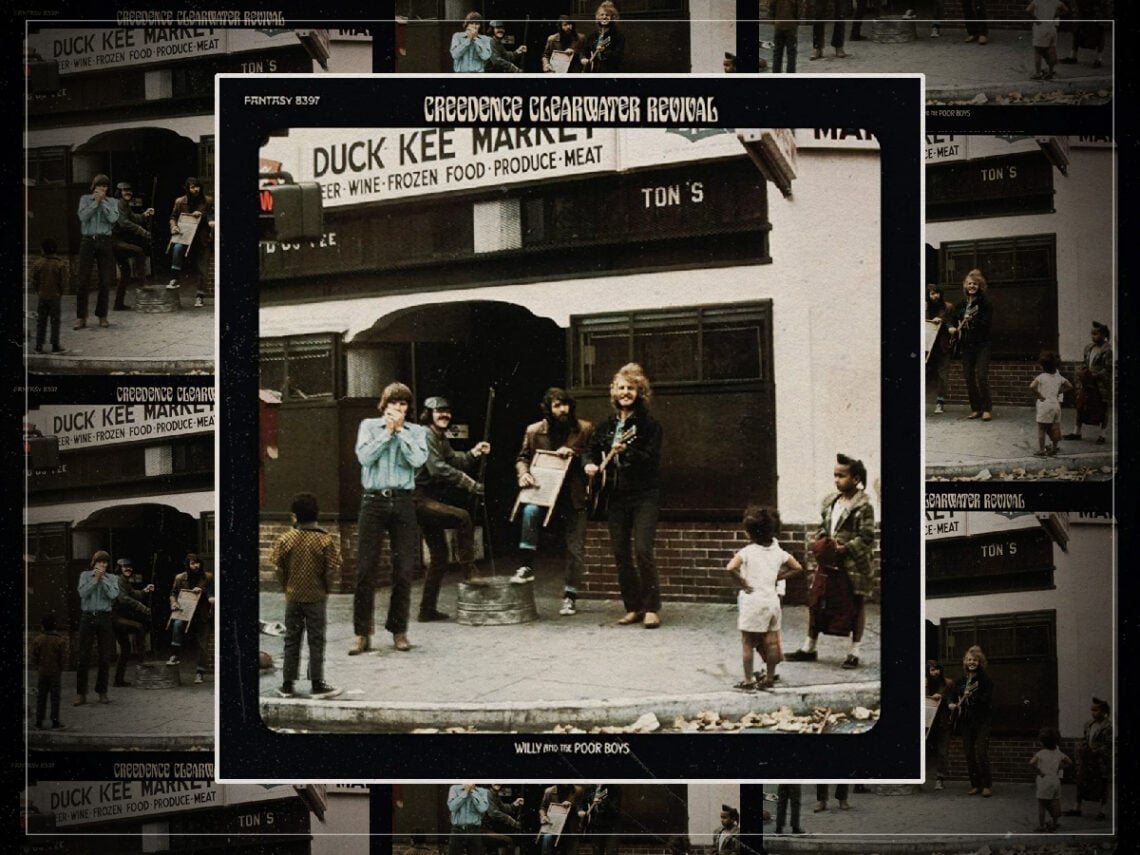
The third of those albums was Willy and the Poor Boys, which initially, Fogerty planned to use to fully embrace the concept introduced in ‘Down on the Corner’, with Creedence assuming the identity of an old-time jug band called, you guessed it, Willy and the Poor Boys.

“Rooster hits the washboard/ and people just got to smile/ Blinky thumps the gut bass and solos for a while/ Poor boy twangs the rhythm out on his Kalamazoo/ Willy goes into a dance and doubles on kazoo/ Down on the corner, out in the street/ Willy and the Poor Boys are playin’/ bring a nickel, tap your feet,” sings the band, making for some simple, youthful, joyful music that’s impossible to listen to without cracking a smile.
In the end, the Poor Boys concept didn’t carry through the entire album, only surviving beyond ‘Down on the Corner’ via ‘Poorboy Shuffle’, where Stu Cook reprises his washtub bass, Clifford his washboard, and Fogerty his guitar, coming together in a loose, ramshackle jam behind Fogerty’s harmonica.
The concept is also revisited on the album’s cover, where the band is pictured performing on a street corner to a decidedly small audience outside the Duck Kee Market, with the location holding no deeper meaning than it simply happened to be half a block from the recording studio, to the point where Fogerty recalled only setting foot inside the shop once, and that was after the album had already been released.
The Willy and the Poor Boys persona did suit Creedence perfectly, though, as they were a plaid-shirted, no-frills band who had paid their dues long before success arrived, and their music reflected blue-collar roots forged in Oakland, California, with songs like ‘Fortunate Son’ railing against privilege and the Vietnam draft, while ‘The Working Man’ chronicled the grind of everyday labour.
Drawing from rock, blues, and country, their raw, roots-driven sound stood apart from their psychedelic peers, resonating instead with everyday Americans, and in the process, Creedence became unlikely bards of the working class, singing of small towns, traditional values, and ordinary struggles during one of the most turbulent periods in American history.
That spirit was later recognised by Bruce Springsteen when he inducted the band into the Rock and Roll Hall of Fame, saying, “Creedence Clearwater Revival…were progressive and anachronistic at the same time […] An unapologetic throwback to the golden era of rock ‘n’ roll, they broke ranks with their peers on the progressive, psychedelic San Francisco scene. Their approach was basic and uncompromising, holding true to the band members’ working-class origins.”
