


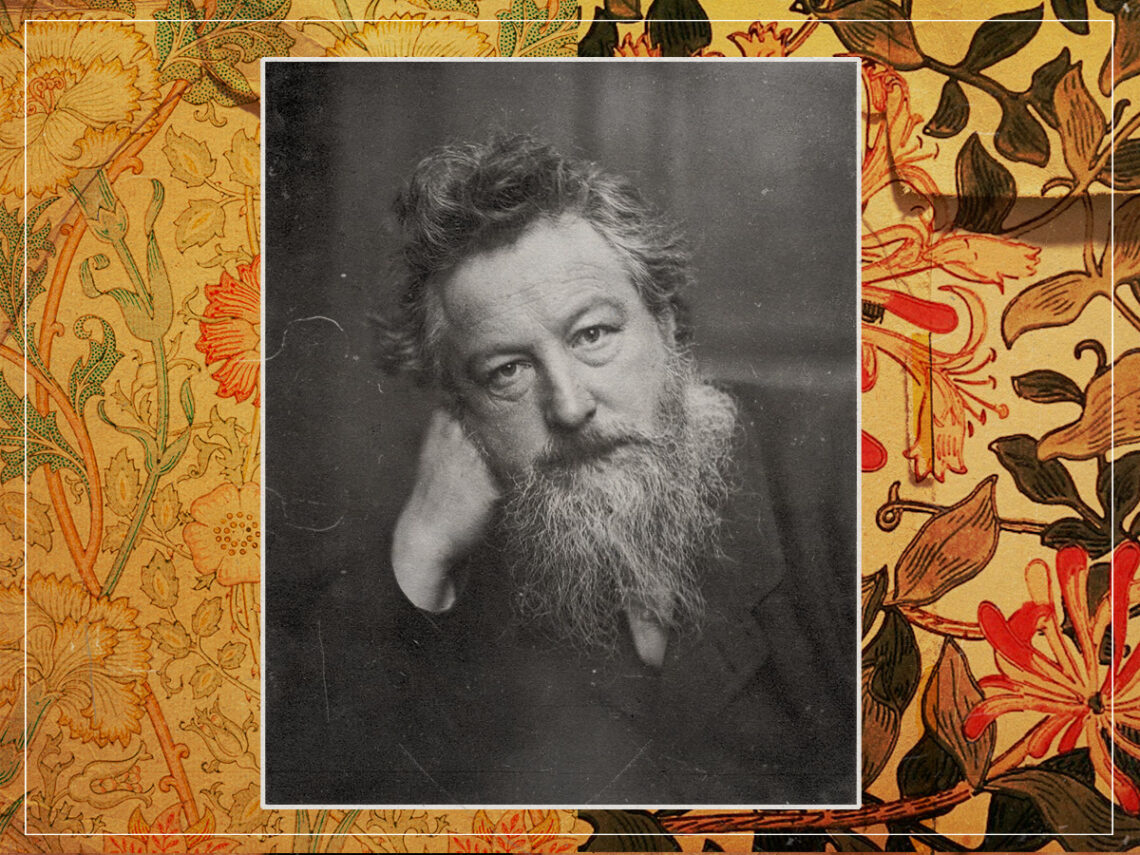
William Morris and the wallpaper revolution

When William Morris was 16, he staged a tiny revolt against the industrial arm of Machine Age design by refusing to go inside the 1851 Great Exhibition. It might have been the earliest indicator he was a born purveyor of taste and the man who would one day conceive of the iconic line: “Have nothing in your houses that you do not know to be useful or believe to be beautiful.” Morris’ rally against industrialisation revived British textile art in such grand fashion that his influence can be felt across most rolls of floral wallpaper you’ll find today. A fierce socialist, he democratised beauty, bringing class consciousness to his swirling Art Nouveau prints.
His awareness of class issues was shaped by friendships formed with “The Brotherhood”, a set of Oxford students who read John Ruskin and Thomas Carlyle and could discuss pressing societal problems with the same ease they could recite Shakespeare. Morris, who was the most well-off member of the group, deeply resonated with Ruskin’s writing – adopting a stance that championed handcrafted goods in favour of the increasing push for mechanically crafted ones.
Morris worked briefly under a Neo-Gothic architect but showed little promise or talent and was instead preoccupied with making the Oxford and Cambridge Magazine to showcase the Brotherhood’s writing. After eight middling months studying architecture, he left to pursue art. His connection to Dante Gabriel Rossetti, a towering figure of Pre-Raphelite art, meant he was soon working alongside him decorating Oxford murals.
In 1860, he and his wife Jane moved into what became known as the Red House, and it was the first significant decorative project Morris undertook. With help from friends, he covered the interior in wallhangings and paintings, finding joy in the collective effort and returning to handmade art. When Morris, Marshall, Faulkner & Co was established, they set about creating the kind of work they’d produced for the Red House.
Two commissions helped bring that vision to life – one for the South Kensington Museum and one for St. James’s Palace. They allowed Morris the financial freedom to start producing his first iconic wallpapers, all made by hand and inspired by historic printing methods. That early period of experimentation set the benchmark for his later career.
In the following years, he became the sole director of the newly named Morris & Company and hand-designed 32 printed fabrics and 21 wallpapers, as well as a host of embroidery and tapestry designs. He even moved locations to Merton Abbey, building a workshop big enough that workers were able to expand upon existing methods of carpet weaving and tapestry – boosting the industrial scale without compromising the artistry.
Morris’ ability to do those things simultaneously sustained the Arts and Crafts movement from the 1880s up to the beginning of the First World War, and his floral designs wove their way across the globe – highlighting the universal appeal of accessible, ethically made designs.
