


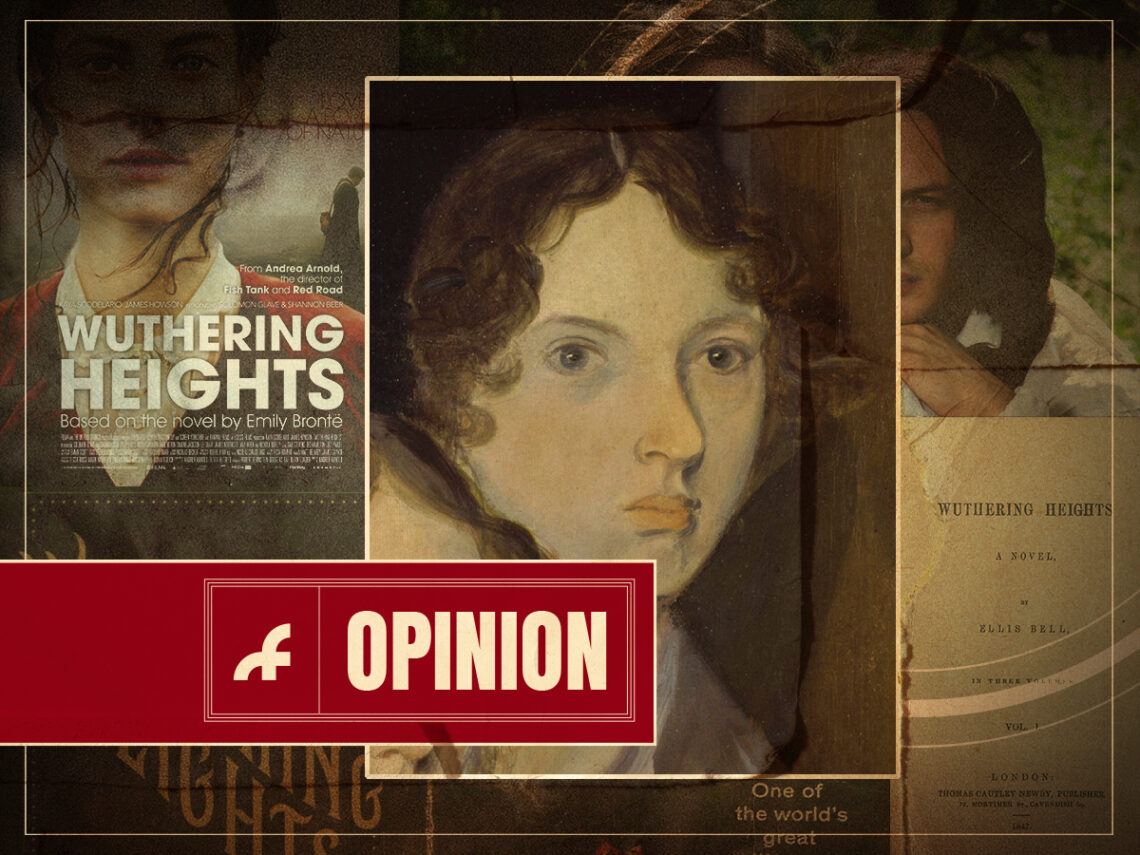
Why does ‘Wuthering Heights’ feel like an unadaptable novel?

A few years ago, I attended a production of Wuthering Heights that was so poorly executed that people actually walked out. During the interval, the bar was filled with loud conversations from the remaining audience members, all wondering what had gone so wrong. The accents were off, the imagery felt clichéd, and the characters seemed utterly lost. Those of us who stayed were met with an abrupt ending, well before the final third of Emily Brontë’s novel, leaving the room in a state of confused silence, followed by a hesitant, half-hearted applause. Later, over drinks, my friend and I tried to pinpoint the issue, but we could only come to one conclusion: Wuthering Heights is an unadaptable text.
That adaptation, along with all the other weak efforts like Andrea Arnold’s 2011 attempt with Kaya Scodelario turning Cathy into Effy Stonem or the 1939 take with Laurence Olivier that fully eliminated half of the story, didn’t – or simply couldn’t – keep up with the original 1847 text. It’s incredible, given that centuries have passed since its publication, that no one seems able to manage to capture the gothic classic in moving image. Now, all eyes are turned to Emerald Fennell as she steps up to the plate to try, but its success already feels rocky.
Instantly, Fennell has fallen into the trap that other adaptations have before. Margot Robbie and Jacob Elordi have been cast as the two leads. That means two of Hollywood’s most attractive figures will be attempting to play classically rugged and rural characters from Yorkshire. Also, importantly, white Australian Elordi will be playing Heathcliff, a character of unknown origins but whose entire treatment hooks onto his outsider status caused by his race. He’s described as “a dark-skinned gipsy” or “a little Lascar, or an American or Spanish castaway”. Falling at the first hurdle of casting doesn’t spell success.
But this conversation perfectly highlights why Wuthering Heights feels so unadaptable; people become fixated on one thing and neglect another. The classic novel is an incredibly adventurous tale at 416 pages long with a plotline that spans generations. The story cannot be easily summarised. It’s a tale of love, class, race, generational trauma. It’s a ghost story but also a deeply common story of forbidden love during the Victorian age, meaning it has to try and navigate both supernaturalism and realism. The characters, in order to carry off such a hefty story, are complex. Cathy, the central figure, has to be both likeable to allow the love story to work but then weak-willed and somewhat unsympathetic to keep Heathcliff as an anti-hero rather than a villain. It’s crucial that there’s a level of support for his character despite his evil streak, but that can only be done if the love story and Cathy are done right.
It’s a delicate cycle. Beginning with Cathy and Heathcliff as children and ending with their own children, this intricate and complex story only works if everything moves together perfectly and if everything is given exactly the time, care and attention that Bronte put into it.

Focus too much on one thing, and the rest collapses. That’s where other adaptations have fallen down. The 1939 version axed the whole plotline relating to the younger generation, essentially making Healthcliffe’s evil deeds pointless and his character somewhat pathetic. The 2011 version cared too much about Cathy’s conflict, making it feel stunted. The stage adaptation I saw cared too much about the setting and the pair’s early relationship, which, although important, left no room for the plot to be fulfilled in the thorough nature it requires. It’s difficult as Wuthering Heights is simply a long book with a lot going on, but maybe that’s why no two-and-a-half-hour film could ever hope to tackle it.
Also, there’s the argument that maybe they shouldn’t try. The beauty of Wuthering Heights, and why it’s endured as a beloved classic, is Brontë’s writing. Despite being a gothic novel, it houses some of the most incredible monologues ever penned on the topic of love. “My love for Heathcliff resembles the eternal rocks beneath a source of little visible delight, but necessary,” Cathy declared, “Nelly, I am Heathcliff! He’s always, always in my mind: not as a pleasure, any more than I am always a pleasure to myself, but as my own being.” This, along with the countless other passages of poetic prose, don’t feel like lines that quite work when read aloud. They crumble into melodrama off the page somehow if they’re not handled right. But with so much beauty in the book, there’s certainly a point to be made that maybe people should just read it instead.
However, Fennell’s role in the project feels slightly hopeful. Saltburn felt like her own take on a gothic novel, complete with uncanny happenings, creepy butlers, class commentary, grand houses, and the works. She also managed to tackle desire and devotion with the same eerie and obsessive edge that Wuthering Heights has. As Heathcliff declares, “Catherine Earnshaw, may you not rest as long as I am living. You said I killed you–haunt me then,” in the hopes of keeping his lost loved one around him, it doesn’t feel too dissimilar to Oliver’s sinister lust for Felix, or Felix’s life.
But even then, it begs the question of why do it again? When Saltburn saw her master the gothic genre and essentially write a story close to the world of Bronte’s own, why go in for seconds? There’s no doubt that Fennell will be able to handle scenes like when Heathcliff digs up and crawls into Cathy’s grave with a glamorous yet gruesome edge. But when she already had Barry Keoghan do that at its shocking best in the infamous grave scene, why do it again? What’s the point of Fennell doing an adaptation when her own original already feels like a great take on the classic? And do we really need an adaptation of a story done so perfectly while still feeling so rich and engaging in its original form? It’s an exercise in futility.
