


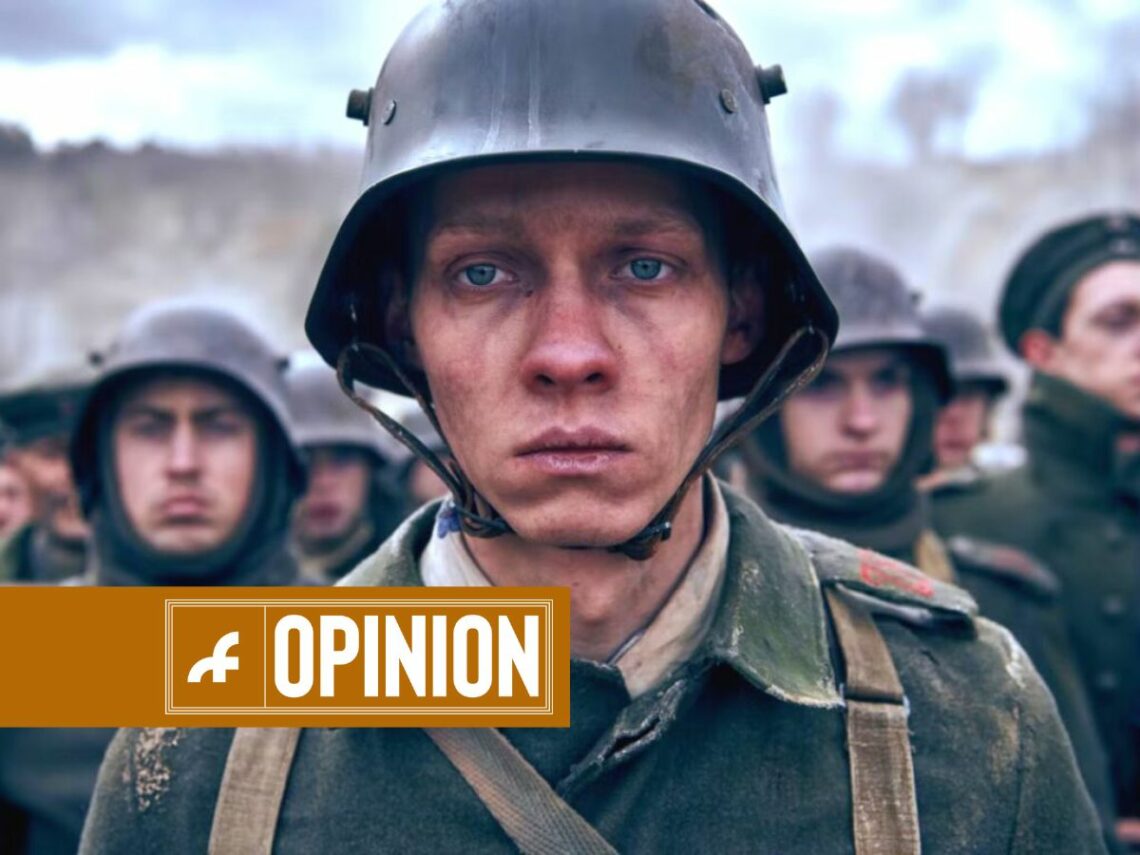
Why do war movies make the perfect Oscars bait?

As Western cinema’s most prestigious and highly held accolade outlet, the Academy Awards remain the ultimate prize for film, with many cinematic contributions aching for a chance to be nominated. The Oscars have offered the opportunity for a ‘Best Picture’ win to 591 features, with 94 being crowned and residing as the most significant accomplishment for their respective creators.
Ostensibly, the awards celebrate the best on show from across the board. However, it often becomes apparent that even this wide arbiter has its own inherent level of bias, and certain genres of film attract far more attention than others.
To elaborate, a recurring feature on the Academy Awards nominations list is the war movie, a historical drama showcasing the brutal and emotionally harrowing battlefield of either World War I or World War II. War films find a way into at least one Oscars category each year, suggesting a long-standing and sacred dynamic between the cinematic genre and the award outlet. These nominations include the significant ‘Best Picture’, ‘Best Cinematography’ or ‘Best Editing’, with the occasional ‘Best Actor’ for the star who gave an emotionally charged performance in a soldier costume.
This year, Edward Berger’s All Quiet on the Western Front, a visually brutal and thematically emotional depiction of WWI, has racked up nine Oscar nominations, including ‘Best Picture’. In 2020, Jojo Rabbit, directed by Taika Waititi, and 1917, directed by Sam Mendes, were two war movies that racked up the Academy’s interest. The year before that, Christopher Nolan’s Dunkirk was a favoured addition to the Oscars, with Mel Gibson’s Hacksaw Ridge appearing the year before.
So why is it that war films are always viewed favourably by the Academy? I propose it’s what their execution, context and effect entail in the grand scheme of Oscars bait, meaning the Academy Award manifesto favours the genre’s style and subject matter. First, the Academy adores turmoil and dispairs as credentials to its holy manifesto. What’s more distressing, draining and dire than some of history’s most tragic catastrophes that saw millions of innocent people lose their lives?
When a director utilises this historical context and executes it against high-budget camerawork, shots of soldiers crying and bodies dropping as corpses edited together with the sounds of gunfire and screams, an Oscar nomination follows like clockwork. The Academy values such upsetting imagery as a whole; the backdrop of war’s tragedy only elevates this as it signals society’s emotional investment in such historical events.
Speaking to Awards Watch, 1917 director Mendes shared his belief that his cinematic presentation of WW1 offered something diverse to the genre. According to Mendes, it’s not just in its award-winning cinematography, as the whole film was edited to appear as one long shot to display the power of cinema as visual storytelling, but also within its plot synopsis of characters avoiding battles. “I don’t think there are many war movies that are about people trying to stop fighting, rushing to stop fighting. I don’t think you ever start by thinking, ‘I’m going to redefine a genre.’ You avoid the big statements,” the director explained. “What you want to do is tell a story where the central characters are vulnerable in some way.”
In terms of effect, war movies make the viewer emotional because they remind us of a horrific real-life event. Those characters aren’t actually fictional, but represent every soldier who gave their life in the fight for freedom. The Academy reacts with award nominations just as much as audiences respond with sympathy and a unified sense of loss and grief.
Essentially, war films residing as ultimate Oscars bait proves how historical context and traumatic imagery are potent tools in filmmaking. However, as war features focus on one event, once you’ve watched one World War film, you’ve watched them all. It’s the exact same story every time, and I perceive them as neither good nor bad in theory.
Despite this, the subject matter is so solemn and sobering that it garners critical respect every time, regardless of whether the film brings anything new to the genre. But imagine if an original story like Damien Chazelle’s Whiplash or Steven Spielberg’s Jaws was remade and re-hashed every year and still received Academy nominations and wins. It immediately reads as strange or exhausting to think about because the historical context is not there to outweigh the repetition.
Despite this restatement, war movies are always showered in nominations by numerous award outlets out of respect for those who gave their lives on the battlefield. It is more of a nod to that suffering than the films. These figures will live on in cinema as long as the Oscars carry on, with filmmakers negotiating the initial intention of paying respect to those who fought in the World Wars with the easy route towards winning an Oscar.
