


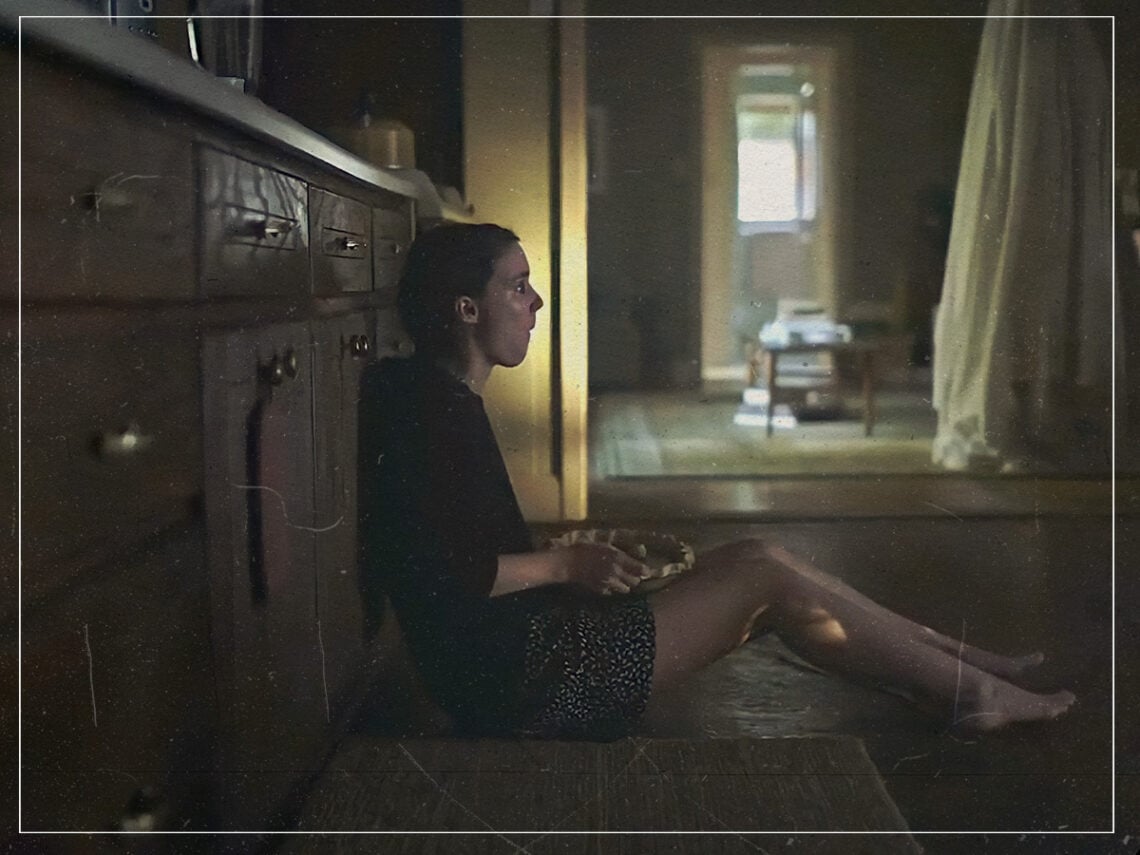
Why the pie scene in ‘A Ghost Story’ is one of the finest cinematic depictions of grief

Grief is a concept so thorny, looming and existential that it is often either mishandled or entirely brushed over in cinema. Actors may weep a thousand well-acted tears, and a score may wish the audience into an incapacitated emotional heap, but grief is so often experienced as a quieter, more empty experience, portrayed well in Ari Aster’s Hereditary when Peter reflects on the death of his sister, or in A Ghost Story by David Lowery, where Rooney Mara’s M finds herself emotionally paralysed by the tragic passing of her lover.
Released to a surprising lack of fanfare in 2017, Lowery’s supernatural indie drama followed the relationship of a couple named C and M, which is put to the test when they escape to the country. Yet, shortly after this life-changing decision, C, the man who was reluctant to flee from the city, dies in a car crash, with the rest of the film being an ethereal expiration of the love and legacy we leave behind after death.
C, played in the first act by Casey Affleck, becomes the most stereotypical spectre possible following his accident, donning a white sheet with oval black eyes. Mute, he watches his lover’s life continue in spite of his death. The result is a haunting existential horror that prefers to prod you with ruminations of the torment of the afterlife rather than force out a momentary squeal with a well-time jump scare.
One of the most evocative sequences comes when M, in a moment of numb grief at the loss of her lover, sinks to the floor of her kitchen and eats a whole pie while the spectre of her departed partner watches helplessly on. An interrupted shot that lasts almost four and a half minutes in total, this poignant moment speaks to the almost surreal, eerie silence left in the wake of someone’s passing.
Alas, death comes with the twilight of every day and is as normal as the sprouting of a springtime seed, yet it is how casual life continues following the passing of someone close that makes their life entirely profound. There is a still, steady solitude in the wake of death, but there is also a weight so pervasive that it sinks your stomach and drowns your soul, with few cinematic moments better reflecting this than watching M quietly demolish a pie.
Though lasting just four minutes, the scene seems to hold for eternity as time slows, forcing the viewer inward, considering every passing second as we explore the space between M and the ghost of her beloved. He might be gone, but the gravity of his presence can still be felt, with this mirrored in the physical manifestation of his ghost, watching her with eyes from the liminal space between the living and the dead.
“I find long scenes like that both peaceful and meditative, but also uncomfortable,” Lowery told ADAMIC Radio, speaking directly about the power of the scene. Putting the audience in the position of a voyeur, he adds: “I wanted the audience to feel as if they were seeing something that shouldn’t be seeing…I wanted the passage of time to be very palpable and for audiences to be very aware of it and to perhaps push back against it you…it breaks you down, and you start to understand time in a different way.”
Grief is, indeed, a lot like love, wherein it’s difficult to describe its grip until you’ve been through its many trials and tribulations. After all, you can’t have one without the other.
