

The 25 greatest Fender guitar players of all time
Read More


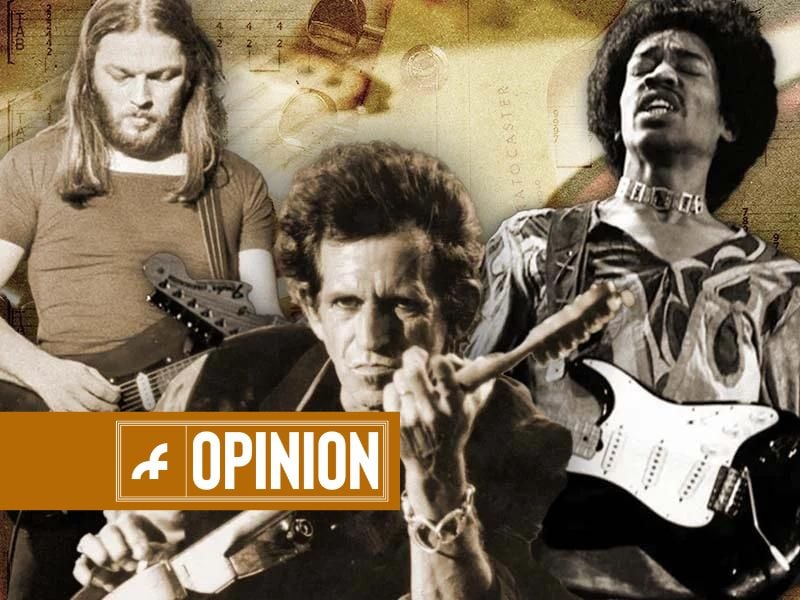
For an age now, there have been two main names in the world of guitar manufacturing: Fender and Gibson. Whilst both have produced numerous iconic models that are the most ubiquitous within the business, it is safe to say that this age-old derby has been dominated by the company founded by Leo Fender.
This statement is not meant to disregard the work of Gibson, as it certainly has its place right in history, with some of their most iconic models such as the Les Paul, SG, ES, and the myriad of acoustics such as the Songwriter helping to create some of the best-loved music in existence. However, it is Fender models that have managed to find themselves in the arms of a much greater volume of significant musicians, thanks to their sonic and aesthetic appeal.
For seemingly an age now, Fender has had every base covered, which is why the company is so omnipresent and equally as cherished. For instance, there’s a reason why the Stratocaster has solidified its presence as the industry standard. One glaring factor is the variance in tone a user can get from its three single-coil pickups, with the warm neck and more metallic bridge positions symbolising stylistic opposites. It means that a user can switch from the bite of rock ‘n’ roll or punk style of playing to the heady hues of jazz in an instant.
For this reason, the Stratocaster is the ultimate Fender model, as any artist can pick it up and obtain the sound they desire. Putting it into perspective, George Harrison, Wayne Kramer, David Gilmour, Billy Corgan, Jimi Hendrix, and John Frusciante are just some of the most eminent adherents of the model, with all having very different techniques and tones, showing the wide berth that it covers.
Whilst Gibson’s most popular model, the Les Paul, has also given some of the most iconic musicians their sounds, such as Slash, Jimmy Page, Mick Ronson, and Mick Jones, the sound one can get from their two humbuckers or P-90s, depending on model, is no way near as versatile as The Stratocaster.
This difference can also be found in the realm of basses, with the clank of Fender’s Precision bass much more popular than the SG bass or Thunderbird. As well as the Stratocaster, Fender has produced the Telecaster, which is almost as ubiquitous as its three-pickuped sister and is played by the likes of Keith Richards, Jim Adkins, Denny Dias, Bruce Springsteen, and Tom Morello, as well as a host of other country, blues, and indie musicians. It’s even made its way into metal over the past two decades, with Slipknot’s Jim Root boasting a signature model, reflecting just how far Fender’s influence extends.
Arguably, the main difference between Fender and Gibson comes down to what Fender has to offer, and nowhere else is this more evident than in the other models that they have produced that are far more popular than those that their American rival has delivered.
The Jazzmaster, Jaguar, Mustang, Jag-Stang, and even other newer models such as the Meteora not only appeal to a wide variety of people but also offer quality, despite being mass produced, and unfortunately, this is something that cannot be said for Gibson, with the quality of their guitars dropping considerably over the years. Then again, you also have the sound, with the Jazzmaster and Jaguar being arguably the two most versatile guitars in existence, with their tone pickups and tone controls stretching further than that of the Stratocaster.
Added to this is that this widespread quality has meant again that more guitarists find themselves turning to Fender as sonically, aesthetically, and in terms of quality, there is simply so much more on offer. To put it into perspective, there’s a reason why alternative rock practically hinges on Fender, and that is because the genre, which is one of the most multifaceted on the planet, can turn to Fender time and time again. Its main figures have used models that are real workhorses as well as sonic wonders, and they, such as Sonic Youth and Kurt Cobain, push these axes to their limits by their own invention, and it’s a testament to their guitar’s quality that they never buckle under the pressure of such genius. In many ways, Fender guitars are the real athletes of the guitar world, and it’s a reputation it would take a lot to spoil.
There’s another key reason why Fender has always stood out, of course, which is how the company looks after its customers. Fender policy reacted to falling relevance at a couple of points over the years, such as the period of the 1980s when hair metal was its pomp and managed to re-establish itself as a company by the players and for the players. This is exactly why there are many different models of electrics, basses, and acoustics on offer – each one presenting different specialities.
Hence why there are numerous artist signatures, as well as hybrids such as the Player Stratocaster, which employs two single coils and one humbucker, accounting for different players’ requirements. Reflecting this in 2018, Fender released the Parallel Universe series, which brought models to life that many people had long dreamed of, such as the Fender Jazz Telecaster, which was complete with a rosewood fretboard, Jazzmaster pickups, and a floating tremolo system – mixing two of the company’s most treasured models into one hell of a hybrid that is now highly sought after.
This is why some of the best music is made on Fender guitars. There’s an appeal to every player of every walk of life, a factor that means Fender’s catchment far surpasses that of Gibson, known primarily as a rock or metal brand. Name any genre, and Fender will have given the sound to some of its most lauded figures, indicating just how brilliant they have been at being exhaustive in what they deliver. They’ve carved out such a monopoly that it seems impossible that they will ever not be at the top of the pile.
