


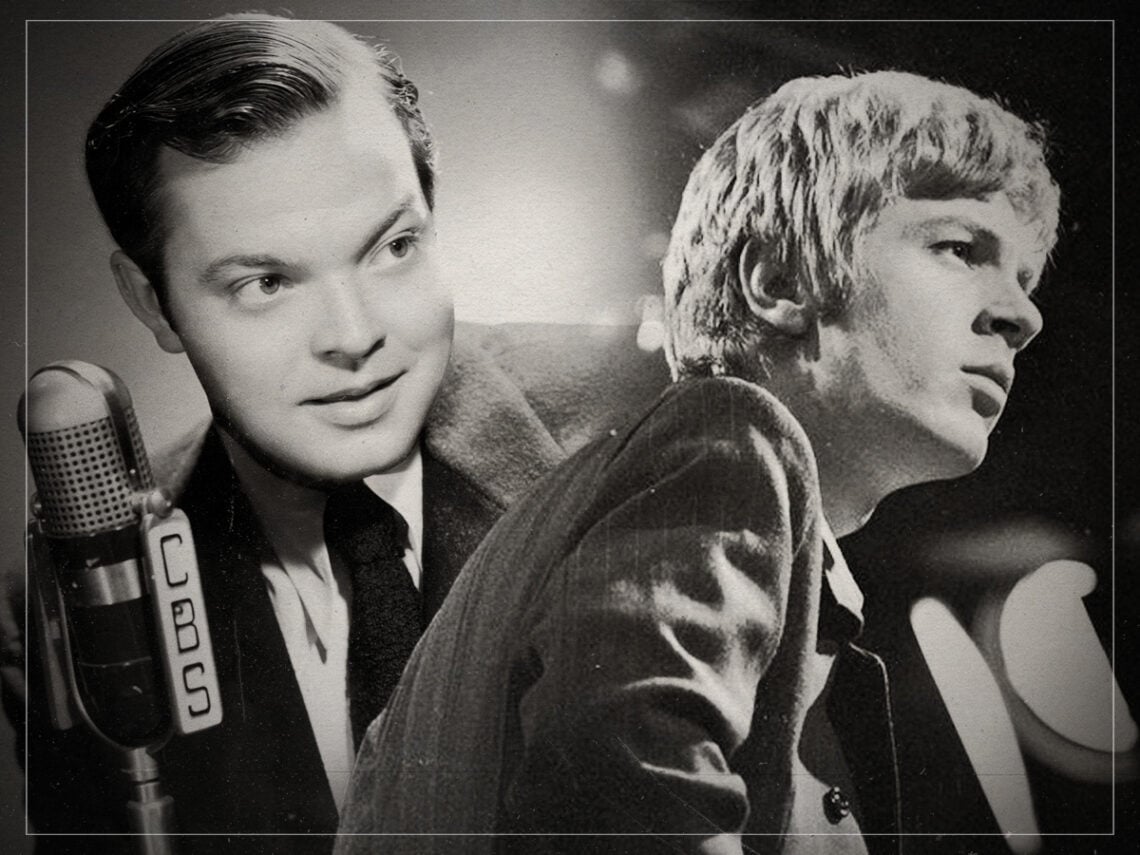
Why Scott Walker called himself the “Orson Welles of the record industry”

By the time they notched their second UK number one single with 1966’s ‘The Sun Ain’t Gonna Shine Anymore’, the Walker Brothers looked increasingly like a covert CIA operation, a counter-attack on the British invasion that had already taken over the pop charts in the States.
Despite crafting a string of gorgeous chamber-pop songs in a similar spirit to the Righteous Brothers, the LA-based Walkers remained oddly obscure in their home country, as if their sole purpose had been to woo the young romantics of Britain. As another similarity to the Righteous Brothers, none of the Walkers were actually siblings, nor were any of them named Walker on their birth certificates. This was explained away as simple showbiz theatrics, but they might as well have been secret identities.
As sometimes could happen with a secret mission in the 1960s, though, one of the agents started to question his assignment, losing sight of where the alias ended and his own legitimate self-expression began. Originally, Scott Walker (born in Ohio in 1943 as Noel Scott Engel) told reporters that he “would rather quit” music altogether than leave the Walker Brothers and go solo.
“Mentally I have a lot of trouble coping with the pop business as a member of a group,” he said, “I would never be able to cope as a solo singer.”
Of course, by 1968, the first Scott Walker solo album was in shops, but his prediction hadn’t been entirely wrong. Two words would consistently follow Walker over the next 40 years of his career: “genius” being the nice one and “difficult” being the equaliser. With his complete disinterest in chasing chart hits, Scott quickly shed a lot of his original fan base from the Walker Brothers days, but a whole batch of other listeners were mesmerised by the Panavision scope of his poetic, introspective, and increasingly ambitious records.
Even a lot of producers and record executives appreciated that Walker was operating on a higher frequency, and hoped they might be able to marry his levitating creative talent with a game plan closer to the ground, more like his original pop mission. Just about all of them learned that Walker was not a compromising participant anymore.
Speaking to the Eastern Evening News in Norwich back in ‘68, Walker talked about his younger days as an aspiring singer; how he’d left LA because of the “boring Hollywood hippies”, but then also regretted going to New York, where he became “cynical of everything and everybody. I’ve stayed that way, and that’s half of why many people don’t like me today”. As a 25-year-old, Walker said the idea of failing in his solo venture would destroy him: “I’d quit and go wandering off into obscurity forever”.
Once again, he was half correct. When some of his best efforts confused critics and went unnoticed by the public, Walker did disappear for extended periods, but he always came back, often wooed by the musicians he’d inspired, though he was rarely great at connecting with them.
In the ‘80s, his label tried to get him in a studio with heavy-hitting producers Brian Eno and Daniel Lanois, but an initial meeting soured quickly. “I didn’t like the studio anyway,” Walker told the Independent years later, “It was way out of town, and, I don’t know, it transpired that it became an irritation”. The driving motivation for Scott Walker wasn’t really suited to the rock and roll space; he was more of a painter obsessed with finding a new technique, or a Hollywood director with an auteur’s vision, hemmed in by businessmen and budgets.
“I’ve become the Orson Welles of the record industry,” Walker said in 1995, referring to the man who directed Citizen Kane, only to have his follow-up, The Magnificent Ambersons, hijacked and re-cut by his studio, explaining, “People want to take me to lunch, but nobody wants to finance the picture”.
