


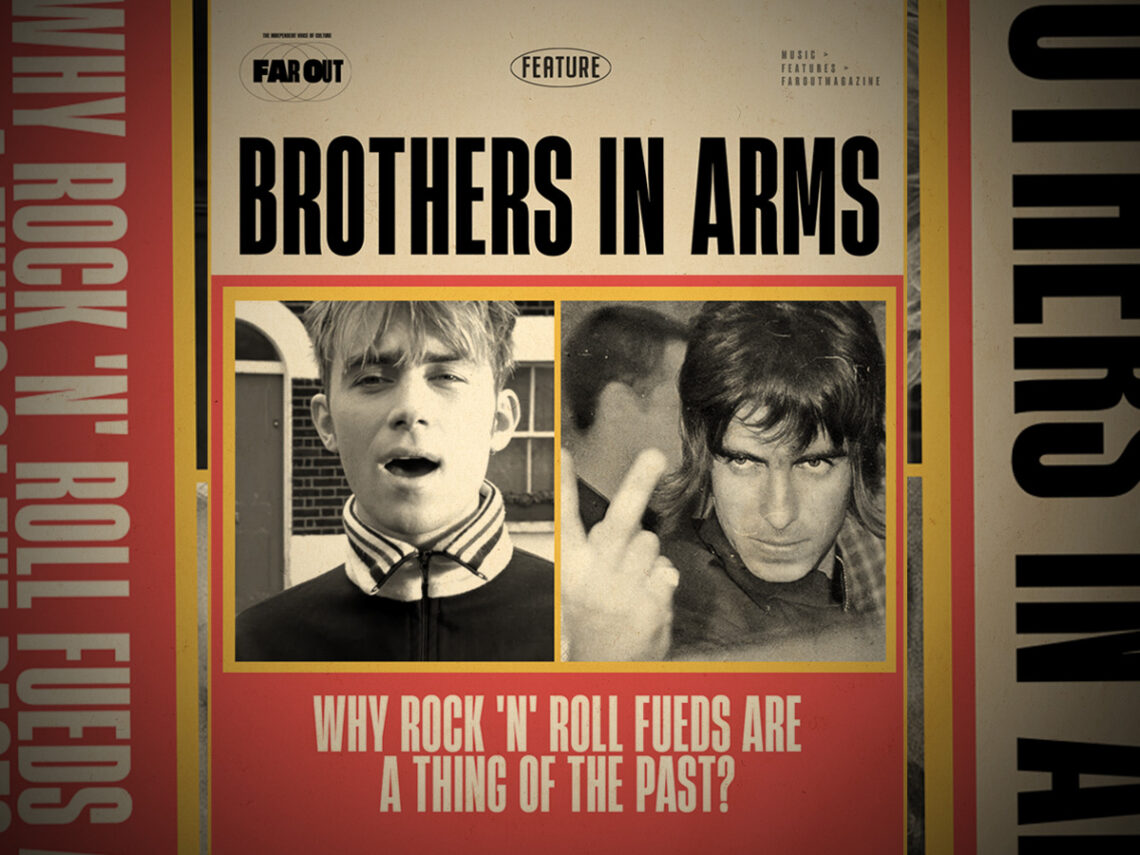
Why are rock ‘n’ roll feuds are a thing of the past?

A question for all those who lived through the Britpop era: Did you actually enjoy the Oasis versus Blur drama? With the beauty of retrospect, to me, it all just felt salacious nonsense driven by the labels to increase sales.
That was seemingly the primary benefit of the whole ordeal, besides maybe a slightly increased level of exposure for each respective band. But then, that felt wholly damaging to the possibility of any nuanced conversation on the topic.
This was particularly the case for Blur, who were unfairly bundled in with Oasis simply because of their age and presentation. They, too, were an outfit of 20-somethings heavily strapped with electric guitars, but realistically, their music had no right to be compared to Oasis’ hearty brand of indie rock.
However, everything but the music made these two bands perfect enemies, pitted against one another by the marketing powers that be. North vs South, arrogance vs timidness, salt of the earth vs high brow: it was indeed a battle that could be thrown over the entire UK society as a means of dividing them.
Then again, the midst of Blur and Oasis’ rivalry is what many would consider the last peak of British alternative music. Indie heads would claim that, since those days, guitars have been in steady decline and waning in popularity. So maybe, the salacious drama is a necessary evil for good old-fashioned rock and roll to flourish?
Let’s really assess whether this broken world needs a feud. Who would be the fitting candidates for such a rivalry? Well, two such bands step forward for two reasons. The first is reserved for those who earnestly listen to their respective music and would find and compare genuine similarities within both the bands’ timelines and sonic approaches. Then there were those with callous marketing intentions, who would focus merely on the shared appearance of two male, white, five-piece bands. I’m talking about Fontaines DC and Idles.
Once the ridiculousness of the latter is put aside, the more respectable similarities are drawn. In 2019, they were both nominated for a Mercury Prize—Fontaines DC for their debut, Dogrel and Idles for their sophomore record, Joy as an Act of Resistance. Those records combined ushered in a new era of “post-punk”, if you will. Riding off the back of post-Brexit Britain, while Irish, Fontaines DC’s record was widely consumed in Britain, showcasing an appropriately jagged sound, laced with articulate violence that spoke to the disillusioned, and waved goodbye to the ignorant bliss of 2010s’ indie.
Thereafter, the bands climbed up every festival bill, releasing albums along with it that spoke to this growing zeitgeist. Idles arguably followed Blur’s lead, delving into a space of experimental density while Fontaines DC led with the heart of Grian Chatten, galvanising the masses with their poetry.
So far, fans weren’t made to choose. They could enjoy the parallel but contrasting brilliance of these two bands, exclusively, until June 28th, 2024, when both headlined Glastonbury’s Friday night on two separate stages. Critics softly billed it as the battle we had all been waiting for, where fans were given an ultimatum by which they would always live by: Who would come out on top?
Quite frankly, neither. The evening shared its riches and gave to them both equally. Sure, Idles may have conquered the bigger stage, but Fontaines DC laid the foundations for what has since been a bigger album campaign.
But none of this truly matters, because I ask again, does music right now really need rivalries? With a continued effort to systemically silence any musician speaking out against these atrocious war crimes and a genocide that has claimed 59,733 victims and is ongoing, artists are rightly banding together to protect the sanctity of expression and continue using their art to make necessary criticisms of what is becoming an increasingly dark chapter in history.
Maybe in the 1990s, it was rare to have two bands top the charts so frequently, in Blur and Oasis. And maybe, that was rightly celebrated. But in 2025, let’s celebrate the idea that two bands, who share the crown of modern rock supremacy, are both brazenly using their hugely attended live shows to make their shared political stance clear. In the face of smear campaigns, they’ve doubled down on their rhetoric, corralling their fans to be on the right side of history, regardless of whatever their musical tastes may be.
Rock and roll feuds are a thing of the past, and so they should be. Of course, music is a form of liberated expression, but in times of humanitarian bleakness, it’s a tool for resistance. And right now, we are enduring more than our fair share of tribalism to start carving out salacious narratives.
