


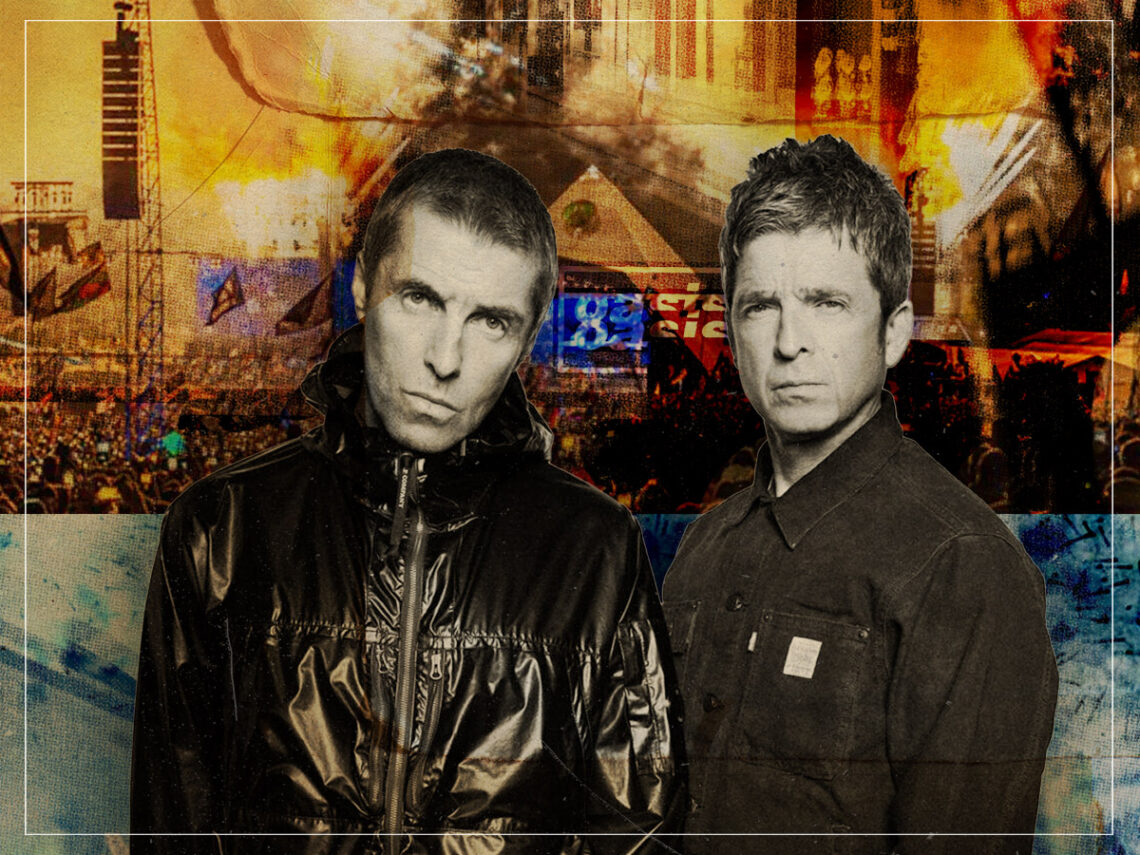
(What’s the Story) Glastonbury Glory: Oasis and Worthy Farm is a match made in Heaven

“You can have it all, but how much do you want it?” – Oasis
As the beacon of hope and austerity extends its embrace over a dull, greyed-out Britain, Oasis’ promises of a charmingly messy future rise to new heights. Along the glowing horizon, excitement brews in the glistening eyes of those whose moment in the freedom arena is long overdue and in the aching hearts eager to reclaim energy that seemed all but gone. This is the singular moment when anything seems possible. Oasis are back, and it’s everything you want it to be.
Following 15 long years of longing for a band that once seemed as far away from reuniting as possible, the promise of their return feels, for many, too good to be true. This isn’t just a monumental contemporary spark reigniting the subdued hues of 1990s Britpop but a resurgence of a cultural force that shaped a generation. “It’s just a bit of fun,” is what you might hear on the lips of the many who have enjoyed yelling the lyrics to ‘Wonderwall’ or ‘Champagne Supernova’ in a dark club far too many drinks in—but it’s more than that. It’s for everybody who has felt at a loss. It’s for the culturally and politically disillusioned.
Glastonbury, known for championing people from all walks of life on and off stage, has always provided a monumental opportunity for performers to spread their wings of peace. The festival offers performances that are as much about fun as they are about making cultural statements on the current landscape. Granted, these deeper messages are often subtle, buried beneath the surface and visible only to those who view them through the right lens. But this subtlety is a necessary conduit to achieving greater levels of enjoyment.
When Oasis performed at the festival for the first time in 1994, their entire presence was drenched in the perils of the working class; donning everyday attire spoke as much to the everyday music fan as their unrelenting desire to commit to not giving a fuck about being perceived in a way that detriments their entire career, mainly because their career crafted an immunity to such criticisms because it was built on being exactly what the cynical fault-finders would struggle to criticise.
Being unable to afford the “right” thing to wear also didn’t distract from the nerves they felt, partially because they didn’t feel any, but also because what they were giving to their audience wasn’t anything to be fearful of. “I didn’t go on and go, ‘Woah, there’s loads of people,'” Liam Gallagher once reflected. “I was more like, ‘Just get up there, and nail it. I’d do Glastonbury every fucking day.'” Tracing the seemingly oscillating lines of rejoicing in times of societal upheaval and unrest leaks into many of the band’s songs, warranting joint celebration of messy happiness and finding light in times of trouble.
Singing the lyrics to ‘Live Forever’, confidently expressing themes of mortality, disappointment, and resilience, Oasis proudly declared, “Maybe you’re the same as me, we see things they’ll never see,” before promising that this shared experience would live forever. In that moment, Glastonbury became everything it was always meant to be: a unique blend of music, culture, and social activism. A lot of this harkens back to the earlier days when the festival aimed to put on an unforgettable show at Worthy Farm, showcasing its simultaneous commitment to having a finger on the pulse and proving the power of music in uniting the world.

Adapting to the contemporary landscape is a challenge every festival must face, but for Glastonbury, the effort to keep up over the years seems to have worn down its once solid fabric, with popular acts now struggling to maintain crowd engagement. For instance, Oasis’ headline show in 2004 faced several challenges that might overwhelm today’s more delicate infrastructure, including controversial ticketing processes and weather conditions that caused delays, leaving some areas dangerously wet and muddy.
Still, with the exception of Arctic Monkeys’ headline sets in 2007 and 2013, respectively, Oasis’ inclusion not only contributed to something Glastonbury hasn’t experienced for years—overwhelming demand—but also signposted one of the festival’s flagship events with a sense of historical significance and unwavering excitement. As they snarled through hits like ‘Supersonic’, ‘Acquiescence’, ‘Morning Glory’, and more, their vocals could barely be heard over the screaming crowd, and yet their message was received loud and clear.
This year, criticism of Glastonbury reached a high point following years of debate about its quality and relevance. SZA’s set, in particular, became infamous for the wrong reasons, while headliners Coldplay and Dua Lipa left many wondering about the festival’s future direction, if any. It’s indisputable that SZA is a highly successful and influential artist, but this fact complicates Glastonbury’s shortcomings even further. Why are they struggling to maintain their once-solid dominance in the festival market, and when did audiences become so divisive in their choices?
Over the years, Glastonbury seems to have moved further and further away from the diverse, eclectic spirit that once defined it, increasingly leaning towards mainstream acts and commercial appeal. While this isn’t a bad thing by any stretch, it does threaten to shift the festival’s identity and may alienate some long-time fans who cherished its original, more unconventional charm. However, there may be one cure-all in the not-too-distant future, and while many have already speculated and shut down a potential 2025 headline show for Oasis, the benefits seem as bright and certain as—what do they say?—sunshiiine.
The Oasis reunion tour already seems a robust certainty when it comes to eclipsing potential hype for others, but if they were ostracised from Glastonbury’s marketing efforts, this would surely mark the beginning of its downfall once and for all. Despite their long and painful hiatus, Oasis have been a constant for many, a symbol of happiness in times of turmoil, and proof that letting your hair down and dancing with your mates when nothing else in the world makes sense can be powerful.
Alongside the brilliance of their music, Oasis represents everything Glastonbury has lost—its raw, rebellious spirit and the unfiltered, authentic energy that once made the festival a groundbreaking cultural phenomenon. Historically, people gathered at Worthy Farm to experience a perfect moment of complete escape from their worries, with their souls uplifted by music that made them feel truly at one with the universe. Oasis embodied that spirit, delivering performances that resonated deeply and provided a soundtrack to those transcendent experiences.
Even if they don’t grace the stage at the coveted festival next year, at least we’ve learned one thing along the way: without such acts, the alternative landscape remains a nostalgia-ridden landfill where joyful fun remains frozen in the past, with the heart and soul of music that brings people together risking being diminished, waiting for the day when something new and vibrant emerges from the ashes of a dull, greyed-out Britain.
