


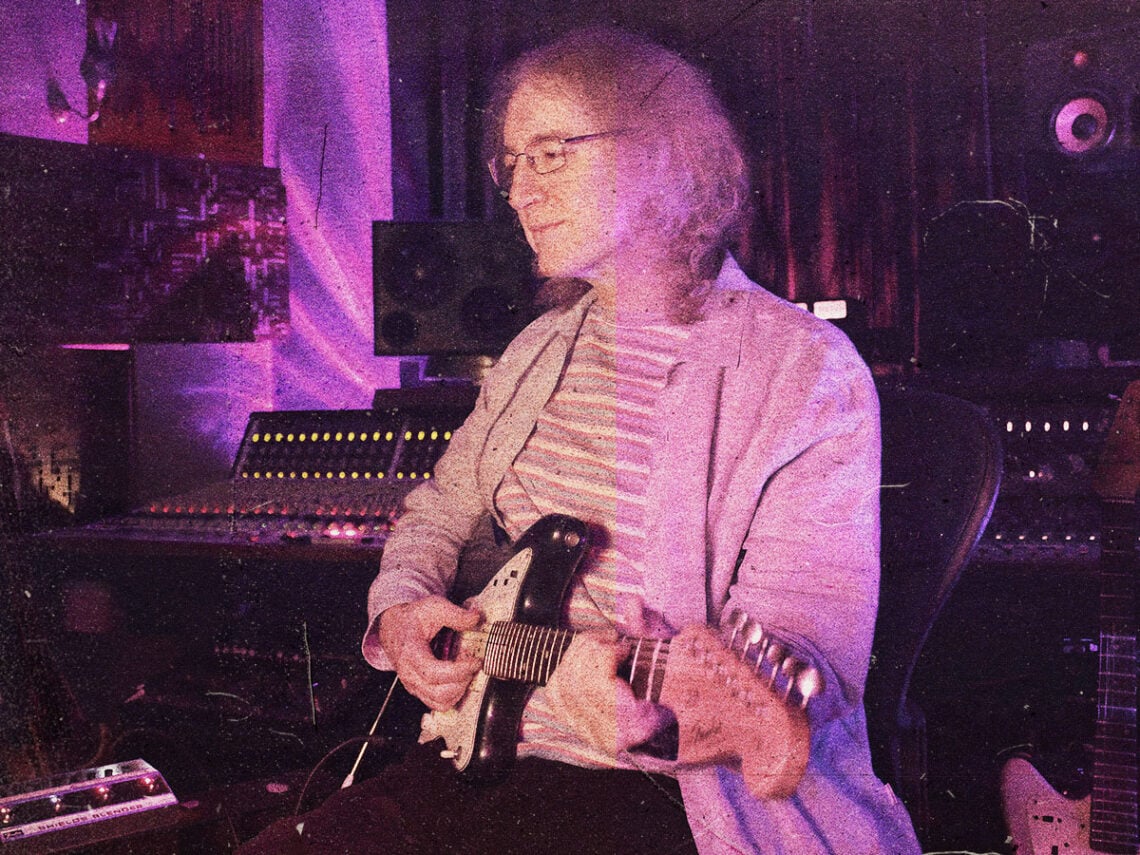
Why Kevin Shields “gravitated” towards the Fender Jazzmaster

Only a few guitarists institute such innovation that they become synonymous with their instrument. For the world’s most popular model, the Fender Stratocaster, its definitive player is Jimi Hendrix, with Led Zeppelin leader Jimmy Page the man most closely associated with the meaty tones of its rival model, the Gibson Les Paul. Then, for the underground’s weapon of choice, the Fender Jazzmaster, My Bloody Valentine’s driving force, Kevin Shields, is the player inextricable from the innovations the model has elicited.
The definitive shoegaze player, while Shields was inspired by the Jazzmaster toting boundary-pushers who came before him, such as Sonic Youth pioneers Thurston Moore and Lee Ranaldo, as well as Dinosaur Jr maestro J Mascis, he pushed the instrument to new heights. He did so by fusing necessity, effects, drugs, and a desire to do something as distinctive as those that had influenced him. His sound is as resounding as anything anyone has ever produced on a six-string, with the elemental closer ‘Soon’ of 1991’s Loveless perhaps the perfect distillation of this.
In fact, the entire 1991 masterpiece is famed as Shields’ best moment. It refined the raw strides made on My Bloody Valentine’s 1988 debut Isn’t Anything and set the scene for the all-encompassing, if not a touch overlooked 2013 third effort, MBV. It was the sound of the digital future calling in an era when the guitar band was back ruling the roost but was largely ensconced in fundamentalist punk simplicity and fury.
Also featuring the likes of ‘Only Shallow’, ‘I Only Said’, and ‘When You Sleep’, Shields’s creation of a full-bodied and augmenting accompaniment for chemically altered states was a stroke of unfettered genius. It went far beyond the mostly feeble trills of 1960s psychedelia and was all due to his convergence with the Jazzmaster. He could not have enacted such innovation with the short arm of the Stratocaster’s tremolo.
According to legend, My Bloody Valentine had been around for five years when Shields first picked up a Jazzmaster. One day, he borrowed a 1964 Jazzmaster from a friend; until then, he had been playing cheap knockoff models. Its appearance and specs appealed to him so much that he naturally “gravitated” towards it from the off. It seemed to offer infinite possibilities, particularly with its long floating tremolo arm, which allowed him to strum uninhibited while using it.
Although the strings on his friend’s guitar were heavy gauge, Shields tuned the strings together to bend them and create a resonant din in a show of his resourcefulness. On 1988’s You Made Me Realise EP, things started to take shape for him on the tracks ‘Thorn’ and ‘Slow’. The latter was the first time his now-iconic gliding style really came to the fore, helped on by reverse reverb, the tone turned off, and heavy bending of the tremolo arm.
According to Shields, this strange tape effect emerged in just one afternoon, which is quite remarkable for a sound that changed the world. Yet, as we’ve seen with so many consequential instances, they are often mistakes or haphazard discoveries.
Explaining the magnetism of the Fender Jazzmaster, Shields told Fender: “I just gravitated nearly solely to the Jazzmaster in the ’90s”. Recalling his discovery of its scope, he added: “I was already a massive fan of the shape. I didn’t know what this was all about until I discovered it, you know what I mean? (The tremolo) meant I couldn’t play guitar without this.”
