


Why did Jimi Hendrix play ‘Star-Spangled Banner’ at Woodstock?

When looking back at the most iconic moments in rock and roll history, there are some instances which are utterly undeniable. Elvis Presley walked into Sun Studios, The Beatles played on The Ed Sullivan Show, and even the Sex Pistols show at The Lesser Free Trade Hall in Manchester; all of these events changed the course of rock history indefinitely. If one event triumphs above all in terms of its iconic and enduring reputation, though, it is Jimi Hendrix and his performance at the Woodstock Festival in 1969.
The 1960s was a revolutionary time for rock music, as artists around the world began to tear down barriers and redefine the boundaries of the genre. This era of vibrant political and artistic expression inspired countless future generations to musical greatness, but its defining moment came in 1969 with the Woodstock Festival in New York. Boasting perhaps one of the greatest festival line-ups of all time, including the likes of The Who, Jefferson Airplane, and Janis Joplin, among many others, the most legendary moment across the weekend came at the very end when Jimi Hendrix took to the stage.
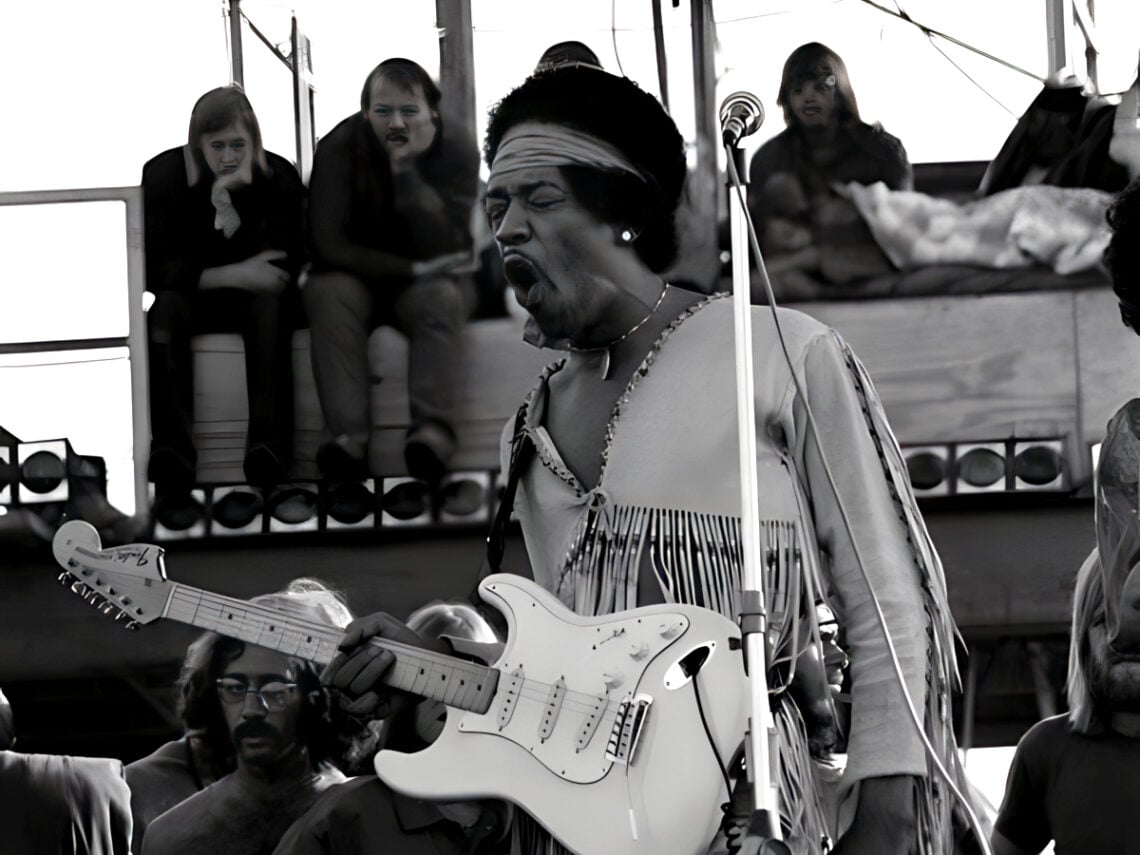
Originally scheduled to headline Sunday evening, poor organisation and a lack of cooperation from mother nature meant that Hendrix did not take to the stage until Monday morning. Delivering a blistering set which included many of his defining tracks, like ‘Fire’, ‘Foxy Lady’ and ‘Purple Haze’, his Woodstock set helped to reaffirm Hendrix’s position as an unparalleled guitarist and showman. His entire set was utterly awe-inspiring, but it is perhaps best remembered for the guitarist’s unique take on the US national anthem, ‘Star-Spangled Banner’.
There are not many national anthems which lend themselves to a psychedelic guitar reimagining, but Hendrix could make virtually anything sound good. If you had to pick one singular moment to encapsulate the rock music scene of the 1960s, it would have to be Hendrix and his groundbreaking performance of ‘Star-Spangled Banner’, but why exactly did he do it?
Was it to do with the Vietnam War?
At the time, many fans theorised that his performance was an ironic comment on patriotism during the horrific period of conflict in Vietnam.
Indeed, Woodstock saw its fair share of Vietnam protests over the course of the weekend. After all, much of the music and ethos that the festival was built on was rooted in the hippie counterculture and anti-war movement. Hendrix’s rendition of the national anthem could be viewed as a criticism of the American establishment and its actions in Vietnam. Equally, it could be seen as a rallying cry for the younger generation, especially those at Woodstock, to rise up and set about building their own United States from the rubble of the current establishment.
For his part, Hendrix claimed that the inclusion of ‘Star-Spangled Banner’ on the Woodstock setlist was nothing out of the ordinary, as it had been a part of his live show for many years by that point. The guitarist also affirmed that his motivations were entirely musical rather than political, although that is a little harder to believe.
Hendrix regularly made political comments during his performances, albeit subtle ones. During his performance of ‘Machine Gun’ at Fillmore East, for instance, he dedicated the track to “All the soldiers that are fighting in Chicago, Milwaukee and New York… Oh yes, and all the soldiers fighting in Vietnam”. This calculated quote branded soldiers in Vietnam as an afterthought, as being less important than those fighting for civil rights and liberty on American soil. So it seems more than likely that Hendrix’s performance of ‘Star-Spangled Banner’ at Woodstock had some political motives, even if he was apprehensive to confirm them.
