


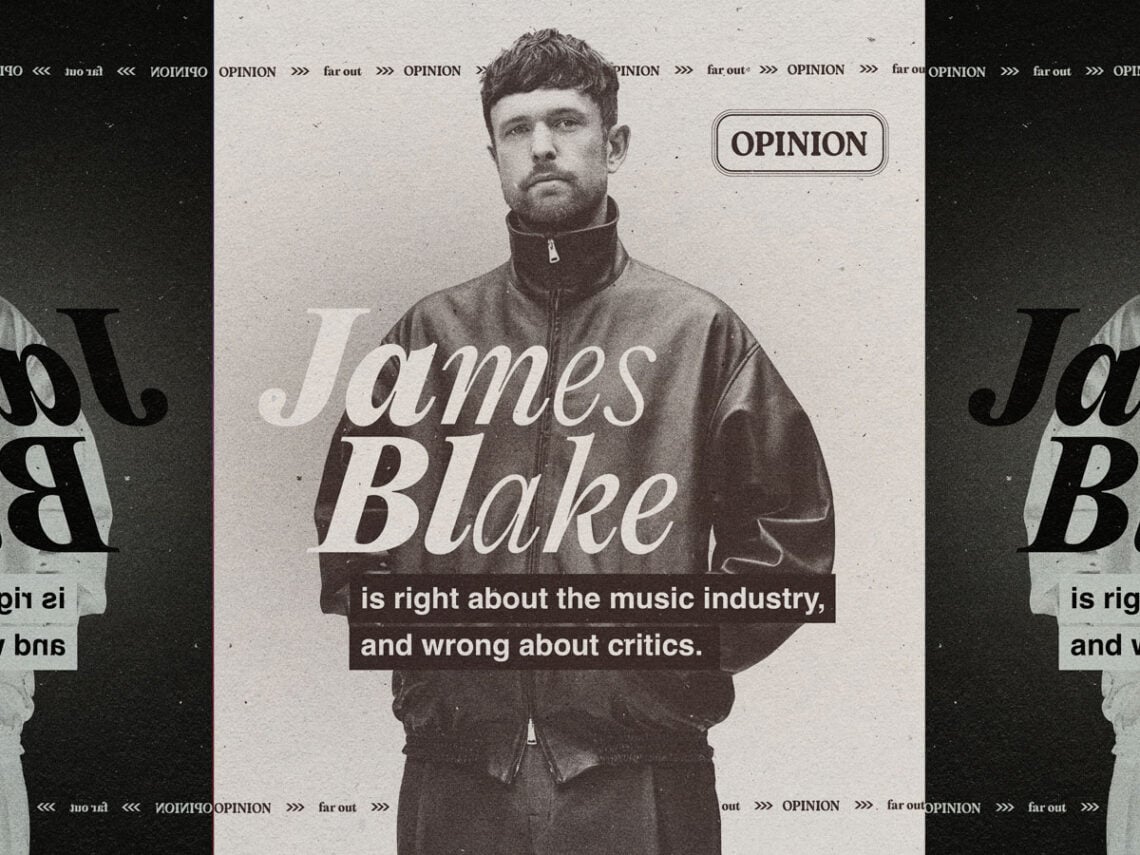
James Blake is right about the music industry, but wrong about critics

‘Music criticism is dead’: I, a very real music critic with a very real set of bills to pay, must read variations of this argument almost every day.
For over a year, I’ve been a full-time music critic at Far Out; I have lived and breathed the mantra that reviews must be honest, content must be purposefully curated, and rigorous quality controls are essential to combat the toxic leakage of AI throughout a sinking, porous industry. Though we work alongside PRs to aid new music discovery, we’re never in the business of trading favours.
Despite this zealous commitment to delivering fresh, sincere and authentic human-led independent journalism to the public, my Far Out colleagues and I must face the same condemnation every day: ‘Music criticism is dead’.
We might come to expect it from hot-shot chart-toppers shaken by an unfortunate album review, or from labels attempting to convince the market that their less-than-favoured act is really the victim of an industry smear campaign. We might not have come to expect it from multi-hyphenate Grammy Award winner and champion of independence, James Blake.
After more than a decade in the major label system, boasting collaborations with the likes of Beyoncé, Kendrick Lamar, Jay-Z, and Travis Scott, the Enfield-born producer has often used his platform to call out the exploitative contracts, restrictive algorithms, and shmucky data that defines major label system, which scolds parties on every side of the music: musician, fan, critic, and so forth.
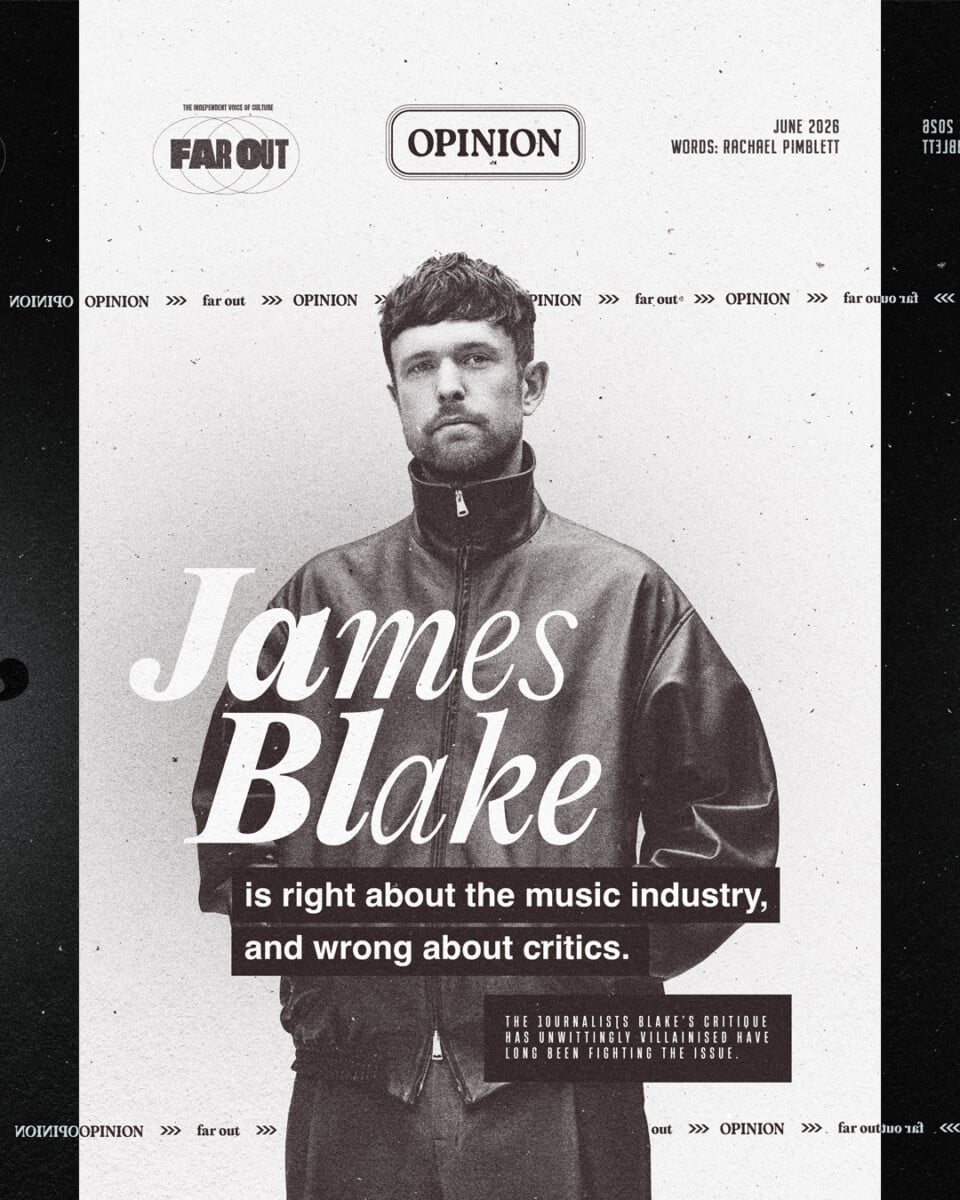
But now, Blake’s commitment to the perks of being an independent artist has grown into a near-paranoid takedown of the industry at large: “If you’re an artist, remember that in 2026 there’s not a single part of the system that isn’t faked,” he shared.
So began an agitated bullet-point list of issues administered through the black background of his Instagram story: “Can’t trust a review because blogs/mags stopped making money so journalists now get paid off by labels.”
Blake also provided succinct takedowns of newly fraudulent social media comment sections, streaming numbers, and the ubiquity of AI.
Blake, who previously partnered with AI soundscape company Endel to create a Wind Down Soundscape of his work, is correct in many ways, and surely he skirted nuance to some extent to simply sharpen his points. Within the world of music journalism, major labels have achieved a cultural, economic hegemony; they can pay for psy-ops, a term recently made famous through the case study of Brooklyn alt-rockers Geese, whose overwhelming online fanbase appeared to be, at least in some part, manipulated by a marketing firm.
The monopolisers influence the market. Nobody has spare cash to support music journalism, ergo, the money pit dries up. To continue to exist, journalists must source funds elsewhere. Some, cheeks smeared in a traitorous red, ran to the big labels, who could exchange market security for the price of five gold stars.
This isn’t new, nor is it exclusively a music journalism thing: Brands pay footballers to wear their latest shoeline, and pay celebrities to endorse their latest mascara. But an industry is not a faceless entity, and the journalists Blake’s critique has unwittingly villainised have long been fighting the issue.
Independent publications and independent writers are grafting with makeshift hazmat suits to put out this fire. With our hands burnt and our pockets sullied from the efforts, Blake’s casuistic gesture suggests that we’re the very vessels through which this disaster moves. All of a sudden, all 850,000 of his followers have an incentive to question the credibility of real writers who are already working tirelessly against a machine that holds no place for us, we who retain no economic benefit but exist for the sheer pleasure of thinking and feeling in excess.
It must be frustrating for the public to learn that a lot of mainstream journalism is less than savoury, but it’s even more frustrating when independent publications (present company included) work tooth and nail in a bid to combat as much. We miss out on glamorous opportunities and throw sneaky bonuses to the wind, all for the sake of committing to hard, honest work, and yet, a vital conflation of truth has seemingly painted us as the enemy.
From what I assume was much pushback, Blake followed up his claim with another black-and-white Instagram story, clarifying that “not all journalists are paid off or given perks for their critiques”, though the increase in these exchanges has “cheapened the craft”.
Though we might forgive his earlier lambastations, Blake’s suggestion that criticism has been “cheapened” overlooks the unique, original, and independent perspectives, like Far Out, still waving bloody murder within the marketplace of ideas, asking for engagement. Which is to say, in a market dominated by fakes, the real becomes even more valuable. Though he claims to respect the work, Blake’s pessimism has already given up on the power of independent thought, critique, and curation.
This isn’t to say that a publication must run only negative reviews that might jeopardise any behind-the-scenes label sycophantry. Just look at what we’ve reviewed recently, and you’ll likely find more positive reviews than negative ones. Modern music is thriving, and creativity still finds its own way to flourish in spite of artificial issues. Any good independent outlet can, and must, still celebrate music while calling out when and how the industry falls short.
Believing that human creativity can shine through corruption is vital if we want to restore the balance. We know this from our efforts against AI’s totalising sheen. We must trust our instincts to recognise the human in this instance, too.
Blake’s barking up the right tree, for sure, but in doing so, he’s also presented an unnecessary attack on a necessary part of the industry still working, for crumbs, to uphold the importance and integrity of art at a time when the real power structures are painting it as vapid and useless.
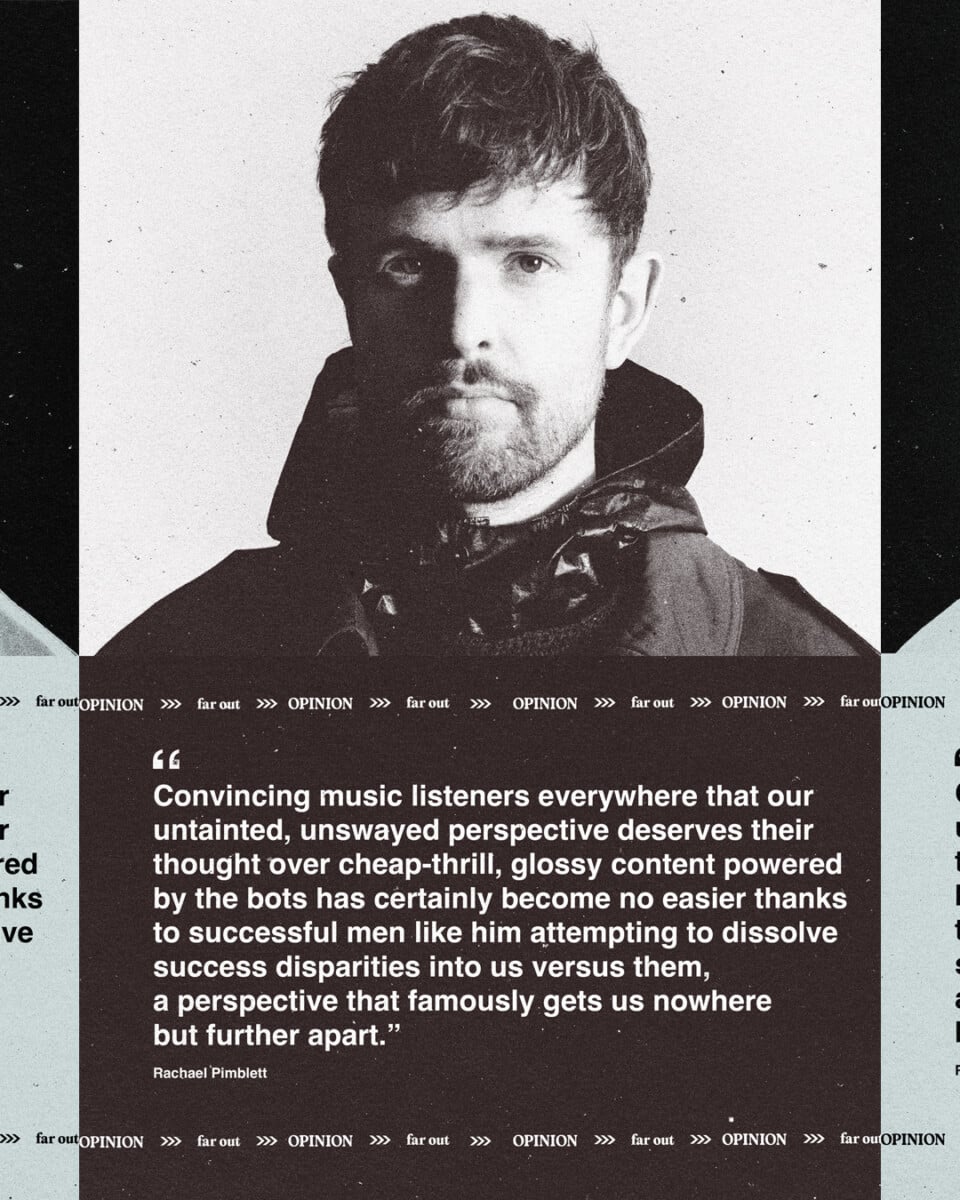
Convincing music listeners everywhere that our untainted, unswayed perspective deserves their thought over cheap-thrill, glossy content powered by the bots has certainly become no easier thanks to successful men like him attempting to dissolve success disparities into us versus them, a perspective that famously gets us nowhere but further apart.
Blake offers me his sympathy, at least: “I feel bad for the increasingly underpaid critics and journalists with integrity, that they’re dragged into it. I have come up alongside many of you and respect your work and dedication. But I’m watching you be replaced one by one for figures who will say what is asked of them.”
He might not think so, but rest assured, there’s a battalion of us out there, fighting to make sure that’s something we will never be.
