


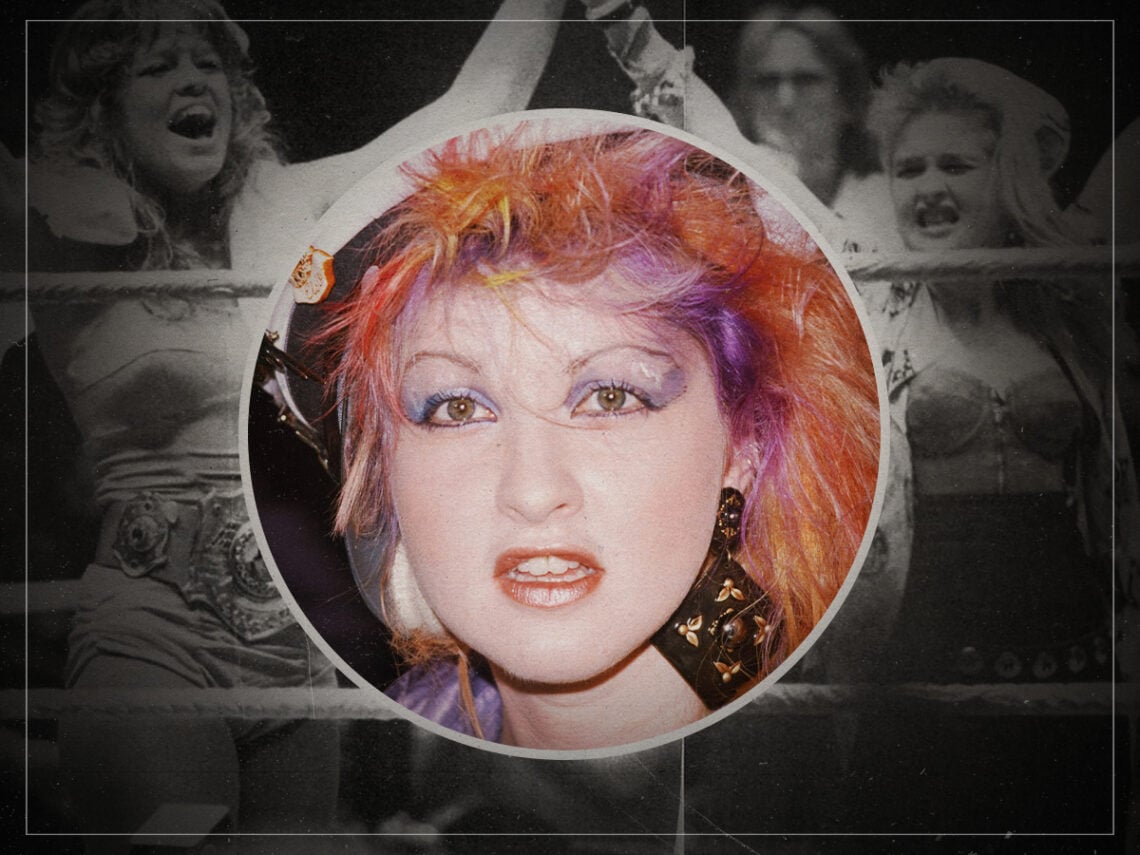
Why is Cyndi Lauper considered an icon of pro wrestling?

There might not be a single photo more representative of American pop culture in the 1980s than the one of pop star Cyndi Lauper posing with one arm around Mr T and the other around Hulk Hogan.
Loud, colourful, cartoonish, garish, these were the biggest stars in attendance at the first-ever WrestleMania in 1985, but the question is, what the hell was Cyndi Lauper doing there in a showcase of steroidal muscle men in spandex?
Whether you’re a fan of professional wrestling or not, it’s impossible to deny the gigantic mainstream reach of the WWE in 2026, with Netflix carrying its weekly broadcasts and 20,000 fans regularly filling arenas to see the company’s never-ending touring show. Big stars from Hollywood and music don’t hesitate to associate themselves with the brand or even to take part in matches: Bad Bunny has done it, along with Arnold Schwarzenegger, Hugh Jackman, Kim Kardashian, Snoop Dogg, and even Betty White.
Back in the day, though, the WWE, then known as the World Wrestling Federation (WWF), didn’t have the clout to roll out the red carpet. Pro wrestling was considered low-brow kids’ entertainment, and for many people, it still is. What WWE chairman Vince McMahon managed to do in the ‘80s, however, was to buy out a lot of his competition across the US, turning wrestling from a highly regionalised ‘sport’ on local TV stations into a national conglomerate and star-making machine. Hulk Hogan was one of the first great successes to emerge from this new era, and WrestleMania, as the new crown jewel of the WWF’s pay-per-view events, was wrestling’s first real attempt at a proper Super Bowl of its own.
To make it work, though, McMahon couldn’t just rely on the usual weekly stable of WWF TV viewers and casual Hogan or Andre the Giant fans. He needed to catch the attention of a different segment of the American populace, the ones who preferred to get their shiny objects from the new cable network known as MTV. And in 1985, nobody represented that demographic better than a 32-year-old, pink-haired pop whirlwind out of Queens, New York named Cyndi Lauper.
Fresh off winning the Grammy for ‘Best New Artist’, Lauper agreed not only to appear at the first WrestleMania on March 31st, 1985, but to participate directly, as she’d already shown up on several previous WWF events broadcast on MTV, aligning herself as a sort of ring manager and tag-team partner of the women’s wrestling champ Wendi Richter. She also had an ongoing, imaginary feud with the scruffy, middle-aged wrestling star Captain Lou Albano, who claimed he’d made her famous when he played Lauper’s dad in the ‘Girls Just Wanna Have Fun’ music video.
“I had always liked wrestling; I still do,” Lauper told the San Antonio Light in 1986, “I see myself as a multimedia artist. I’m not just making sounds, I’m also creating images, in the videos and on stage and on the record jackets and in the TV appearances I make.”
Participating in WrestleMania certainly enhanced her image, but it probably didn’t do her any favours with music critics, who likely wondered whether they ought to take this woman seriously, after all. In the long term, the bigger winner was the WWF/WWE, which had proof of concept for bringing in more stars for similar cameos. Ozzy Osbourne and Ray Charles showed up at WrestleMania II, and Alice Cooper and Aretha Franklin were there for WrestleMania III, with Cooper following Lauper’s lead and helping to manage the wrestler Jake ‘The Snake’ Roberts and his pet python.
The wall between wrestling and entertainment had officially broken containment, and Rock and Roll Hall of Famer Cyndi Lauper was a big part of that cultural shift. Even longtime WWE commentator Jim Ross recently spoke out about Lauper’s impact, saying on his podcast that “she brought a lot of publicity, a lot of awareness to the WWE, to a brand new audience, that MTV audience… I think she should be in the WWE Hall of Fame as a result of that”.
