


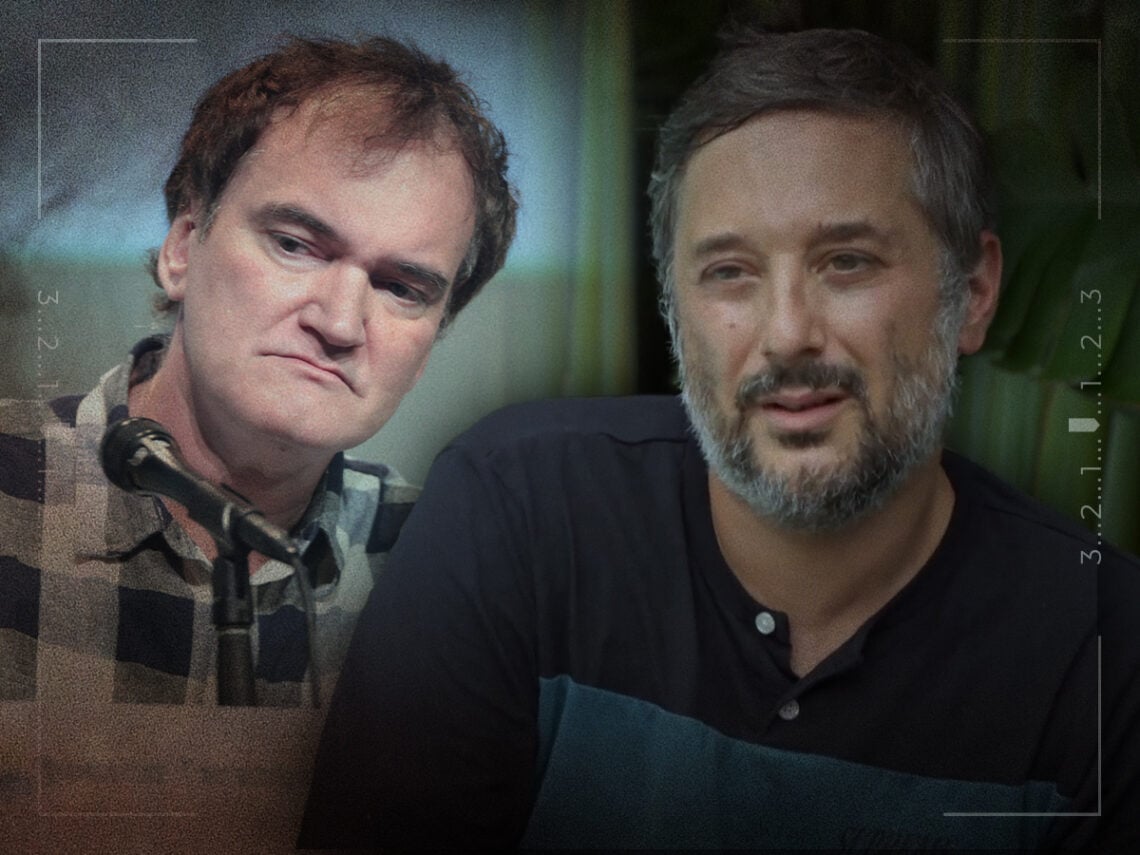
“There’s a void there”: Why Harmony Korine doesn’t care about Quentin Tarantino

Emerging in the early 1990s with Reservoir Dogs, Quentin Tarantino instantly asserted himself as a bold new voice in the industry, demonstrating the potential for hugely successful movies to be made on a small budget, but not everyone was impressed.
To some audiences, his approach was too violent and too conversational, the filmmaker’s style so idiosyncratic that you either loved what he was doing or found it utterly pretentious. Tarantino’s whole deal is making movies heavily inspired by bygone eras of filmmaking, his work jam-packed with homages and even direct references to other movies. Sure, many filmmakers make references to movies that have inspired them within their own work, but Tarantino admittedly takes it to new levels.
Look at Django Unchained, a reference to the 1966 film Django, complete with a cameo from Franco Nero, and then there’s Once Upon A Time in Hollywood…, a reference to Sergio Leone’s Once Upon a Time in the West. Death Proof was Tarantino’s take on a grindhouse exploitation movie, shot on film that was subsequently dirtied up to look like it had been discovered decades later, like a forgotten gem of the ‘70s.
Kill Bill has The Bride, who wears a Bruce Lee-inspired jumpsuit, the tune that Elle Driver whistles is lifted from Twisted Nerve, while the opening scene is lifted from The Good, the Bad, and the Ugly, and that’s just scraping the surface.
To some audiences, Tarantino’s constant references to other movies are great fun to spot, reflecting his deep love for cinema in all of its forms. But to others, like Harmony Korine, it’s just unoriginal. Say what you want about Korine’s work, which includes the likes of Gummo, Trash Humpers, and Spring Breakers, but you can’t deny his pretty original approach to filmmaking. For him, cinema is a playground designed for bringing your own ideas to life, not just shoving a bunch of references to other movies into another.
“Quentin Tarantino seems to be too concerned with other films. I mean, about appropriating other movies, like in a blender,” Korine once said, “I think it’s, like, really funny at the time I’m seeing it, but then, I don’t know, there’s a void there. Some of the references are flat, just pop culture.”
It’s not that he hates Tarantino’s movies full stop, but rather, he sees the creation of an odd smoothie of both classic and niche movie references as getting old real fast. Of course, Tarantino has long been concerned with homages because he is so obsessive and encyclopedic when it comes to movies, having worked in a Video Archives store when he was starting out, which taught him everything he needed to know about cinema.
Listen to any interview or read anything the filmmaker has ever written, and you’ll discover a man who totally lives and breathes cinema. It’s impressive, you’ve got to admit, that one person can know so much about cinema, although perhaps his obsession has clouded his approach to filmmaking a little.
Sometimes, it feels like he’s putting a reference in just for the sake of it to prove that he knows more about cinema than anyone else, and to be honest, that might actually be true.

Never Miss A Take
The Far Out Quentin Tarantino Newsletter
All the latest Quentin Tarantino content from the independent voice of culture.
Straight to your inbox.