


Why did Gram Parsons leave the Flying Burrito Brothers?

When he was nine years old, Gram Parsons saw Elvis Presley perform in Waycross, Georgia, on February 22nd, 1956. Witnessing ‘The King’ in person planted the seeds for a life devoted to music, and five years later, a young Parsons began performing in rock ‘n’ roll cover bands.
From an early age, Parsons was no stranger to strife. Born Ingram Cecil Connor III, his parents both struggled with alcoholism and depression; his father, a World War II veteran, would take his own life in 1958. His mother, Avis, the daughter of a citrus fruit magnate, remarried to Robert Parsons, of whom Gram adopted his surname.
On the day of his high school graduation in 1965, his mother passed away from complications of alcoholism. Gram spent a semester at Harvard University before coming into his annual trust fund income at age 21. Music became an evident rescue in a life that, while lined with privilege, was marred by tragedy.
Parsons transitioned from traditional rock cover bands to folk music by the age of 16, balancing playing gigs at coffee houses and high school auditoriums with being enrolled in prep school. Travelling between his native Florida and New York City, Parsons found himself performing at the famed Café Rafio in Greenwich Village, immersed in folk history. Growing into his musical identity, Parsons would become perhaps most widely known for his tenure with Southern California’s folk rock pioneers, The Byrds.

Born from the brains of Roger (then Jim) McGuinn, Gene Clark and David Crosby, the trio emerged from the coffeehouse circuit and set to merge the stylings of the British invasion, with a heavy Beatles-esque influence, with traditional folk music, filling the gap between the two genres. Crosby would depart the band in 1967, and, in turn, Parsons would be recruited by McGuinn and bassist Chris Hillman.
Initially contributing as a jazz pianist, Parsons would fluctuate into rhythm guitar and vocals, slowly inflecting a country influence into McGuinn’s already multifaceted influences. Their sixth album, 1968’s Sweetheart of the Rodeo, was transformed from McGuinn’s concept of a history of American popular music into a country project fashioned from Parsons’ mind, primarily recorded in his chosen Nashville studio. His love of country giants such as Waylon Jennings and Merle Haggard poured into each song, making a stark departure from their earlier sound that, while not widely understood in the moment, stands as a prolific capsule of country-rock.
“Being with The Byrds confused me a little,” he reflected to Melody Maker in 1970. “I couldn’t find my place.” In the summer of 1968, ahead of a planned tour of South Africa, Parsons left The Byrds due to his opposition to apartheid, as reported by David Fricke in the 2003 liner notes to Sweetheart of the Rodeo. During this time, he conjured a friendship with Mick Jagger and Keith Richards, staying at the latter’s house in the south of France and imparting his wisdom of country music onto the two musicians.
On his return to Los Angeles, he reconnected with Hillman and formed The Flying Burrito Brothers, continuing his mission of championing country-rock while adding soul, gospel and psychedelic rock to his unique fusion, brewing what he referred to as “Cosmic American Music”, as quoted by his close friend, Pamela Des Barres.

“I think pure country includes rock and roll; I don’t think you have to call it country-rock,” Parsons once stated. “I was brought up in the South. I never knew the difference between gospel music and country music. It was all the same to me.”
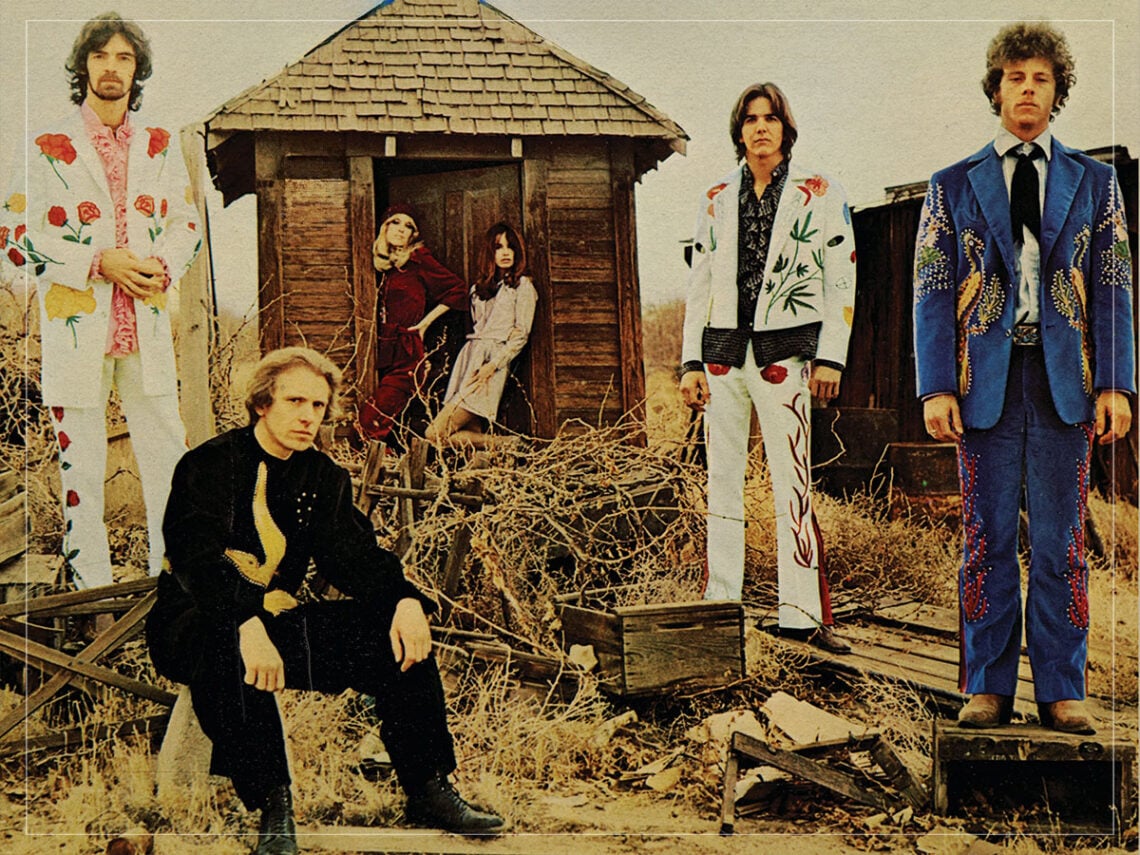
Their debut album, 1969’s The Gilded Palace of Sin, was not commercially successful, but it laid the foundation for the following decade’s iteration of rock music. Its album cover, on which the band is photographed wearing “Nudie” (sequin-covered) suits, adorned with colourful hippie symbolism, signalled a shift, merging Parsons’ singularity with a nod to the counterculture that grounded his creativity.
While the Burritos were undoubtedly talented, and Parsons’ vision evidently ahead of his time, the band was often clouded by their frontman’s behaviour. His addictions tended to consume his performances and, as time went on, he increasingly prioritised drug use and partying with the Stones as they recorded Let It Bleed, neglecting to write and compose new music.
Collectively, the Burritos placed themselves in debt rather quickly, losing most of their money in an unfortunate poker game and racking up their debt in the wake of Parsons’ frequent absences. Their second album, 1970’s Burrito Deluxe, was recorded in somewhat of a rush, with its original material written quickly in the studio and supplemented with outtakes from their debut. Not well-received by audiences nor critics (in contrast to the former), Parsons mutually agreed with Hillman to leave the Burritos. They recorded one more album in his absence with Hillman at the helm, before officially disbanding in 1971.
For a few years, Parsons continued to tour and record as a solo artist and alongside Emmylou Harris as his frequent duet partner, before his untimely death at just 26, from an overdose in his frequented Joshua Tree desert. Though his life was tragically short, his influence on rock history cannot be understated, as he remains pivotal in changing the trajectory of rock music.
