


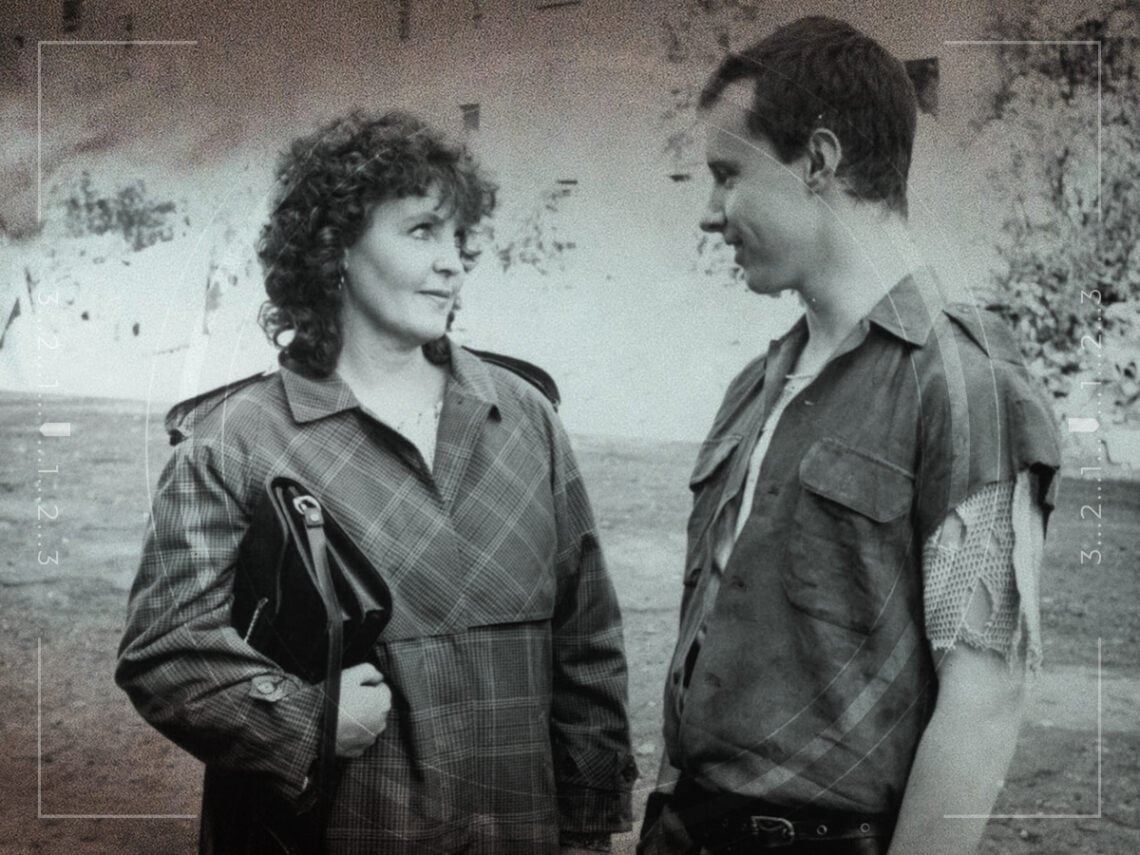
Why every woman should watch ‘Shirley Valentine’

Before Phoebe Waller-Bridge was talking to the camera in her relatable, deadpan, self-deprecating style in Fleabag, Pauline Collins aired her character’s frustrations about her husband and dissatisfaction with her life in Shirley Valentine. It’s one of those movies you might have heard your parents talking about, or perhaps you watched it when you were young, but if you’re a woman who has never seen Shirley Valentine in your 20s or beyond, you should consider it an essential addition to your watchlist.
Directed by Lewis Gilbert and based on the play by Willy Russell (who also penned Gilbert’s Educating Rita, another vital watch), the film is a true testament to going after what you want, highlighting the fact that it’s never too late to pursue the life you’ve always wanted. When we meet the middle-aged housewife Shirley, she tells us how she sometimes speaks to the wall because she’s so lonely, although her spirits are high, nonetheless, doing all she can to keep herself entertained while staying at home all day.
When we’re introduced to Shirley’s husband, Joe, we instantly understand the reasons for her unhappiness – he is selfish, unkind, and demanding. He is reliant on her for stability, embodying the stereotypical husband who cannot look after himself, having never learned to cook or clean due to his expectation that a wife would do it for him. Thus, when Shirley agrees to go on holiday with her friend to Greece, something she had never allowed herself to do before – going away spontaneously doesn’t exactly fit into her role as a housewife – Joe’s life falls apart, and he finally gets a taste of Shirley’s unhappiness.
Before Shirley sets off to Greece, her interactions with a former school friend and her neighbour, both of whom admire the protagonist for her bravery and courage, inspire her to keep heading towards her goals. The film reminds us that, just because we can’t always see our own positive traits and progress, this doesn’t mean that they don’t exist. Shirley finds a sense of strength in her interactions with these women, and when she lands in Greece, away from the cold, industrial streets of Liverpool, she realises that there is another world out there that can be hers just as much as it can be anyone else’s.
It’s on her holiday that she experiences a transformation in herself, no longer realising that you must limit yourself in life. “I have allowed myself to lead this little life, when inside me there was so much more. And it’s all gone unused. And now it never will be. Why do we get all this life if we don’t ever use it? Why do we get all these feelings and dreams and hopes if we don’t ever use them?” she initially says. However, when she is left to fend for herself after her friend disappears with a handsome stranger, Shirley soon discovers the life within herself that she had previously neglected to use.
She finds excitement in meeting Kostas, a Greek taverna owner who soon woos her and has sex with Shirley on a boat. Yet, this isn’t simply a case of a man being the catalyst for Shirley finding freedom. Rather, it’s one of many instances during her holiday where she starts to feel alive. From soaking up the sun on the beach to fulfilling her wildest desire to have passionate sex away from the confines of a bed, Shirley realises that there is more to life than routine and simply doing what is expected of you.
This is further emphasised by the fact that when Shirley decides not to board the plane home and instead goes back to Greece, she finds Kostas seducing another woman. This is a pivotal moment in Shirley’s development; she realises that she didn’t come back for Kostas, she came back for the freedom and the sun, the new beginning and the change of pace.
Gilbert’s film gives us an incredibly powerful performance from Collins, whose wittiness, no matter her situation, reminds us that sometimes all we can do is laugh and not take things too seriously – because if you can find the courage within yourself to move out of your comfort zone for the greater good of your life, you’ll be just fine.
