


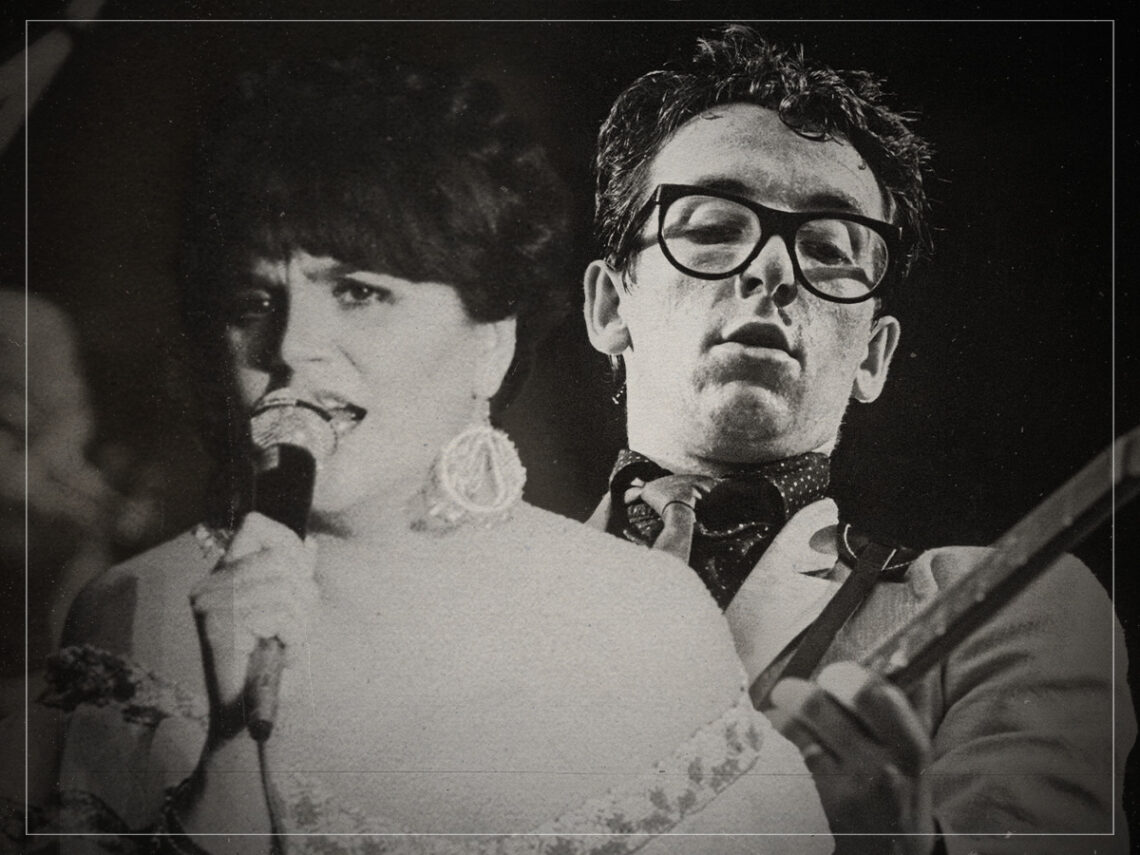
Why Elvis Costello hated the “sheer torture” of Linda Ronstadt’s covers

There’s a common consensus today among music fans that Linda Ronstadt is the queen of everything. Talent, humility, patience; she has it all, despite the hyperbole. So why did Elvis Costello once disagree?
Throughout Ronstadt’s life and career, there have been a lot of twists and turns. But a closer look makes you understand how suitable these discrepancies actually are. Ronstadt grew up around a diverse spectrum of music because of her parents. She entered the LA music scene with an eye for uniqueness. She knew how to factor her interests and heritage into her art and bring something new to the table. It’s incidentally why she earned the moniker the Queen of Country Rock.
But there are also moments in which she faltered a little, which, all things considered, is completely normal. Ronstadt’s trajectory was pretty abnormal compared to her peers, but there’s charm even in the lesser-appreciated gems in her discography. One was Mad Love, a record so forgettable by Ronstadt’s standards that she barely even acknowledges it herself.
But there was another part of the record that Elvis Costello took issue with, and that was the covers of his own songs. On Mad Love, Ronstadt included a handful of Costello covers – and he hated every single one. “They are like sheer torture,” he later said. “Dreadful. A total waste of vinyl.” He also observed how Mad Love failed to do well, which he rather self-depracatingly blamed on her taking on his songs.
“There’s the curse of Costello to consider when you look at Linda,” he told Musician in 1989. “One moment she was the biggest-selling female singer in America. The next thing she’s in opera.” He went on: “Record four of my songs — that’s enough to finish anybody’s career! Now she’s singing Mexican songs; she knows I can’t write in Spanish.”
While it’s hard to say the flop of Mad Love wasn’t partially because of Ronstadt’s bold choices for tracklisting, it’s hard to use that as the sole blame. After all, her venture into singing more Mexican songs had more to do with her innate interest in her own heritage than anything solely to do with the commercial success of Mad Love. She also never cared about her own commercial profitability and usually only did things she actually wanted to do.
So, rather than pivoting because she hadn’t done the right thing, she likely wanted to instead work on a project that felt closer to who she was at that moment in time. She might famously hate listening back to her own stuff, especially when it comes to her vocals, but she has always enjoyed the act of performing enough not to think about the other side all that much. And who knows – maybe Costello didn’t actually hate her covers, he might’ve just struggled to swallow a version of something that wasn’t hers to begin with. Which, in a way, is valid too.
Other people struggled with Mad Love because they felt it was Ronstadt attempting to fit into the new wave zeitgeist of acts like Blondie. But, according to her, it was nothing like that. She was just doing what she always did and selecting songs she liked. Plus the fact that she was in a high churn at that particular moment in time, which meant time was of the fucking essence.
As she later said, “I don’t think that’s how we wanted it to sound like intentionally. I was just trying to find ten or so songs to do. Back then, I was doing about an album a year, so Mad Love fell into that cycle.”
