


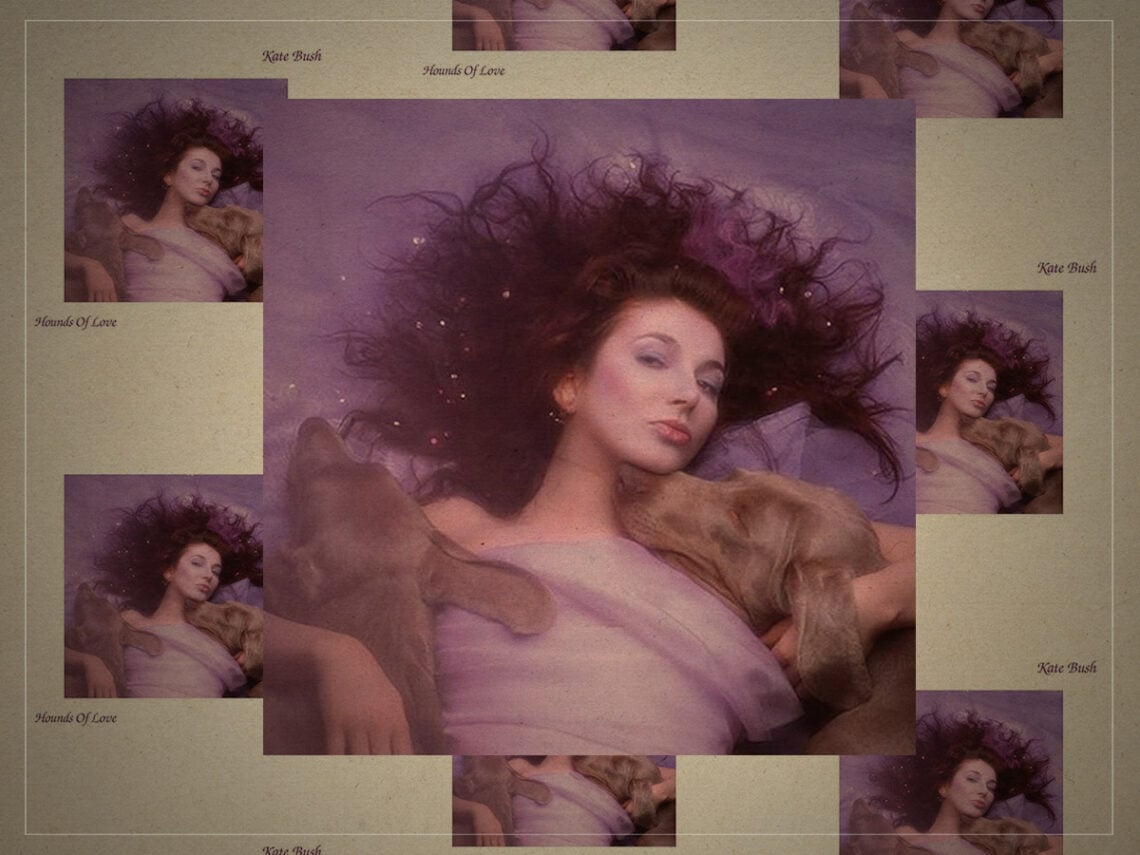
Why does Kate Bush’s ‘Hounds of Love’ feel a lot younger than 40?

Kate Bush released her fifth studio album, Hounds of Love, in September 1985, and returned to the limelight after her 1982 LP The Dreaming reaped little reward.
If you’re doing the math, listening to the record featuring tracks like ‘Running Up That Hill’ and ‘Cloudbusting’, somehow still feels timeless four decades later, but how?
Bush began working on Hounds of Love in the summer of 1983, recording snippets onto 8-track equipment. Following a series of recording sessions later that year, and a handful in Ireland, the English musician started to mix the album, a process that would take a year. Combining traditional Irish instruments, piano segments, layered vocals and synths courtesy of a Fairlight CMI, Bush took musical experimentation to the next level, eventually finishing the LP in the summer of 1985.
Originally produced as two suites, with one side being called Hounds of Love, the other The Ninth Wave, the album journeys through themes of death and resurrection, something critics have likened to Tennyson’s series of Arthurian poems, Idylls of the King.
In August 1985, Bush gave audiences a teaser for the album with a performance on Terry Wogan’s BBC show, during which she performed ‘Running Up That Hill’. The single then entered the UK charts, peaking at number three, a position just behind the one achieved by her debut ‘Wuthering Heights’. The album launch party at the London Planetarium saw guests treated to a laser show as theatrical as the singer, soundtracked by the new release. Since then, the likes of Suede’s Brett Anderson have recognised its effect on his band’s sound, while Stevie Nicks has Hounds of Love down as a favourite of hers. Imagine receiving that compliment!
Despite its historic significance, the album continues to impress, constantly redefining its already extensive legacy. In 2022, the record found a new life on social media (the double-edged sword that keeps slaughtering older works), after an orchestral remix of ‘Running Up That Hill’ was featured in the fourth season of Netflix’s Stranger Things, courtesy of composer Rob Simonsen.
It was this feature that would give Bush’s track, and the album from which it originated, an evergreen feel. The song soared to number one on the UK charts, making Bush the solo artist with the longest gap between two number one singles, which only went to show her ability to enthral not only those who were alive at the time of Hounds of Love’s release, but also Gen Z, who took to featuring the song on TikTok. Bush had invariably kick-started a nostalgic revolution that would only be bolstered with the likes of Sophie Ellis-Bextor’s ‘Murder on the Dancefloor’ reaching number two in the UK charts 23 years after it was released, helped largely by Barry Keoghan’s unabashed dong exposure.
Still, while the rebirth of ‘Running Up That Hill’ must be considered when unpicking Hounds of Love‘s timelessness, the answer also lies in the album’s forward-thinking nature. Lyrically, the LP has been described as progressive, given that Bush tackles themes such as love and female desire rather than the male-oriented experience generally found in traditional rock and pop. In terms of sound, the album is “classically prog”, according to author Ron Moy of Kate Bush and Hounds of Love, as a result of its musical experimentation and rejection of American influences.
Bush’s full use of the modern technology at her disposal, paired with some of her quintessential vocals, also sets Hounds of Love out from its other contemporaries. It’s fresh, different and, most importantly, eternally cool.
