


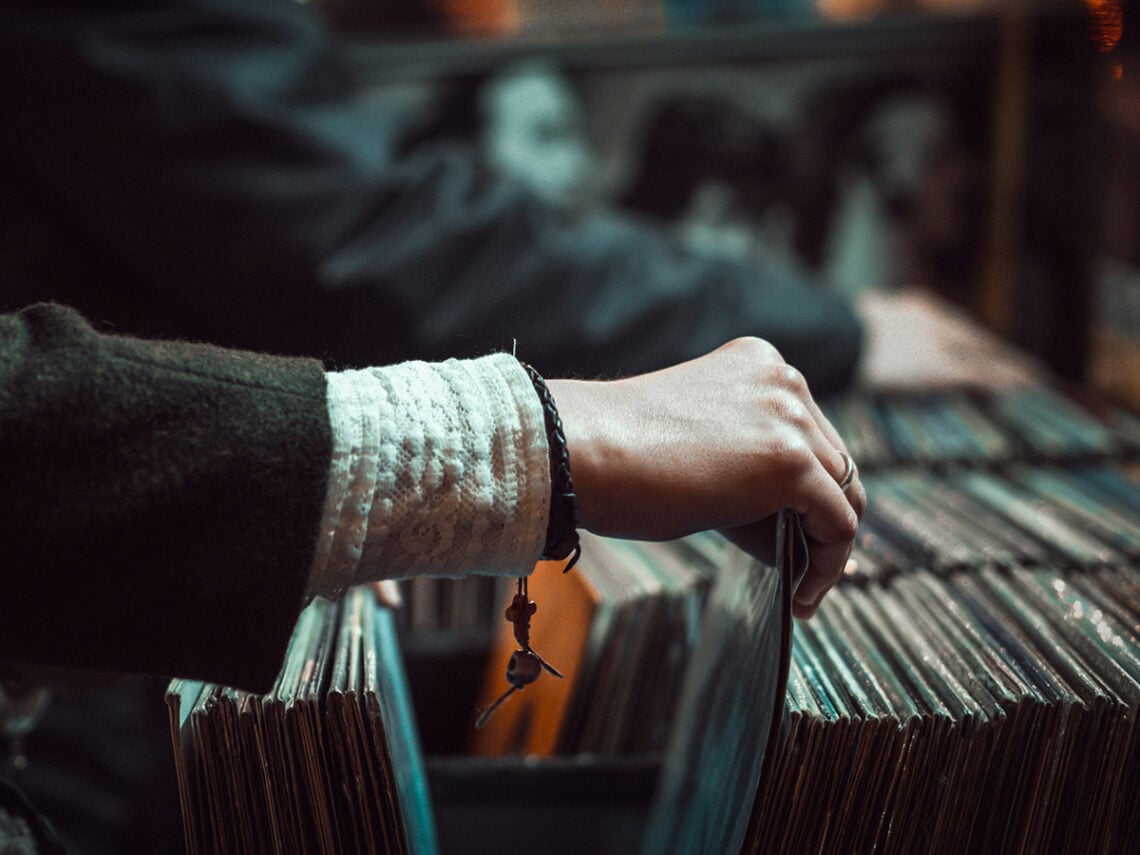
Why do all charity shops have the same records for sale?

My vinyl copy of Simon and Garfunkel‘s Bridge over Troubled Water has certainly seen better days. There are a few little scratches on the record that cause it to jump at some point around ‘El Condor Pasa’, and the outer sleeve has had to be glued back together to prevent the record from falling out and gaining further damage. I would like to point out that none of this was my fault because I bought it second-hand from a charity shop on London Road in Brighton, and that I would never treat my records in such a way.
I paid £3 for the pleasure of owning this classic album, but the most frustrating thing about this is that when I walked into the next charity shop on the same street around 20 minutes later, I saw the eyes of Paul Simon staring me down, and Art Garfunkel peering over the top of his bandmate’s head. Another copy of Bridge over Troubled Water was sitting front-and-centre on their record rack; less battered, and for half the price.
You can call me a moron for not paying the additional £1.50 for the higher-quality record—it’s OK, I do to this day—but the situation prompted me to ask a different question entirely about the nature of charity shop record collections. Not only had I seen two separate copies of the album in consecutive shops, but I’d also seen five different copies of the same Barbra Streisand album on the same street that afternoon, which made me think: why do all charity shops appear to have the same records for sale?
Now, I’m well aware that this isn’t applicable to every single record rack in every charity shop up and down the country, and that there is some variety, but, as a general rule, there is very little difference between what you might find in your local branch of British Heart Foundation and the Cats Protection 100 yards down the road. Itching to own a Jim Reeves LP? You know where to get one. Feeling a sudden urge to spin two versions of Maurice Ravel’s Bolero played by two different orchestras? Again, the search won’t take long. Secretly after an Al Jolson album? You can probably find one in a charity shop, and then go fuck yourself.
Of course, some of these records were best-sellers in the early era of vinyl sales, but you have to wonder how they’ve become so concentrated within charity shops these days. The most common explanation is a morbid one, and these are the record collections of people who have died, and in their passing, their next of kin have chosen to donate them in bulk to the local charity of their choice. However, there are sometimes newer records that appear frequently, especially in relatively more modern formats, such as cassettes or CDs.

While death isn’t something that can be ruled out with these newer collections, the CD sections all appear to share the same taste as well. If the contents of the shelves are anything to go by, people really fell out of love with David Gray and Dido shortly after their heyday in the late 1990s, and lots of fathers ended up quietly disposing of their god-awful Dad Rocks compilations that their now-grown-up kids got for them years ago.
Finding a gem does happen, but it’s rare. Sandwiched between Michael Buble and The Ting Tings might be a portion of someone’s discarded 2000s dance-punk CD collection, with The Rapture, Gossip and LCD Soundsystem being available for a combined bargain of £5. One careless volunteer at the store might have mislabelled Songs in the Key of Life for £2 rather than £20, and you’ve simply got to snap that up in those situations. Charity shops aren’t devoid of genuinely great records, but you’ll have to sift through all the Perry Como to find them.
The thing is, there are better places to get rid of a collection of records that people might actually still want to pay money for, but the audience for Last, Como and Reeves is sadly decreasing in numbers, so the actual demand for their records is dwindling proportionally. There’s little point in putting them up for sale on Discogs or even eBay if there’s nobody out there willing to cough up the cash to take on their ownership, and so charity shops become the last remaining places that will accept them as a donation.
More contemporary or valuable albums will most commonly be sold via these online platforms or through specialist auction houses, which is why you’re unlikely to be able to pick up the latest Taylor Swift album on the cheap in a charity shop. Physical record sales are also nowhere near as high in volume as they were in the ’50s and ‘60s, so not only are there fewer copies of newer releases in circulation, but those who have bought them are likely to want to retain ownership of them because they’ve spent a comparative fortune on them.
This also begs the question whether the charity shop record section will die out soon. Hopefully not, because aside from the obvious good deed of giving money to an honourable cause, they are a great place to find records if you want to stumble upon an occasional low-cost gem or the sort of obscure oddity that you won’t find in a snootier record store. The grouchy anorak whose eyes follow you from behind the counter isn’t going to sell you that King Crimson album for less than £60, but he’s also not going to have a Wicked Rugby Songs compilation, not even in the bargain bin.
They might all be full of near-identical collections from someone’s great-grandmother, but charity shop record shelves are precious things that need to be protected, even if for the fact that they serve as miniature museums or time capsules rather than as libraries of cherished records. If it means that younger generations have their curiosity piqued by the staggering number of Petula Clark records in St Peter’s Hospice, then that can’t be a bad thing. And, if it means that my hypothetical great-grandchildren have somewhere to return that battered copy of Bridge over Troubled Water to in 100 years, that’s fine by me, too.
