


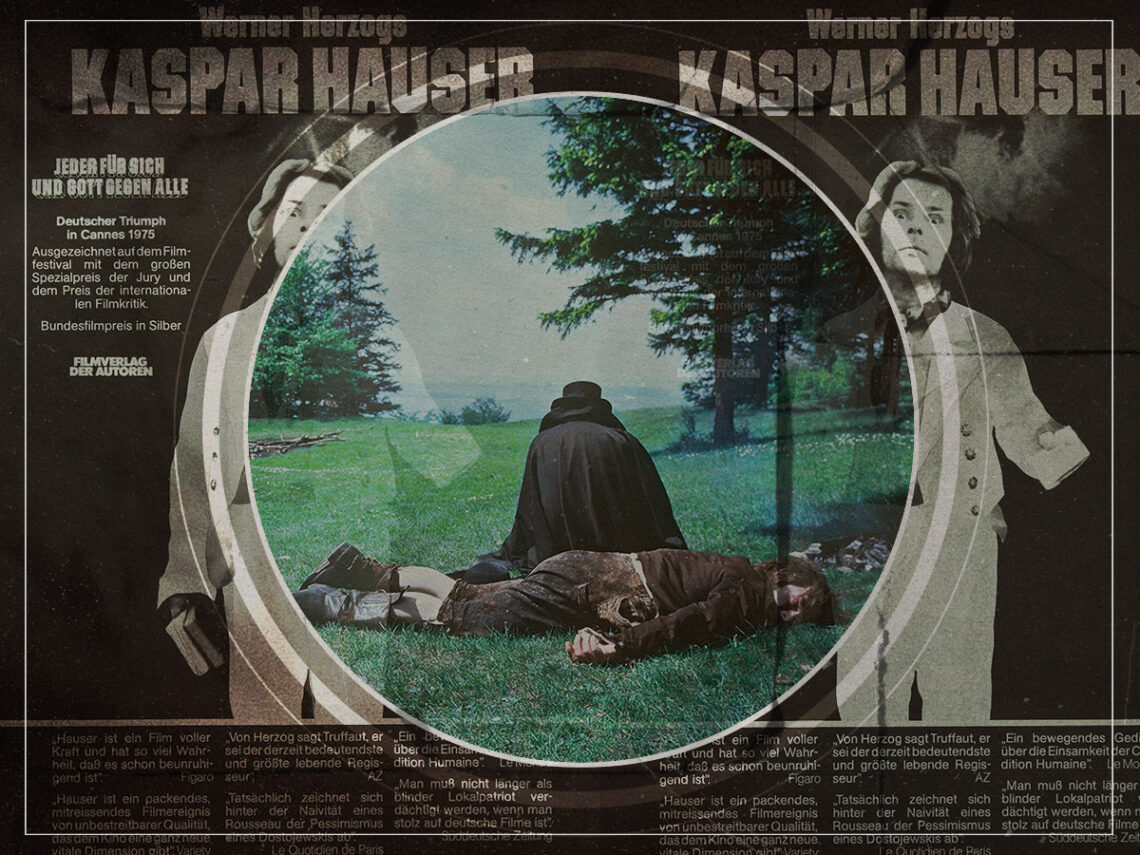
Who was Kaspar Hauser from Werner Herzog’s eponymous drama film?

A true master of German cinema within the dual realms of both fiction and documentary, Werner Herzog has a back catalogue of works that speaks for itself. Amongst some of his most notable films are Aguirre, the Wrath of God, Fitzcarraldo, Bad Lieutenant: Port of Call New Orleans, and Grizzly Man.
Herzog’s themes and treatments spread far and wide. His fictional efforts often feature protagonists with wild ambitions, while his documentary works frequently focus on individuals who seem to be in contrast with the natural environment surrounding them. When it came to his 1974 effort, The Enigma of Kaspar Hauser, he used a real story surrounding a strange 19th-century German youth as the basis for stunning drama.
In 1828, a 16-year-old adolescent named Kaspar Hauser suddenly showed up in Nuremberg, Germany, claiming to have spent much of his life in a dark, isolated cell with no human contact. The sudden appearance caused much public speculation and intrigue in Germany at the time, and Herzog captured the strange circumstances of his life in his 1974 film.
Bruno S., known for his frequent collaborations with Herzog, was responsible for playing Hauser, a young man thrown into the highs and lows of society with no prior conceptions of its workings. Throughout The Enigma of Kaspar Hauser, Herzog pays particular attention to the reality of social conditioning and human nature and the disparity between innocence and brutality.
When Hauser first arrived in Nuremberg in May 1828, barely able to walk or talk, he was carrying a letter addressed to a local cavalry captain explaining that he wanted to become a cavalryman like his late father. Another note that Hauser carried suggested that he had been kept in a cell for his entire life, and as he slowly began to learn how to speak and communicate with those around him, his story became one of sheer fascination.
At first, Hauser was imprisoned at the Luginsland Tower in Nuremberg Castle, with some believing that he had been raised in the wilderness. Still, Hauser maintained his isolated cell beginnings, where he had been fed rye bread and water every morning until he was eventually released and brought to Nuremberg by a masked stranger, being taught the phrase “I want to be a cavalryman, as my father was” despite not knowing what the words meant.

Eventually, Hauser was adopted in Nuremberg and began living with a schoolmaster and speculative philosopher by the name of Friedrich Daumer, but later suffered a number of injuries, first a cut wound on the forehead, which Hauser said was inflicted by a hooded figure he recognised as the man who first brought him to the city. Later, after being transferred to the care of Johann Biberbach, he suffered a mysterious pistol wound to the right side of his head, which was played off as an accident, although some believed it to have been caused during an argument.
Over the following years, Hauser was transferred to the care of many individuals and families, including the house of Baron von Tuchor, the British nobleman Lord Stanhope, and another schoolmaster called Johann Georg Meter in the Bavarian city of Ansbach. Many figures distrusted Hauser and thought that he had lied about his early life, and on December 14th, 1833, he was stabbed in the chest in the Ansbach Court Garden, dying of his wounds three days later. Some historians argued that the wound had been self-inflicted.
As Herzog’s title suggests, Kaspar Hauser was a true enigma, and the German director uses his story to examine the contrast between isolated innocence and cruel society, implying that Hauser understands life better than those around him precisely because of his isolation from civilisation, the historical figure himself remains a source of philosophical and sociological intrigue.
There are several theories surrounding Hauser, whether the discarding notion that if he were to have lived in complete isolation in a cell, he wouldn’t have been able to develop beyond the conditions of an infant or the belief that he was really just a pathological liar. After all, Hauser’s story was so full of inconsistencies and even absurdities that it’s rather difficult to believe it in the slightest. That’s not even to mention that some argued that Hauser was the hereditary prince of Baden, being switched as an infant in order to have his family’s bloodline secured 16 years into the future.
Whatever the truth behind Kaspar Hauser’s story, it has provided the basis for some excellent pieces of narrative art. It not only references the works of Herman Melville, Suzanne Bega, and Robert Heinlein but also serves as the source of examination of one of Werner Herzog’s earliest movies, an important piece of cinema that interrogates the reality of human nature and the impact of civil progress.
