


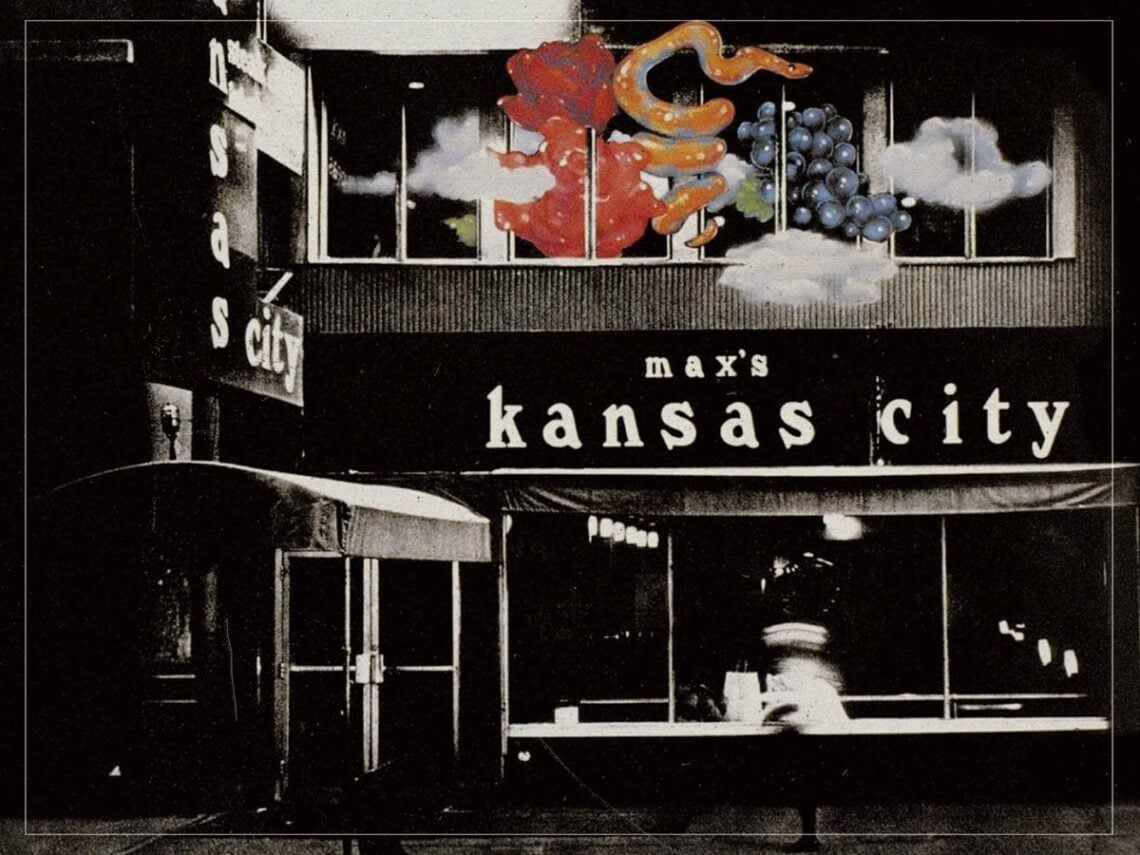
Who played the first gig at Max’s Kansas City?

There’s always a lot of talk about the CBGB, the iconic New York venue that’s often credited with birthing the punk scene, but there was something before that. Capturing the crossover between the fast and glamorous 1960s and the new dark side of the 1970s, Max’s Kansas City was the place to be.
It took on two iterations, two moments divided by one key moment – the shooting of Andy Warhol in 1968. That was a rupture felt city-wide in the art scene, mostly because, as Patti Smith wrote of in Just Kids, the crowd all resolved around the same points. It was “the city’s Bermuda Triangle,” as she called it, “Brownie’s, Max’s Kansas City and the Factory.”
In the ‘60s, Max’s was the spot. Smith writes of reading stories about that period, “When it was the social hub of the subterranean universe, when Andy Warhol passively reigned over the round table with his charismatic ermine queen, Edie Sedgwick.” He was the king, and his court was bustling with superstars, musicians, artists, and drag queens.
But after his shooting, things changed. Warhol basically disappeared. Before, the Factory had an open-door policy, meaning that the countercultural world floated in and out of it before doing the three-minute walk to Max’s for the night, but now the doors were firmly shut. He was no longer there, but the crowd still was, as Smith wrote, “they all seemed as if they were auditioning for a phantom, and that phantom was Andy Warhol.” Even in his absence, the crowd kept up the energy as if still trying to please him. It meant that Max’s still thrived, especially when they started allowing bands.
Mickey Ruskin was the man in charge and he was one of those true patrons of the arts. He hosted happy hours, offering free food and cheap drinks to the drag queens and artists in need. But he also was a stickler for the vibe, a control freak over it, meaning that for a while, the music playing was under his control too.
Given the reputation of the bar-slash-restaurant-slash-social hub, they had offers, or maybe more begging requests, from bands to play there. They turned down big names at first, including one request from The Band, simply because Ruskin didn’t think it suited the atmosphere he was trying to make.
One group did, though, and it’s a surprising one, but one that perfectly captures what Max’s was and who it was for.
So, who was the first band to play Max’s Kansas City?
No, it wasn’t The Velvet Underground. Despite Lou Reed and co being early performers and undeniably the band that put the place on the map as a music venue with their early 1970s residencies that would be immortalised on their Live at Max’s Kansas City, they weren’t the first group in the door.
Despite being known as an iconic rock and roll hub for that scene, the first group to play was from a very different world. It was Silver Apples, an electronic duo that had become a cult act in downtown. Made up of Simeon Coxe and Danny Taylor, the duo were on the cutting edge, bringing an early iteration of the synthesiser to the stage to create psychedelic, electronic music with enough of a rock foundation. They were on the first wave as one of the first acts to adopt the synth outside of the more academic music circles, who were only just getting to grips with it.
That’s what Max’s was all about and what Ruskin cared about – it was to be the hub of the pioneers. So Silver Apples were the first, starting in 1968 and being placed way ahead of any big name. “We were just wild and crazy enough to fit his whole concept of the restaurant,” Coxe recalled, “So we became the house band up there for the longest time, pretty much for a whole year.”
In the years to follow, once the musical flood gates were opened and the spot was more established as a venue, a long list of icons would take to the stage. The Velvet Underground, Alice Cooper, Bruce Springsteen, Patti Smith, New York Dolls, The Stooges, Billy Joel, Television, Talking Heads and so on. It sadly shut in 1981 as another tragic loss from that time, another venue that became a casualty of the times changing.
