


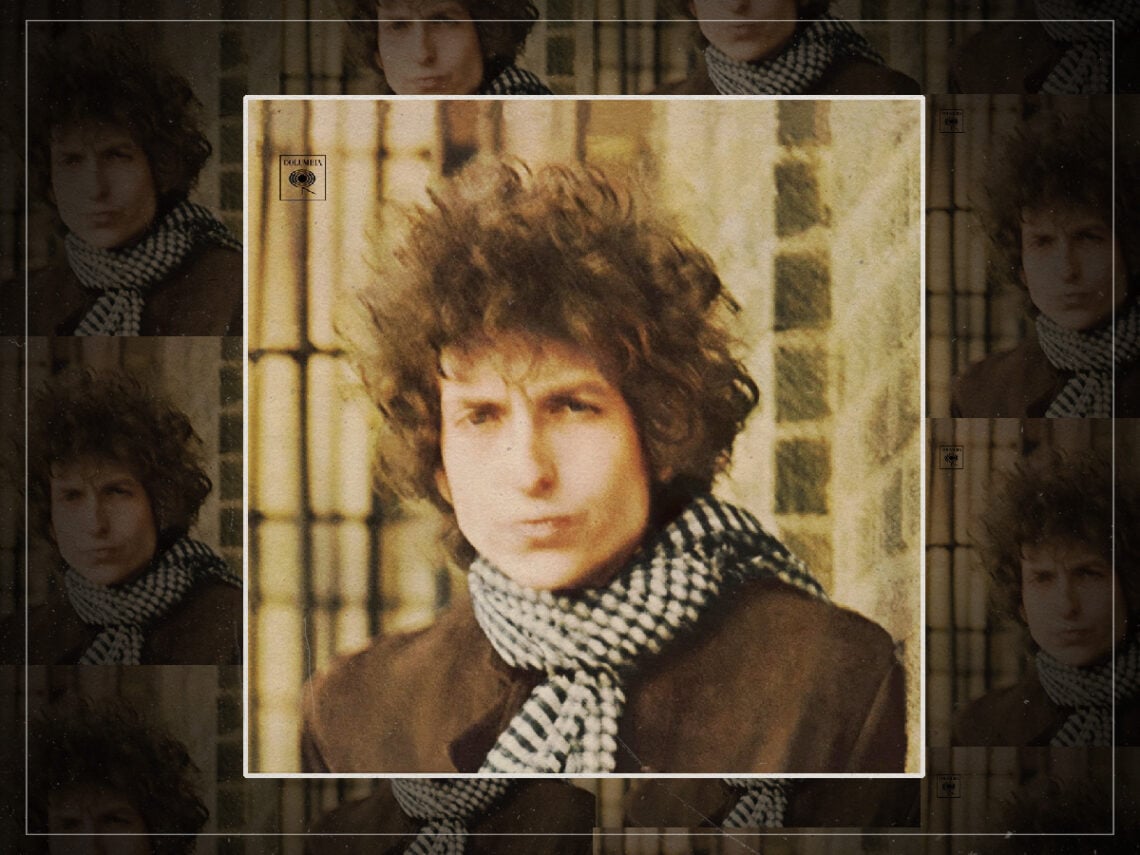
Who came up with the ‘Blonde on Blonde’ album title?

Bob Dylan doesn’t always make it plainly obvious where his album titles come from. While some are named for songs on the records, like The Times They Are-A’Changin’, New Morning, Tempest, some of his album titles tell stories all by themselves.
Another Side of Bob Dylan. Self-Portrait. Planet Waves. Blood on the Tracks. Street-Legal. Empire Burlesque. Time Out of Mind. “Love and Theft”. Rough and Rowdy Ways.
Blonde on Blonde.
But what does that last one mean, and who came up with the name? Dylan himself doesn’t even know. “I don’t even recall exactly how it came up, but I know it was all in good faith,” he has said. “I don’t know who thought of that. I certainly didn’t.”
As with everything that Dylan has ever said, done or sung (let’s call it the AJ Weberman effect), there are countless theories around as to who the titular blondes might be and what the name might mean.
At the time, Dylan was newly, and secretly, married to Sara Lownds, but as she was a brunette, she can likely be ruled out of the running. The same is true of Joan Baez, with whom he so famously shared so many stages in the early part of his career, and of Claudia Cardinale, who was shown in photographs on the original inside gatefold of the double album.
Elsewhere in the images included with the album were some taken of Dylan with Vogue model Sandra Paul, now known as Lady Sandra Sutton, but who in almost every photo with Dylan either has her face obscured to the point of being un-recognisable (indeed, various Dylan superfans over the years have unflatteringly mistaking her for Dylan’s then-manager Albert Grossman in the photographs) or else is hiding both her face and blonde hair behind a magazine cover.
It has long been rumoured over the years that Dylan was also romantically involved with scene-queen, superstar and Factory Girl Edie Sedgwick, and indeed the pair were incredibly close, even at one point trying to work out the logistics of making a movie together. It is said that songs like ‘Just Like a Woman’ and ‘I Want You’ were written about the silver-haired Edie, and that she inspired the title of the album.
It’s also said that Dylan’s long-time disdain for Andy Warhol seems to stem from the way he believed the pop-artist coerced and controlled Sedgwick; the way he so encouraged her excessive drug taking, and how he held back her talents once he had grown paranoid that she might just end up becoming a bigger star than he was. Perhaps Blonde on Blonde, then, was named in reference to the push and pull that was always going on between Warhol and Sedgwick (both of whom, it must be said, were known to dye their hair, rather than being born as natural blondes, but never mind all that).
Another theory is that the album’s title is a reference to the George Tabori musical revue tribute Brecht on Brecht, which Dylan saw off-Broadway in 1963. Suze Rotolo, another blonde and Dylan’s early New York love, took him to see the play and later spoke of his fascination with the legendary German practitioner and his assimilation of Brecht’s ideas, images and use of language in his own work (which you can still hear today, maybe that you can especially hear today, in Dylan’s heavy use of the Sprechstimme talk-singing vocal style).
No matter what caused the album to be named and forevermore known as Blonde on Blonde, and no matter how iconic the cover art (featuring that blurred photo from Jerry Schatzberg) or mysterious the identities of the people on the inside sleeve, the only thing that really matters is the music. This album contains some of the finest music, lyrics and singing from anywhere in Dylan’s career and, therefore, some of the finest music, lyrics and singing from anywhere in music history.

Never Miss A Tale
The Far Out Bob Dylan Newsletter
All the latest stories about Bob Dylan from the independent voice of culture.
Straight to your inbox.