


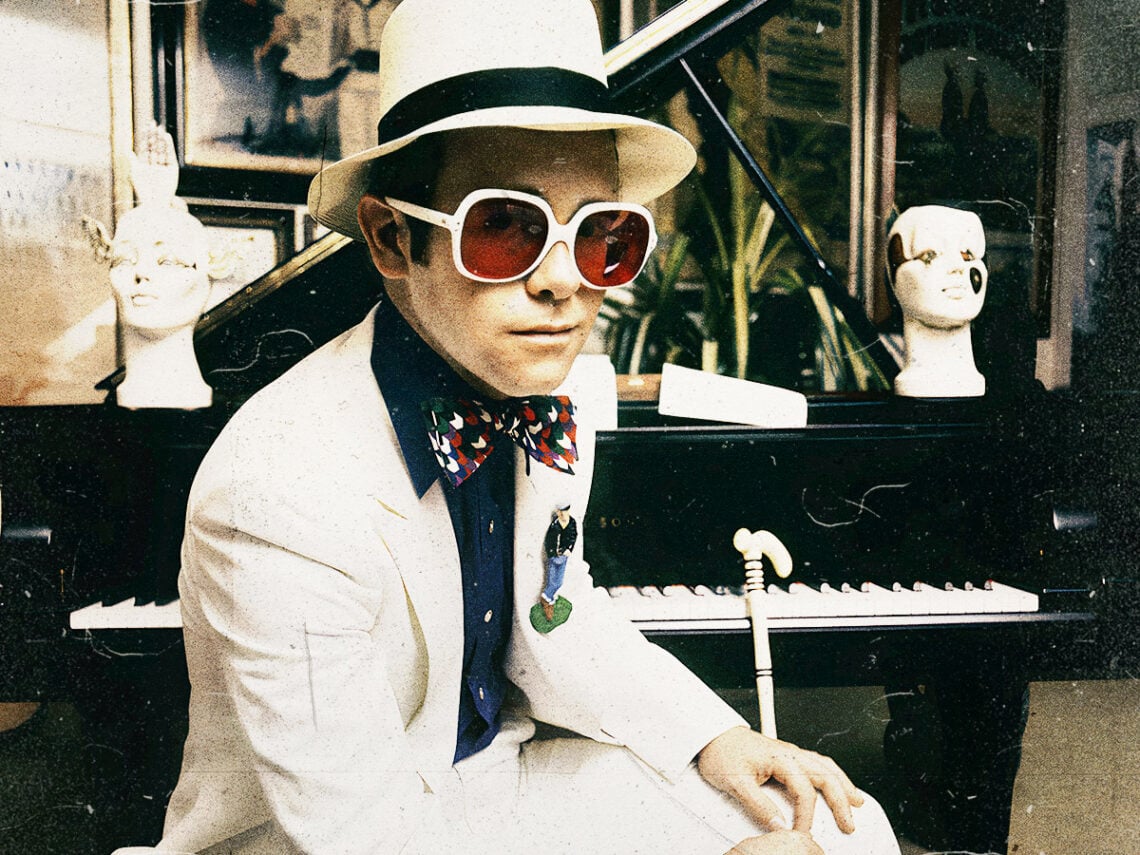
Who were ‘Bennie and the Jets’ from the Elton John song?

Elton John’s 1973 album Goodbye, Yellow Brick Road was a global smash, producing no fewer than four hit singles, each of which has its own distinctive personality and has developed its own legendary status. The last of these singles was the otherworldly ‘Bennie and the Jets’.
The musician himself was reticent at the five-and-a-half-minute track being released as a single, given its unusual structure, slow, staccato-driven tempo and echo-effected drums. Yet it was an unexpected dance hit, in part thanks to its proto-disco vibes and its glam sound. Its studio recording of the song also invokes the thrilling atmosphere of one of John’s live performances. In fact, the live show sound effects are from a show of his at the Royal Festival Hall in London the year before ‘Bennie and the Jets’ was recorded.
John’s songwriting partner, Bernie Taupin, wrote the song’s lyrics first while the two were on a writing retreat together at the Flamingo Hotel in Jamaica. “I knew it had to be an off-the-wall type song, an R&B-ish kind of sound or a funky sound,” John later told Rolling Stone of his initial reaction to the lyrics. “The whole thing is very weird,” he admitted.
The lyrics driving the music make sense for ‘Bennie and the Jets’ perhaps more than any other Elton John song. But that process doesn’t help clarify the meaning of the lyrics in the first place. Who is the weird and wonderful titular character, with “electric boots” and “a mohair suit” and her “weird” but “wonderful” set of jets?
In your heart when she ain’t in your speakers?
The song makes several allusions to Bennie and the Jets, a music act that experiences the highs and lows of being mass entertainers. They feature in a magazine John claims he’s read, but later, they become “victims of the crowd”, and he complains that their “music’s lost its soul”.
Their leader, Bennie, is a charismatic female frontwoman suited and booted with exotic wool and cyberpunk electricity. Accompanied by “spaced out” backing band members “Candie” and “Ronnie”, Bennie delivers “ageless” music to make her masses of fans cry “tears of joy”. Still, she’s reduced to “selling sex” to satisfy her record label. But who was she?
Taupin explained that Bennie was a fictional character fronting a fictional band. Something akin to David Bowie’s Ziggy Stardust and the Spiders from Mars, from his landmark glam rock album, released the year before Goodbye, Yellow Brick Road.
The song wasn’t the first time John and Taupin had created a fictional musical universe with one of their songs. John’s 1972 single ‘Crocodile Rock’ tells the story of a make-believe dance from the late 1950s, which he reflects on nostalgically. It reflected the wave of nostalgia for all things rock and roll in the early 1970s, a phenomenon that underpinned the glam rock genre.
‘Bennie and the Jets’, on the other hand, is looking forward. Not only to disco music of the late ‘70s, but the punk rock movement that other glam bands like the New York Dolls prefigured. Taupin “saw Bennie and the Jets as a sort of proto-sci-fi punk band, fronted by an androgynous woman, who looks like something out of a Helmut Newton photograph.”
Perhaps Ronnie and Candie were named after two 1960s icons: Ronnie Spector, the lead singer of the Ronettes, and Andy Warhol’s transgender superstar Candy Darling. But otherwise, the song is moving full steam ahead towards the two prospective music revolutions just around the corner.
