


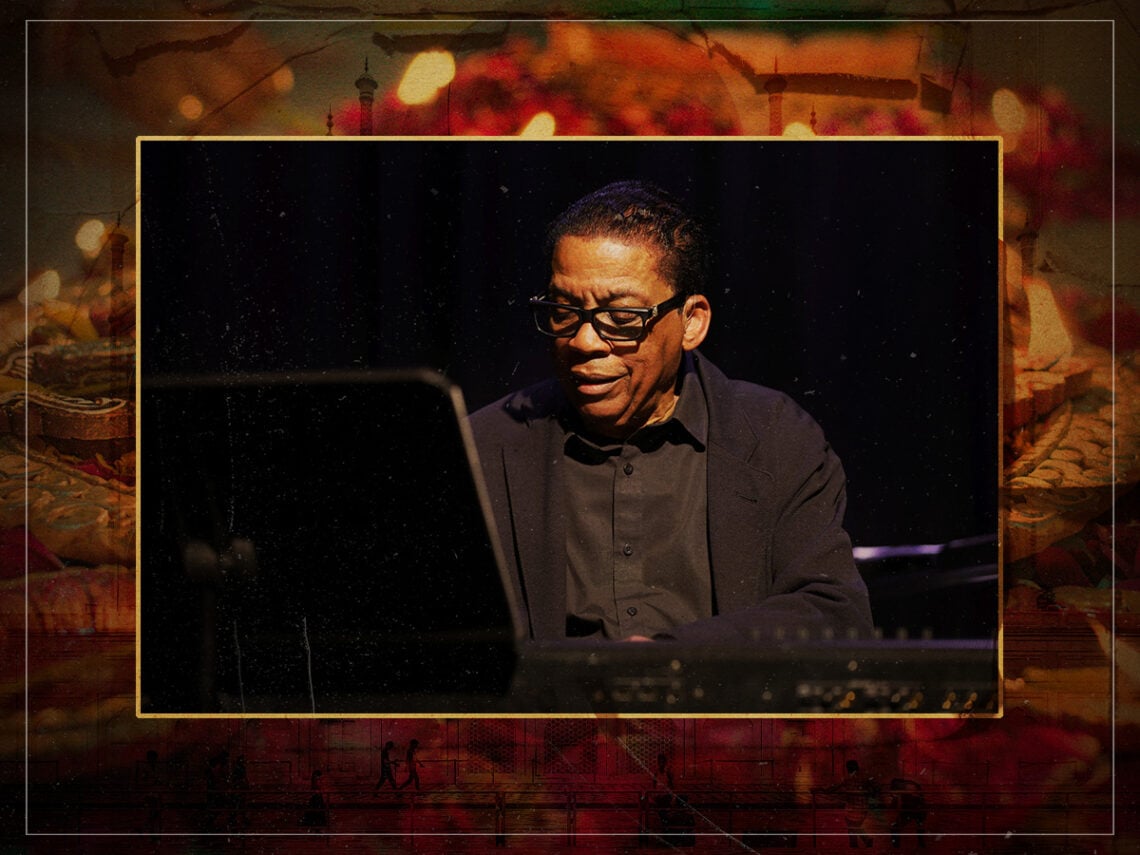
‘The Song Goes On’: when Herbie Hancock traveled to India to record a classic

Sometimes inspiration comes to you, and sometimes you have to go to it. If your process at home has stagnated, it’s time to pack a bag – so that’s what Herbie Hancock did.
In 2010, Herbie Hancock released a truly global record. The Imagine Project was specifically dreamed up to take him to as many countries as possible, engaging with as many different musical cultures as he could cram into a ten-track lineup.
“It’s a record that’s basically about peace,” Hancock explained to Billboard magazine. He added, “To me, the path towards peace is through global collaboration, so the heart of this record is the idea of making a global record or an international record, in multiple languages and in a variety of places.”
Artists are often looking for things they can do to help the world. Using music to do so is nothing new, but on this project especially, Hancock was interested in the simple power of merely working together, of bringing people from different backgrounds together, and using the mutual language of creativity to build a connection.
And so, the making of the record involved a lot of jet-setting. He found himself setting up shop at studios all around the world, calling in a global cast of musicians alongside some celebrity names like Jeff Beck or Pink.
But perhaps the most interesting track on the album is the final one. Chaka Khan is on that one, but more intriguingly, Hancock packed a bag, flew to India, set up shop in Mumbai, and called in the best of the best, including KS Chithra and Anoushka Shankar, the daughter of Ravi Shankar, who is now a pro on the sitar in her own right.
The song they were working on was not born in India, though. As with all of the songs on the album, the track had nothing to do with the place he chose to make it in. Instead, ‘The Song Goes On’ is an old Larry Klein song, inspired by an even older poem from Rainer Maria Rilke.
With that source material, though, Hancock was intrigued by the idea of making it bilingual and multicultural, bringing in a whole new world of sounds. “The poem is about music and space, the space between notes. And Larry got it translated into Hindi. So we were able to record Chaka singing in English, Chithra singing in Hindi, with Anoushka Shankar on sitar,” Hancock recalled, also bringing in Khan and adding, “I thought she might be interested because she’s so open to music and the joy she has when she has the opportunity to connect with jazz.”
The result is something special and something that encapsulates the entire project – bringing together global collaborators through a shared language of music. But more so than that, it brings them together through a unique and fascinating tapestry where the sounds and styles of different cultures work in tandem, making that collaborative music all the most interesting and exciting.
