


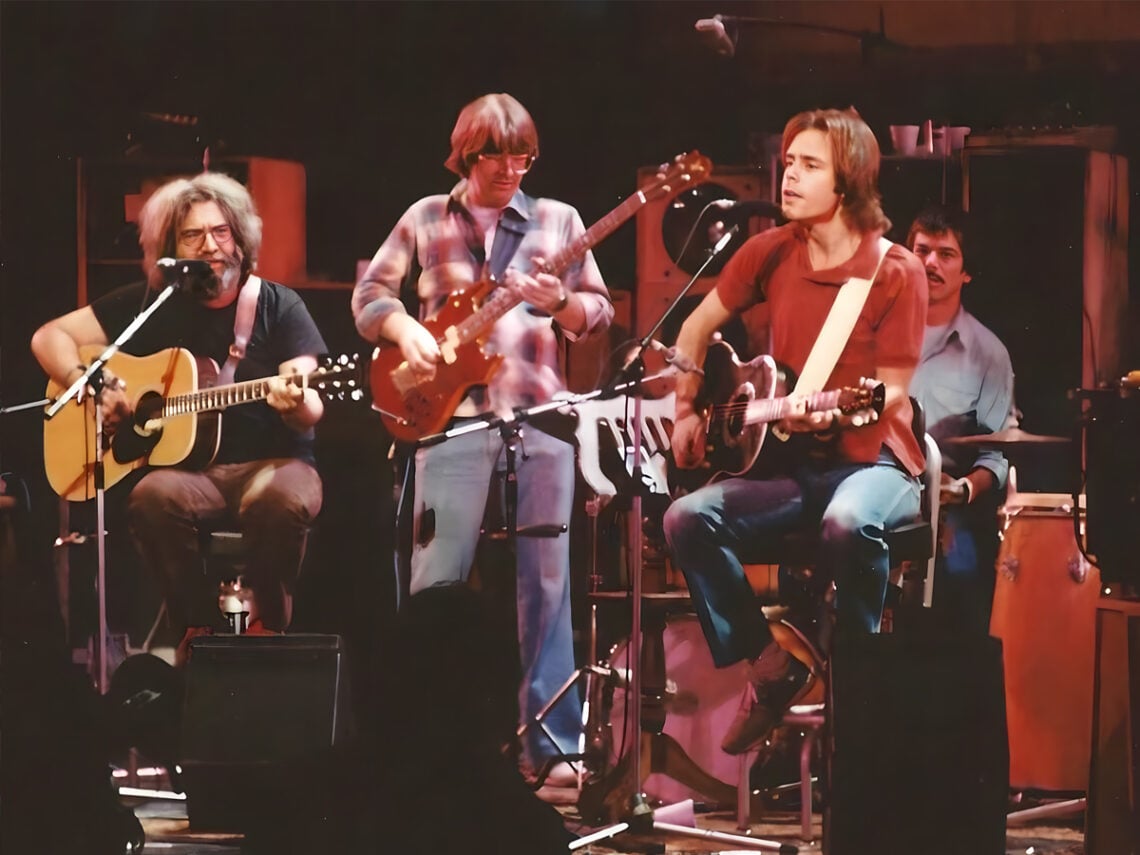
“Busted, down on Bourbon Street”: When Grateful Dead fought the law

On March 14th, 1993, the audience of Grateful Dead at the Richfield Coliseum in Ohio was treated to an unlikely cover version capping off one of The Dead’s trademark marathon setlists.
Now, covers in a Grateful Dead setlist are nothing new. In fact, the fourth song on that particular setlist, approximately three days earlier, had been a spirited run through of the Bob Dylan classic ‘Just Like Tom Thumb’s Blues’. However, this was something new.
To close the show, the band cued up a version of ‘I Fought the Law’. A song nominally by The Crickets, but let’s be real here, these days it’s as much a song by The Crickets as ‘Still D.R.E’. ‘I Fought the Law’ is a Clash classic on the level of ‘London Calling’ and ‘Should I Stay or Should I Go’, but this version sacked off Strummer and co’s punk rock ramalama in favour of something close to the original. A bashful, piano-led run-through emphasising the “it’s a fair cop guv’nor” nature of The Crickets’ hit.
The irony is that The Dead have as much reason to rage against the cops as The Clash ever did. This may be somewhat of a surprise to you. After all, the Grateful Dead have all the hippie credentials of Willie Nelson at Woodstock, clad in nothing but mud with a lit joint in every orifice. Surely they’re all “peace and love”, right? Well exactly. They are. And since when has the American legal system ever let that particular infraction go unpunished?
Grateful Dead had more than their fair share of troubles with the law when the American government took aim at the marijuana. As the 1960s turned into the 1970s, Richard Nixon’s famously upstanding and trustworthy White House decided that it wasn’t the worsening Vietnam War or the atrocities committed against civil rights leaders and protestors that was corrupting the youth of the USA. No, it was ‘the devil’s lettuce’.
How did Grateful Dead get in trouble with the law?
Thus, as the 1960s came to an end, attempts were made to make an example out of anyone still associated with hippie culture. Since The Dead were the ultimate hippie band who’d literally formed in the Haight-Ashbury neighbourhood of San Francisco, where the movement began, this led to more than a few brushes with overzealous narcs with twitching noses.
The first such instance was in 1967, when the band’s shared home was raided without a warrant by eight narcotics agents and a dozen reporters and TV crews. Two of the band’s members were arrested, along with nine of their entourage, including their managers. It was clear this was a sham for the cameras, as a press conference was held in The Dead’s living room shortly after the group was released on bail.
After a thoughtful statement condemning the arrest, the first question from the assembled press was about how long it took for Danny Rifkin to grow his hair out that long. Go figure. However, a much more serious brush with the law occurred in 1970. With the dissolution of the hippie dream, the movement wasn’t the powerhouse it had been a few years earlier, but The Dead were still a powerhouse band and one of the biggest live draws in music.
Thus, their arrest in New Orleans for drug possession made national headlines and saw them banned from the state of Louisiana for the next seven years. This clearly bothered the band as it made its way into the lyrics of their classic song ‘Truckin’: “Busted, down on Bourbon Street / Set up, like a bowlin’ pin / Knocked down, it gets to wearin’ thin / They just won’t let you be, oh no”.
The ultimate irony of this all is that despite the attention from law enforcement officers, the Grateful Dead are, y’know, the Grateful Dead; quite possibly the least intimidating band in rock history. Yet, that’s what happens when an oppressive authority turns its all-seeing eye upon you. It doesn’t matter what you’ve done; it’s wrong. The Dead fought the law, and while in the moment, the law won, they also showed just how much you can thrive in the face of authority trying to shut you up—something to revere in this day and age.
