


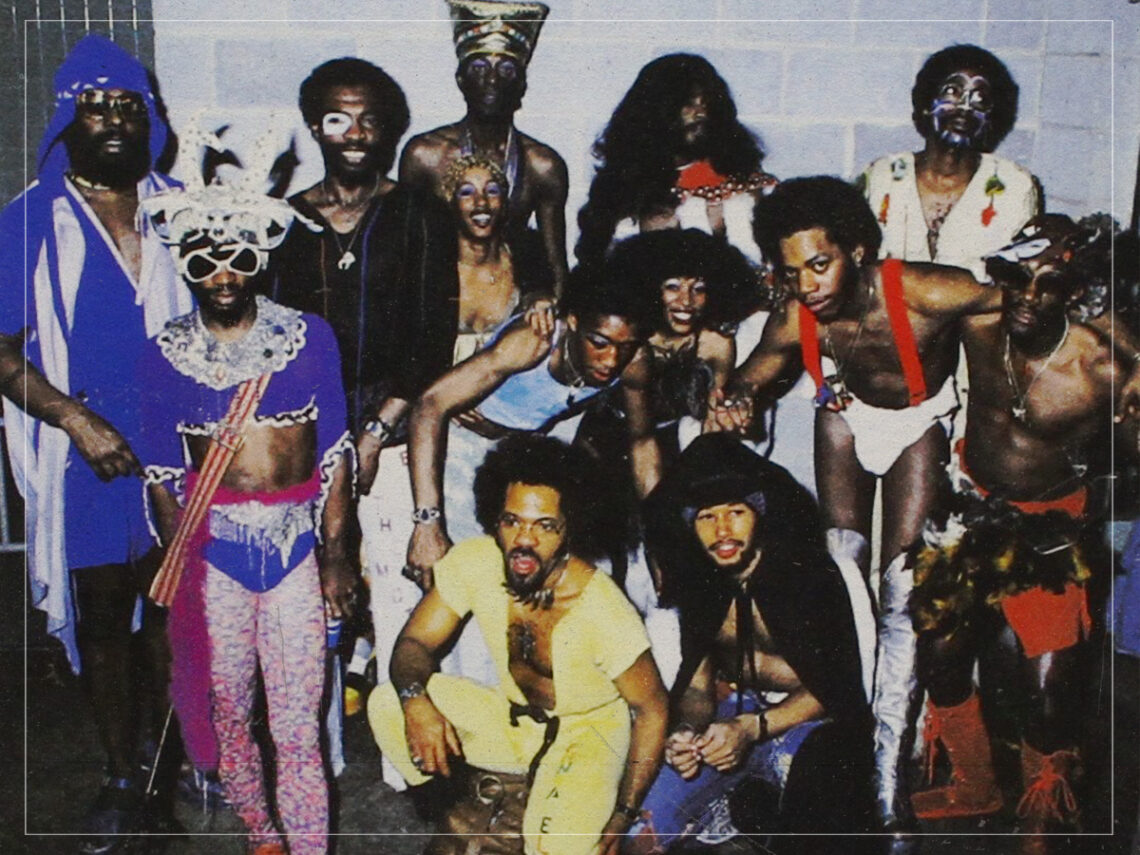
When Funkadelic’s liner notes were written by a cult: “We really did get loony”

When first considering George Clinton’s P-Funk mythos, most’s immediate internal flash is the Parliament mothership floating through the cosmos, scored by interstellar funk conjurings and a sci-fi blitz of Afrofuturist, UFO glam.
It’s arguably P-Funk’s most famous incarnation. But, before Dr Funkenstein, bop guns, and ten-foot spaceships descending on stage, the eccentric ensemble was largely captained underneath the Funkadelic moniker, an infinitely darker, grittier, and psychotropic brew of street-level lyrical reportage of the American Black experience scored with acid-fried soul and heady rock heft. Charged by a fiercer political edge, Funkadelic followed the paths paved by Sun Ra and Sly and the Family Stone to cut the record that forever defined their LSD soaked thunderstorm.
The arresting cover said it all. Depicting Barbara Cheeseborough’s Afro’d Mother Nature screaming from the earth, 1971’s Maggot Brain sought to capture a primal howl echoing from the depths of a US counterculture long passed from peace and love idyll to a nightmarish bad trip of social unrest, future uncertainty, and the Civil Rights gains’ initial afterglow a faint echo. Such demonic summoning demanded a fittingly apocalyptic conceptual anchor. As well as Clinton’s stirring opening narration, and Eddie Hazel’s devastating guitar solo on the ten-minute title-track’s scarred ruminations, further apocalyptic dread was conjured on the record’s lengthy polemic slapped across its liner notes.
“Fear is at the root of Man’s destruction of himself,” states the first paragraph. “Without fear, there is no blame. Without blame, there is no conflict. Without conflict, there is no destruction.”
Such fraught recitals came straight from the era’s surge in new religious movements, ensnaring many a lost soul wandering the era’s confusing political upend. Introduced to Clinton by band associate Ron Scribner, the teachings of the UK’s Process Church of the Final Judgement found their esoteric way in shaping the evolving P-Funk lore.
Founded in 1966, former Scientologists Mary Ann MacLean and Robert de Grimston conceived of a quasi-sect espousing the doctrinal idea that human personalities were made up of four divine character elements being Jehovah’s strength, Lucifer’s light, Satan’s separation, and Christ’s unity. Considered the “Great Gods of the Universe”, each Process member was instructed to embrace two of the four divinities to realise their spiritual identities in rejection of the conforming pressures of society.
It was all febrile, conceptual fodder to slather his violent new LP with, lifting the church’s ‘Process Number Five on Fear’ text as a further slice of Maggot Brain’s evil enticement. There was also a hell of a lot of acid indulged in, as well as plenty of cocaine and smack passed around by P-Funk’s younger members, all fuelling the sessions’ feverish visions, but the Funkadelic head was never a true believer in the Process’s cult influence.
“I guess we really did get loony and didn’t know it,” Clinton confesses in Kris Needs’ 2014 book on the band. “I wasn’t no guru ’cause I’m still trying to get some pussy. I don’t want nobody taking me seriously like I ain’t… But I ain’t no fool either. I knew we made a big step. We came out of the ghetto, where you got to watch your back about everything. Now here I’m gonna take something that ain’t got no reality to hold onto whatsoever, but it felt good. It was a permanent smile on my face.”
Looking back on those chaotically creative days, Clinton saw Maggot Brain’s cabalistic burnishing as a necessary part of P-Funk’s artistic evolution. “I don’t regret that,” he made clear. “I don’t regret nothing I did, if I did it. I try to find out what’s the best lesson I can learn from it. I look at anything like that; what is it trying to tell me? And if it’s something that’s hurtin’, I usually find out about it before it has a chance to hurt bad.”
