


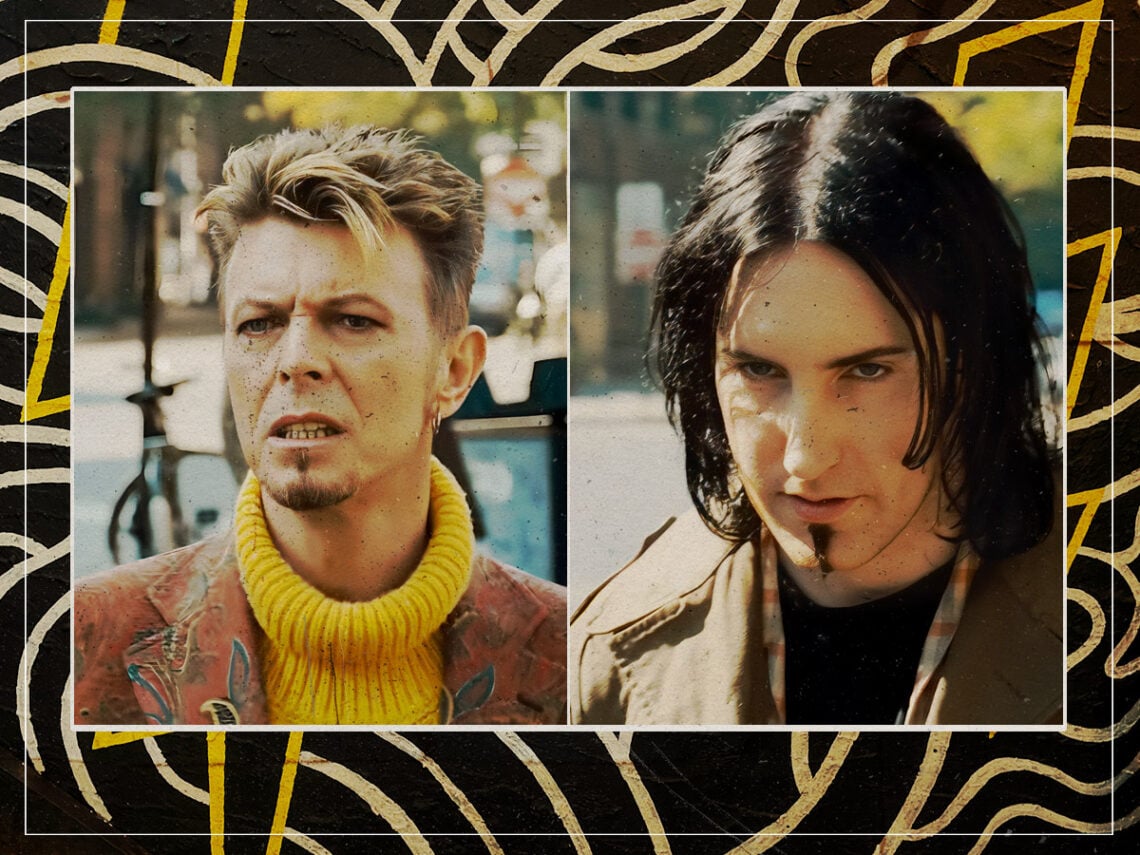
‘I’m Afraid of Americans’: when David Bowie embraced Nine Inch Nails

In one of the great album advertising that rubs shoulders with some of Hollywood’s most famous taglines, giant billboards promoting 1977’s smoggy ambient-rock Heroes came bolstered by the immortal lines: “There’s old wave. There’s new wave. And there’s David Bowie…”
It’s a statement that couldn’t have rung truer. Still firmly firing on all creative cylinders, the ‘cracked actor’ entered the next decade with the art-pop masterstroke Scary Monsters (and Super Creeps) led by the synth-spiked Major Tom resurrection of ‘Ashes to Ashes’, a record still haunted by the electronic ghosts from his Berlin experiments but reined in with a bolder, confident accessibility for the pop charts. Bowie’s 14th studio LP became a benchmark by which all future releases would be measured.
The end of the 1980s was markedly different. In a career defined by artistic integrity, the taste of MTV superstardom Bowie enjoyed with 1983’s Let’s Dance saw him wantonly drifting away from the musical vanguard into the decade’s campier excesses, from Labyrinth‘s Goblin King rap to the abysmal ‘Dancing in the Street’ cover with Mick Jagger and reaching his conceptual nadir with the bloated theatrics of his tedious Glass Spider Tour.
Eager to shake off his creative dead end, Bowie sought inspiration from the US alternative underground, particularly Pixies, and assembled the short-lived Tin Machine rock band before jumping back into electronics with 1993’s Black Tie White Noise. Teaming up with Brian Eno again following ’79’s Lodger, Bowie harnessed the abrasive industrial dissonance conjured by the likes of The Young Gods for Outside, the first in an intended detective narrative album series, its lead single ‘The Hearts Filthy Lesson’ marked the first collaboration with Nine Inch Nails’ Trent Reznor, providing one of the track’s many remixes.
Bowie’s and Reznor’s paths had crossed during a period of the former’s career rejuvenation and the latter’s critical zenith, dropping their seminal The Downward Spiral in ’94 and serving as the second disaffected poster boy of the American alternative after Kurt Cobain, not a mantle Reznor was entirely comfortable with. Opening for Bowie on the US leg of his Outside Tour, the two artists worked with a unique segue into each others’ sets, transitioning organically typically via ‘Eraser’s thunderous instrumental. The innovative ideas received a mixed reception, and the two camps in the audience were not without some mutual alienation toward the clash of stylings.
The pair’s most winning collaboration would arrive a few years later. Originally featured on the Showgirls soundtrack, ‘I’m Afraid of Americans’ was reworked for 1997’s jungle and techno-infused Earthling and released as its fifth and final single. A sardonic barb toward the USA’s imperial stranglehold on every corner of the globe, the seeds of ‘I’m Afraid of Americans’ came from Bowie’s dismay at witnessing Indonesia’s Java island’s first McDonald’s: “The invasion by any homogenized culture is so depressing, the erection of another Disney World in, say, Umbria, Italy, more so. It strangles the indigenous culture and narrows expression of life.”
It’s Reznor’s ‘V1’ remix, which scored the memorable music video. Depicting a paranoid Bowie’s increasingly panicked navigation around New York City stalked by the omnipresent persecution from ‘Johnny’, played by Reznor during his late-1990s cool-off before The Fragile. It was the final Bowie single to chart on the Billboard Hot 100 until ‘Blackstar’s’ release in 2015.
Bowie’s earnest collaboration with one of industrial metal’s most forward-thinking and innovative artists spoke volumes about his ceaseless creative curiosity and was a highlight of Nine Inch Nails’ storied career that wasn’t lost on its frontman and life-long Bowie fan. Crafting a special ‘Farewell Mix’ of ‘I Can’t Give Everything Away’ shortly before his death, Nine Inch Nails performed the track as a mark of respect to the ‘cracked actor’ sporadically throughout their sets toward the end of the 2010s.
