


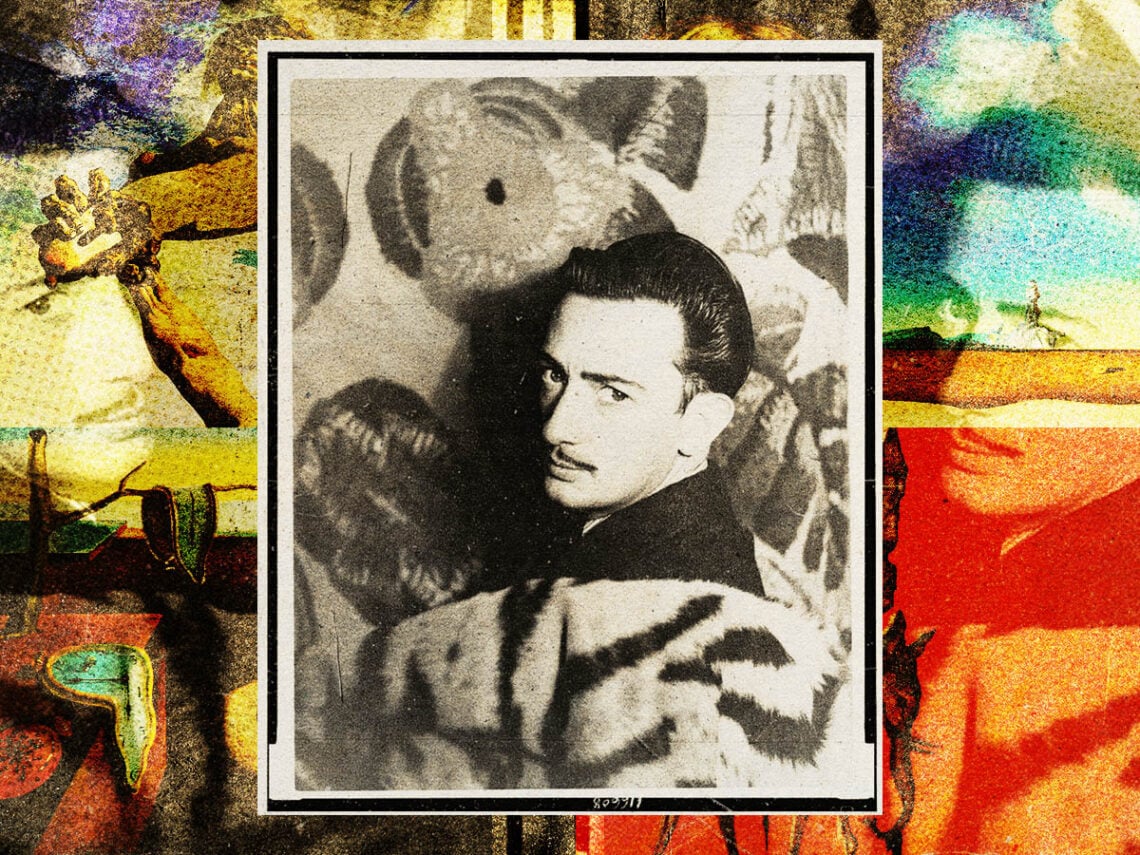
When Salvador Dalí sent Harpo Marx the worst Christmas gift in history

The undisputed titan of 20th-century surrealism is, without question, Spanish artist Salvador Dalí.
Influenced by impressionism but drawn to the avant-garde, his innovative explorations of sexuality, the subconscious, religion, and his esoteric philosophy dubbed “nuclear mysticism” yielded work encompassing an exhaustive scope of craft and practice across painting, sculpture, film, and poetry, 1931’s The Persistence of Memory‘s melting clocks and the razored eyeball from his collaboration with Luis Buñuel on 1929’s Un Chien Andalou ingrained into the popular consciousness.
Famous for his eccentric public profile as much as his work, Dalí’s embrace of celebrity illustrated his lack of distinction between high and low art, naming Cecil B DeMille and Walt Disney as two of the “three great surrealists” in his estimation, collaborating with Disney on the Destino short, long-shelved as an incomplete project before finally seeing a release in 2003.
The other of Dalí’s ‘great surrealists’ was Hollywood comic Harpo Marx. A key fixture of the Marx troupe of vaudeville brothers, the curly-haired Harpo’s mute slapstick theatre played off the wise-cracking wordplay of Chico and Groucho as immortalised in comedy classics Duck Soup and A Night at the Opera. Meeting in 1936 at a Paris party, Dalí allegedly told Marx that the 1930 madcap musical Animal Crackers was “the summit of the evolution of comic cinema!”
In the 2006 essay The Mindset of Salvador Dalí, Stephen Francis Saladyga find humour’s surrealist foundations: “Humor in relation to Surrealism ‘turns our accustomed attitudes upside down by misplacement, surprise, and unexpected associations’ (Duplessis). This technique is most present in movies, such as Animal Crackers by the Marx Brothers, and uses laughter to free the spirit, which is constantly kept in the shackles of mainstream society. By pointing out the absurdities in society, the Surrealist technique of humour can lead to uprisings directed toward an established society.”
Writing in a Harper’s Bazaar piece in 1937, Dalí recounted a wholly verified and grounded account of the pair’s meeting: “I met Harpo for the first time in his garden,” he said. “He was naked, crowned with roses, and in the centre of a veritable forest of harps (he was surrounded by at least five hundred harps). He was caressing, like a new Leda, a dazzling white swan, and feeding it a statue of the Venus de Milo made of cheese, which he grated against the strings of the nearest harp. An almost springlike breeze drew a curious murmur from the harp forest. In Harpo’s pupils glows the same spectral light to be observed in Picasso’s.”
When Harpo returned to America, Dalí sent one of the strangest Christmas presents on record. A full-size harp wrapped in cellophane with spoons for tuning knobs, cutlery glued all over the frame and strings made of barbed wire. Marx was delighted with his hazardous instrument, sending a photo back with him playing the harp with bandaged fingers.
Invited to visit America for a portrait, Dalí and his wife Gala headed to Hollywood to sketch Marx playing the harp with a lobster on his head. Bearing more gifts, Dalí presented a script for Giraffes on Horseback Salads or The Surrealist Woman, a surrealist love story between a Spanish aristocrat (played by Marx) and an unknown mysterious woman, proclaimed by Dalí to be exploring “the continuous struggle between the imaginative life as depicted in the old myths and the practical and rational life of contemporary society.”
Groucho and the brothers rejected it outright, and the studio heads couldn’t make sense of its bizarre plot, but perhaps its drop as a project was beside the point: Dalí sought to express his respect for the legendary comic in boundlessly creative ways.
