


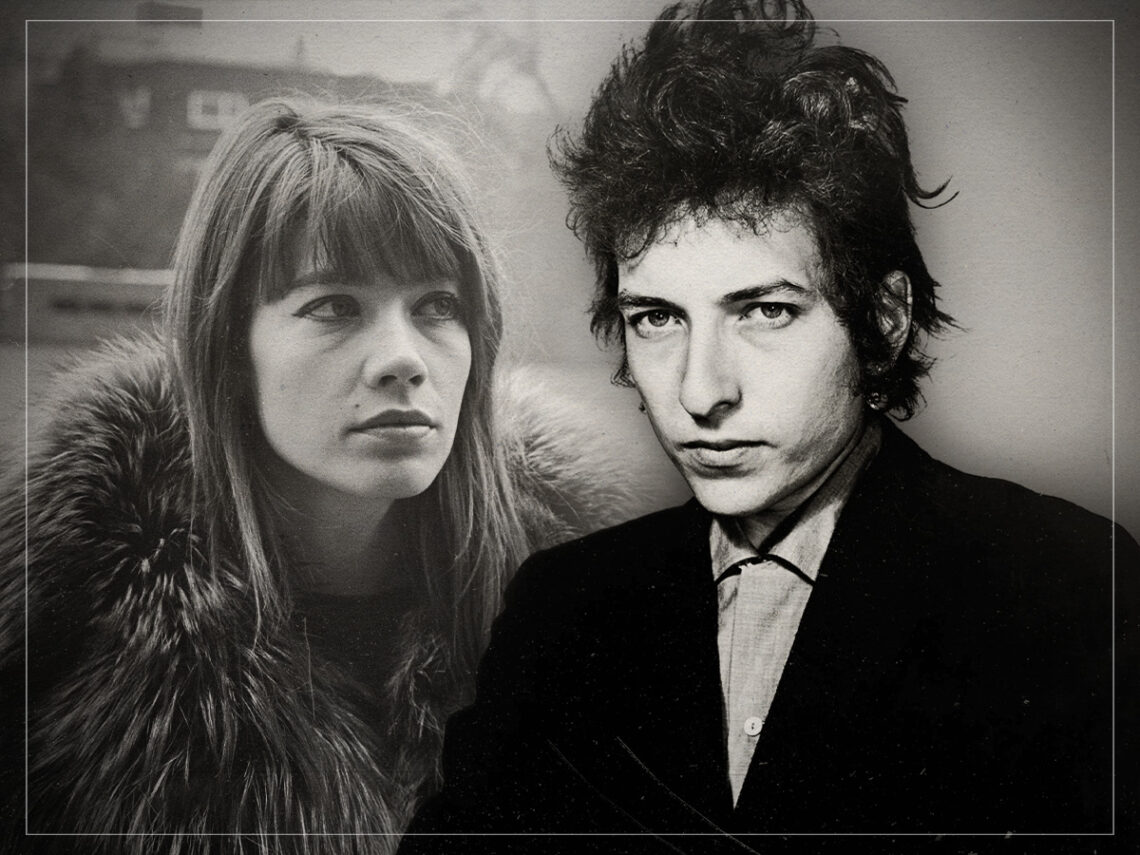
When Bob Dylan attempted to seduce Françoise Hardy: “A romantic fixation”

In the 1960s, Bob Dylan floated around like a mystic numen, capturing the zeitgeist on the wing.
The original vagabond drifted in and out of scenes and social circles, harbouring support or critique at opportune moments. There are countless pivotal junctures underpinned by fleeting intervention sprung forth by the folk sensation, like when he just so happened to pop into the same hotel as The Beatles, turn them onto grass, and completely change their discography, like a magician, in the plume of smoke that followed.
However, the Fab Four weren’t the only ones who found the Freewheelin’ troubadour randomly stumbling into the same hotel. Françoise Hardy, the chic French pop sensation, also happened upon him in a Parisian auberge in 1966. “It was truly a shock to see him,” she recalled. He may well have been less surprised to see her.
She was even more dumbfounded by what followed. That night, he regaled her with hits destined for the world’s first double album, Blonde on Blonde. These were demos destined to change the world, and here he was regaling them shyly in a sepia-toned suite. The enamoured brunette watched on in amazement.
Dylan had just played a set at the Olympia in the midst of his divisive first electric tour. The rigours of the road were taking their toll. Robbie Robertson likened the experience to a roving war, and Dylan was weary. He might have simply instructed his band to ‘play louder’ when calls of Judas were hurled towards them, but the barrage wasn’t always easy to manage.

So, when Hardy and Johnny Hallyday found themselves in his George V hotel room, his battered frame cut a stark contrast to the glossy opulence of the plush abode. “He looked even worse than he did backstage. So thin, so pale, so strange. I honestly thought he did not have long to live,” Hardy told Sean O’Hagan.
She was, however, too dumbstruck to see the none-too-subtle subtext of why he had summoned them to his room… even when he serenaded her with ‘I Want You‘. With a certain degree of flushed cheeks, she recalled, “I was too busy listening intently to the songs, which sounded like something entirely different to anything I had heard before. Plus, I was so impressed and petrified to meet him.”
That’s a natural enough reaction, but years later, she would find out that he was most likely feeling the same way. At the time, he had already, in a roundabout way, dedicated his album Another Side of Bob Dylan to her, adorning the sleeve of his softer album with a poem in her honour.
“For Françoise Hardy, at the Seine’s edge, a giant shadow of Notre Dame,” it read before unravelling into fragmented beat verse, capturing the happening scene that she helped to set up in the always hip Gay Paree. However, years down the line, the extent of her influence over him would become a lot clearer.
In the 2010s, the ‘Le Temps de L’amour’ singer received a letter from an American couple who had once owned a cafe in Greenwich Village where Dylan would obsess over the works of Fyodor Dostoyevsky and other literary greats. Moved by their work, he would then use this cafe as an office of sorts and pen his latest lyrics. With coffee before him and smoke billowing, he’d bash out anything that moved him on the rickety typewriter in the corner.
In his scatty creative haze, he’d often erroneously leave behind drafts that the cafe owners would look to give back to him on his next visit, only for him to shrug them off. In his mystic ways, maybe he figured if he forgot them the first time, then they weren’t meant to be. For everything a reason.
Joan Baez said he was just the same with his melodies, frequently letting would-be classics slip down the back of the piano. In fact, that’s how she happened upon one of her own folk hits, “I mean, literally ‘Love Is Just a Four-Letter Word’ he wrote, dropped behind a piano somewhere and forgot about,” she recalled on Desert Island Discs.
She continues: “I retrieved it in my own house and learnt it. And I guess a year later was singing it, and he said, ‘Hey, that’s a great song, where’s that from?’” Dylan would ask. Baez would reply gobsmacked: “You wrote it, you dope!”
How lust thrust Dylan into the spotlight
While the letters he left in the cafe might be less culturally consequential, they prove no less insightful. Amongst the copies that the owners had kept over the years were a couple of love letters written to Hardy. “So, this is how, only a year or so ago, I realise that in the early 60s, Bob Dylan maybe really had a romantic fixation on me – as only young people can have,” Hardy recalled.
While this romanticism never materialised into anything beyond a fanciful imagination and a fateful meeting in a grand hotel room, not far from the very same Seine where he had depicted her in his poem, the extent of her influence on his songwriting at the time is perhaps more pertinent and measurable.
Much like her own tales of sweetness and grit, strawberry serenades lavished with the mercurial zip of vinegar, he channelled the same pulse of hip timelessness profoundly present in everything Hardy ever did. It’s also noteworthy that she would comment ‘as only young people can’ given that you often forget he wasn’t much more than a young lad when he launched the counterculture revolution, clearly, emboldened by the pursuit of romance as much as anything else.
As for the letters, the late star kept them close to her chest. “Oh, no, no. Never could I do that,“ she told the Guardian when they probed for details. “I can say that the two drafts are very moving, but I cannot reveal what they say.”
She added, “Also I don’t understand everything of what he has written. I do think, from the poem he wrote, which I did not take too seriously at the time, and now these letters, that I had quite a place in his mind at that time and even in his heart. I think maybe I was very serious for him. And, it moves me very much.”


Never Miss A Tale
The Far Out Bob Dylan Newsletter
All the latest stories about Bob Dylan from the independent voice of culture.
Straight to your inbox.