


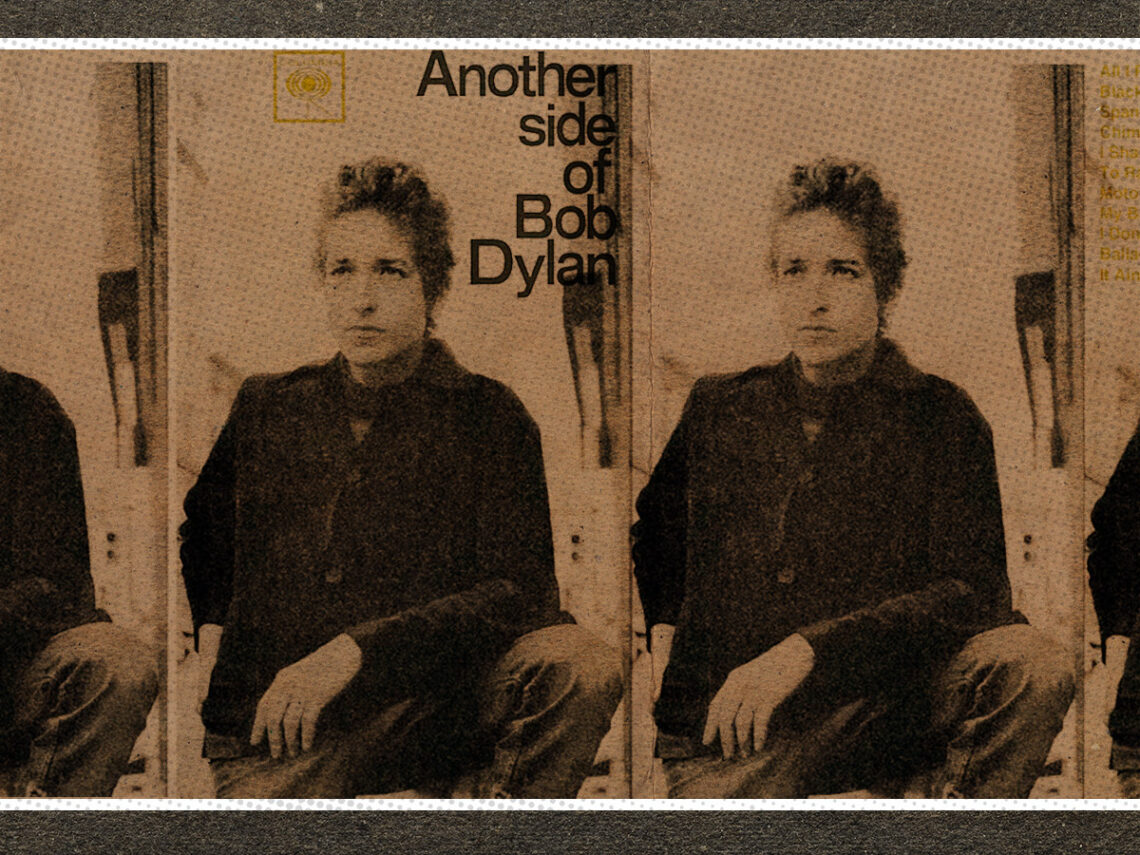
Bob Dylan – ‘Another Side of Bob Dylan’

Nobody knew it, but Bob Dylan was about to change the world of music. He already had in some significant ways, given that he was one of the most talked-about young singers in America, spearheading a folk revival that was fueled by protest songs and social awareness. As he embodied the spirit of Woody Guthrie, Dylan had become a beacon for young radicals and beatniks throughout the Greenwich Village neighbourhood of New York City. And in one fell swoop, Dylan was about to turn his back on all of that.
Another Side of Bob Dylan doesn’t immediately sound like a seismic shift in music. In fact, most of the album sounds exactly like all of Dylan’s previous albums: just him, a guitar, and a harmonica, belting out folk songs for younger generations. But to those that were paying close attention to his lyrics, Dylan was taking his first real steps toward the sacrilegious forsaking of old folk tenets that would get him labelled a “Judas” a few short years later. When he went electric, there was an uproar among Dylan’s true believers. But in truth, Dylan was already a different man all the way back in 1964.
Dylan makes that clear on the album’s first track, ‘All I Really Want to Do’. With a country twang in his voice, Dylan takes a stab at something that seemed almost inconceivable: writing a love song without death or murder entering proceedings. Of course, this being Bob, there’s a twist lurking at the end of each stanza, given that he wanted to be friends instead of lovers. But the lyrics could just as easily have been talking about Dylan’s audience: he was through with being a saviour. Knowing how big his influence had become in such a short time, Dylan proclaimed to anyone who would hear him that he wasn’t “lookin’ for you to feel like me / See like me or be like me”.
Too many things had happened to Dylan for him to look back now. In the six months between the release of The Times They Are A-Changin’ and Another Side of Bob Dylan, he had befriended The Beatles, taken acid for the first time, and broken up with his girlfriend, Suze Rotolo. With his mind officially expanded, Dylan decided that he was done with protest songs. The “finger-pointing” era had come to an end: it was time to see a different side of Dylan’s songwriting.
That mostly meant hearing Dylan either pay homage to – or parody – some of the popular music styles of the time, whether it was blues, pop, or even his own folk style. ‘Black Crow Blues’ is a surrealistic reinterpretation of traditional twelve-bar blues, complete with Dylan’s first recorded piano playing on record. Dylan once again revisits love songs on ‘Spanish Harlem Incident’, romanticising the idea of running off with a gypsy woman and leaving behind his own messy life.
To most observers who picked up Another Side of Bob Dylan for the first time, ‘Chimes of Freedom’ seemed destined to be Dylan’s latest fiery protest anthem. Dylan does manifest images of soldiers and refugees, but also of the luckless, the abandoned, the outcasts, the disabled, the incarcerated, and even the “mistitled prostitute”. Dylan’s biggest revolution on Another Side of Bob Dylan comes through in ‘Chimes of Freedom’ – namely, that he was done writing topical commentaries and was striving for something a bit more universal and finding the individual within that macro theme.
Dylan’s deconstruction of his image continues on ‘I Shall Be Free No. 10’. Positioning himself as just another ordinary person, Dylan dips into the bravado of Muhammad Ali – using his then-current name Cassius Clay – and his own critical acclaim. Throughout the song, Dylan remains purposefully glib, poking fun at his own hard-line stances and remaining hilariously neutral on issues that he previously would have jumped all over, like the Russian space race and the Cuban Missile Crisis. Perhaps more than any other song on the album, ‘I Shall Be Free No. 10’ is the most direct case of Dylan thumbing his nose at the people who took his every word as gospel.
At the time of the album’s recording, Dylan was balancing his breakup with Rotolo with his ongoing affair with fellow folk hero Joan Baez. He remained vague about it, but Dylan is surely singing to one of those two women on ‘To Ramona’. Abandoning his machismo for true vulnerability, he lays his heart bare in one of his most literal breakup songs. As he ends the song with the proclamation of “someday maybe/ Who knows, baby/ I’ll come and be crying to you,” Dylan turns his back on his hardened experience and longs for compassion in the wake of heartbreak.
Almost out of necessity, Dylan attempts to balance out some of the more emotional tracks on Another Side of Bob Dylan with lighthearted material. It is a mark of his wherewithal that he is consciously trying to inject some comic relief after the soul-searching ‘To Ramona’, as he weaves the tale of a farmer with a shotgun in his own Hitchcockian horror movie twist of ‘Motorpsycho Nightmare’. The ebb and flow between the serious deconstruction of Dylan’s persona with humorous jabs at his own ego are what make Another Side of Bob Dylan such a fascinating album. In terms of willingness to forsake his past, Dylan was at the forefront of artistic reinvention.
That reinvention can best be felt on the album’s final four songs. ‘My Back Pages’ pairs Dylan’s folk wheelhouse with a surprising pop melody and flavour. More important than its pop appeal, however, was Dylan’s own acknowledgement that he was done with acting wiser than he was: “I was so much older then / I’m younger than that now”.
Up to that point, Dylan’s records were recorded incredibly quickly. Another Side of Bob Dylan was no exception: Dylan cut 14 tracks in a single night, 11 of which found their way onto the album. His own speed gets the better of Dylan as he messes up the lyrics to ‘I Don’t Believe You (She Acts Like We Never Met)’, chuckling to himself as he fumbles over the order of the verses. It works as a nice and subtle nod to Dylan taking himself off of a pedestal: the man is human, after all, even in the midst of inhuman feats.
Just before Dylan and Rotolo broke up, a physical altercation between Dylan and Rotolo’s sister, Carla. The incident would inspire ‘Ballad in Plan D’, one of Dylan’s longest and least beloved songs. Dylan himself wasn’t fond of the track. “I look back and say ‘I must have been a real schmuck to write that,'” Dylan later claimed. “I look back at that particular one and say, of all the songs I’ve written, maybe I could have left that alone.”
Luckily, Dylan is able to redeem himself on the album’s final track, ‘It Ain’t Me Babe’. His eventual adoption of country music is previewed here, attracting fans like Johnny Cash. This mournful anthem ends Another Side of Bob Dylan on the album’s main theme: whoever you thought Bob Dylan was, he’s not that same person anymore.
Another Side of Bob Dylan is longer and less definitive than he had ever been on record. Some took issue with his abandoning of protest music, just as political protests were at the height of their visibility. Instead, Another Side of Bob Dylan acts as the transition point between Dylan’s first era and his electric period, with the singer waving goodbye to folk music and sending the genre off with a few of his best songs from the 1960s.

Never Miss A Tale
The Far Out Bob Dylan Newsletter
All the latest stories about Bob Dylan from the independent voice of culture.
Straight to your inbox.