


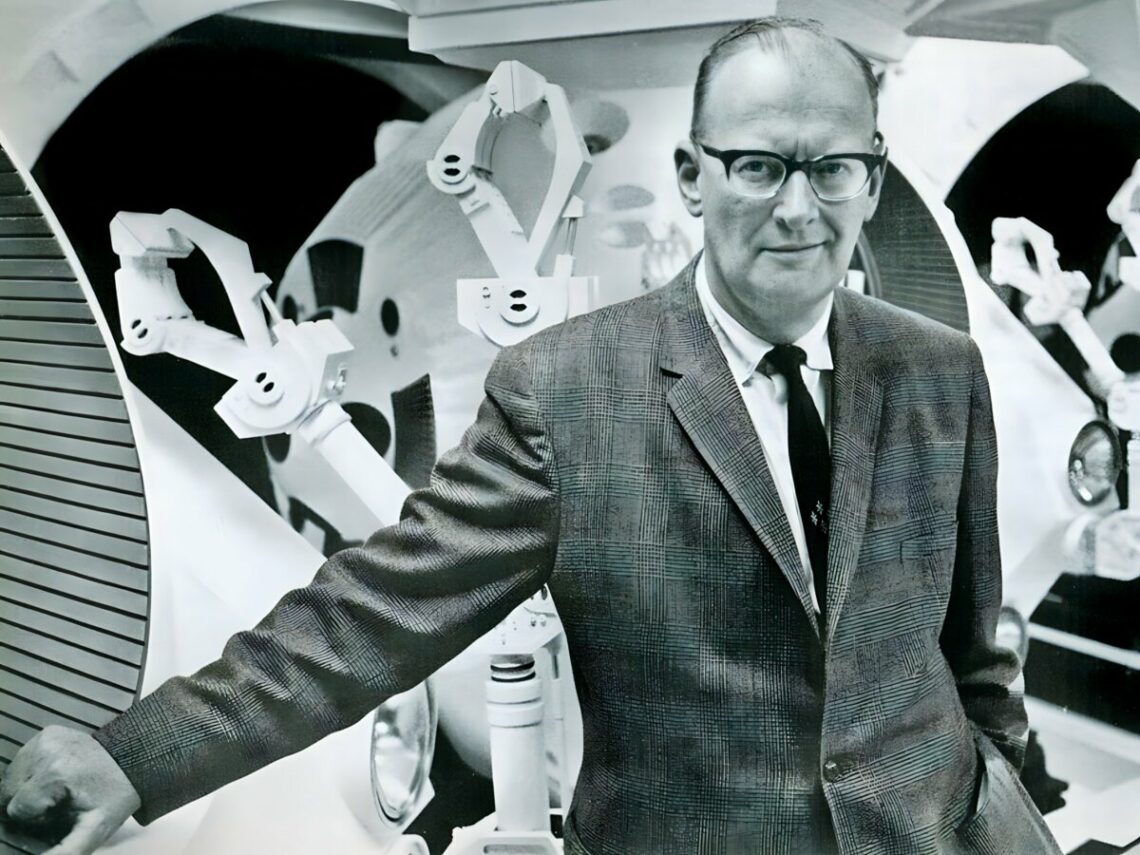
When Arthur C. Clarke predicted the future

Every science fiction writer would love nothing more than to see their far-flung predictions eventually come true, and there are few to have developed a reputation for guessing where humanity’s technological age would be heading quite like Arthur C. Clarke.
The prolific author and Academy Award-nominated co-writer of Stanley Kubrick’s classic 2001: A Space Odyssey had a keen eye for seemingly predicting the future, dating right back to an essay published in Wireless World in the 1940s that saw him opine on how “an artificial satellite at the correct distance from the earth would make one revolution every 24 hours; i.e., it would remain stationary above the same spot and would be within optical range of nearly half the earth’s surface. Three repeater stations, 120 degrees apart in the correct orbit, could give television and microwave coverage to the entire planet.” As a result, Clarke was recognised as the originator of the concept behind what would become known as the geosynchronous satellite.
In a Horizon special broadcast in 1964, Clarke stated that he was being “perfectly serious when I suggest that one day we may have brain surgeons in Edinburgh operating on patients in New Zealand,” with virtual remote surgeries taking place by the early 2000s. Unfortunately, the advancements came with the technical difficulties described in 1975’s Imperial Earth, where the limits of global network connections suggested that the “extra time delay can be critical”.
A decade later, during an interview on Australian television, Clarke was questioned on what he believed the world would look like for his son by 2001, where he essentially nailed the unstoppable rise of the internet and online existence: “He will have in his own house [a console] through which he can talk to his friendly local computer and get all the information he needs for his everyday life; his bank statements, his theater reservations…all the information you need in the course of living in a complex modern society.”
Two years after that, in 1976, during an MIT press conference, Clarke expanded his assumptions to predict the sort of instantly accessible interactive applications that have long since become an accepted part of everyday modern life: “This will be in a compact form in his own house. He’ll have a [television screen] and a keyboard, and he’ll talk to the computer and get information from it. He’ll take it as much for granted as we take the telephone.”
During the same event, Clarke revealed that his pre-cognitive powers even extended towards the search engine after he outlined a method for information retrieval that would soon become commonplace: “You can call in through [a console] any information you want: airline flights, price of things at the supermarket, books you’ve always wanted to read,” he said. “News, selectively; you can tell the machine I’m interested in such and such items, sports, politics and so forth, and the machine will go to the main central library and bring all this to you, selectively – just what you want.”
Of course, Clarke was prone to more than his fair share of misses as well as hits, but that doesn’t make it any less fitting that one of the most influential and accomplished sci-fi creators in history boasted a remarkable penchant for seeing the future, so much so that he was bestowed the nickname “Prophet of the Space Age”.
