


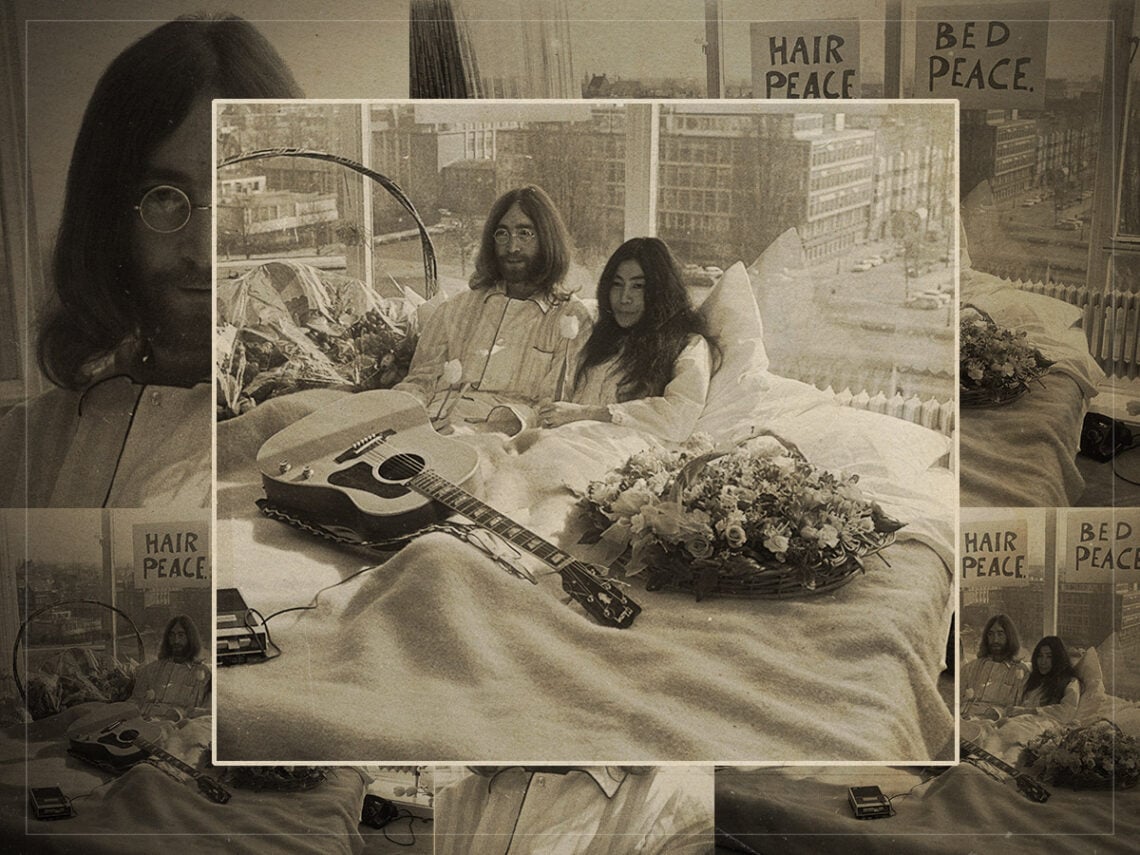
What song did John Lennon record during his bed-in for peace?

True artists don’t need to concern themselves with the fidelity of their work. Even though many of the greatest bands of all time have songs that are brilliantly recorded, some of the greatest albums in punk, for instance, are about capturing the feeling even if the production values sound like it’s being played inside of a trash can. While John Lennon covered both sides of the spectrum when it came to production value, it didn’t matter to him where he was when he recorded any of his tunes towards the end of The Beatles’ tenure.
The Fab Four had quickly outgrown the touring cycle, and while Abbey Road Studios had become their home away from home for most of their later career, Lennon never wanted to be confined to one place when making a record. After all, Two Virgins was recorded with Yoko Ono in his home, and while the album is among the harshest listening experiences ever created by a former Beatle, it at least showed that he was willing to put out something a bit more rough around the edges.
That carried on into what he was putting out with his bandmates as well. He had moments where he needed things to sound like they were in his head, like on ‘Across the Universe’, but he revelled in making things sound slightly off, like the live feeling on ‘Dig a Pony’ or letting people hear multiple versions of the song ‘Revolution’ despite the single already being one of his finest rockers.
But as Lennon was parting ways with The Beatles, music had taken a back seat to politics, and if people got uncomfortable seeing him and Yoko naked on the cover of Two Virgins, he knew that the next course of action was to do something with their platform by making the bed-in for peace. Most people may have been expecting something more risque when they showed up, but Lennon did get one of his greatest tunes out of the deal.
So, what did John Lennon record at the bed-in for peace?
The entire premise of the bed-in was already a means of protesting the atrocities going on in the Vietnam War half a world away, having been a follow-up to the press conference Lennon had where he and Yoko were inside a bag. Although most people didn’t understand the idea of Lennon sitting around for days in a bed, they understood completely once the guitars came out.
Lennon always worked best with a guitar in his hand, and in the midst of the protest, he wrote and recorded ‘Give Peace a Chance’, which became one of the biggest call-to-arms tunes at the height of the peace protests of the time. While many of the -isms mentioned in the verse have been forgotten by history in many respects, the chorus is pretty much bulletproof, only pleading with the world to bring an end to all the violence happening in the late 1960s.
And it’s not like Lennon didn’t have a right to be talking about the need for peace. The Rolling Stones’ infamous Altamont concert cast a dark shroud over the decade and combined with the Manson murders in Los Angeles at the time, it was up to the musicians of the world to say their piece about why people needed to open up their hearts rather than going into every situation with their guns blazing.
Despite the ‘Intellectual Beatle’ spending the next few years unpacking the darkest parts of his psyche on Plastic Ono Band and Imagine, we should never forget the earnestness that he had when coming up with this tune. While statements like ‘Make Love Not War’ can be considered a bit dated when looking back on history, the central theme of ‘Give Peace A Chance’ is strong enough to stand alongside some of the greatest proverbs in history.
