


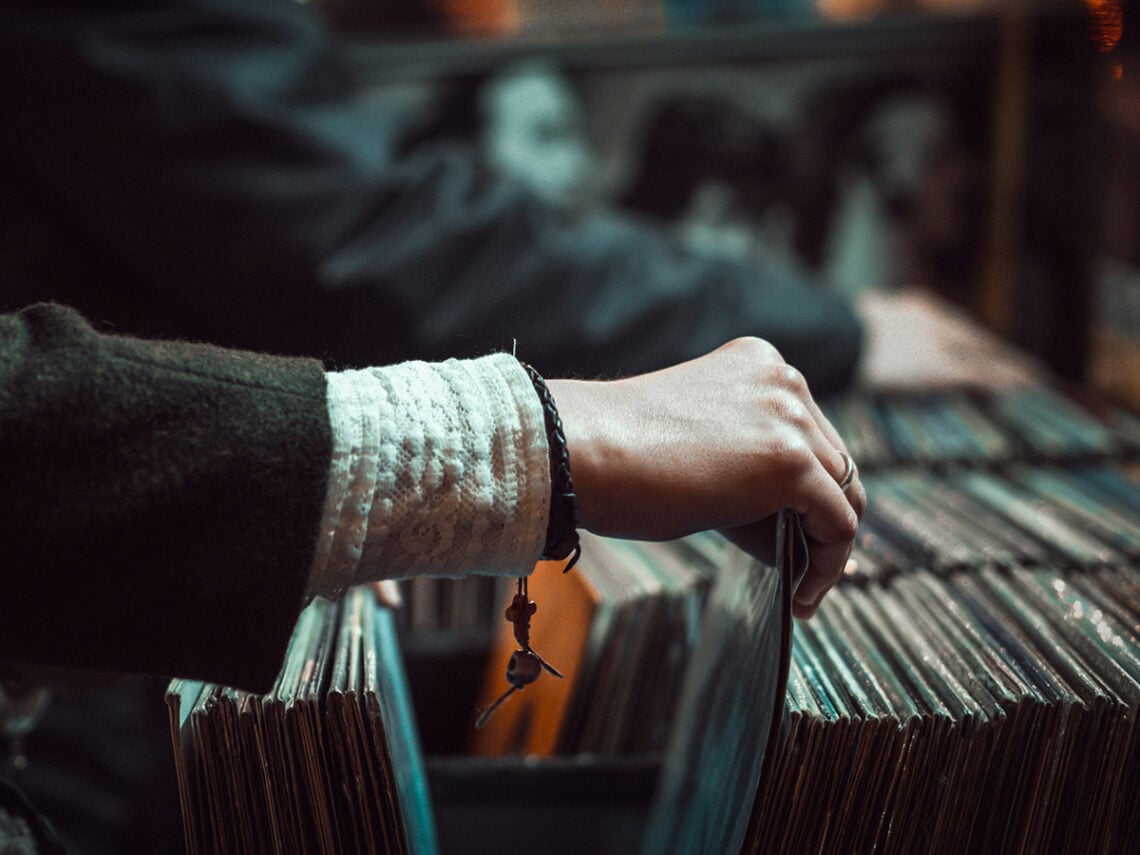
What is the world’s most valuable vinyl record?

A turning point in the life of John Lennon arrived with the simple proclamation: “[The Beatles] are more popular than Jesus now”.
At that moment, he transcended the status of a mere pop star and cemented himself as an idol in the true religious sense. This was signified clearly by the reaction: the uproar that followed simply claimed he was being blasphemous rather than inaccurate.
He was atop a pedestal of veneration, representing a set of revolutionary beliefs for which he was a living symbol; he was a counterculture Christ who was far from hot on religion. This made him larger than his output and, indeed, himself. He had transcended art and became emblematic of a fraction of evolving society. So, while the popularity of his music may have waned by the time 1980 arrived, only scoring one number one in ten years as a solo artist, his status was positively inviolable.
As Professor Phillip Jenkins recently told Far Out, “In The Beatles’ Britain of the ’60s, there were things that everyone knew about the steep decline of Christianity in its very faith-based and fundamentalist forms. That was obvious and undeniable. The future of faith, if it had one, would be liberal, secular, sceptical, and highly oriented to secular improvement.”
So, Lennon was hardly lying. However, this represented a problem for him. By being larger than life, it was hard for people to recognise the fallible, mortal human beneath it all. This was the crux of Mark David Chapman’s gripe with the rock star. Ultimately, it would be the thonry crux that killed Lennon.
During the midst of a mental breakdown, the 25-year-old from Honolulu, Hawaii, who had recently lost his job as a security guard, became obsessed with JD Salinger’s 1951 novel The Catcher in the Rye. Chapman wanted to live his life according to the morals of the iconoclastic protagonist Holden Caulfield, who looked to tear down the false idols of adulthood’s mechanical oppression.
One word is mentioned endlessly in that book: phoney. Chapman thought that this encapsulated Lennon. He saw him as proof that “people always clap for the wrong things”, as the prose of the book proclaims. As his hitlist, which also included Jodie Foster, David Bowie, and a string of others, suggests, it wasn’t necessarily Lennon who drew his sadistic ire but rather the world’s veneration of celebrities.

What was the motive behind the murder of John Lennon?
This sense of disgruntlement over what the world deemed ‘worthy’ drove Chapman – a former Beatles fan – to develop a vendetta against Lennon. Initially triggered by his Jesus comment, Chapman’s rage would fester over the years. “I would listen to this music, and I would get angry at him for saying [in the song ‘God’] that he didn’t believe in God, that he just believed in him and Yoko, and that he didn’t believe in the Beatles. This was another thing that angered me, even though this record had been done at least ten years previously,” he explains in Jack Jones’ Let Me Take You Down.

Continuing: “I just wanted to scream out loud, ‘Who does he think he is, saying these things about God and heaven and the Beatles?’ Saying that he doesn’t believe in Jesus and things like that. At that point, my mind was going through a total blackness of anger and rage. So I brought the Lennon book home into this The Catcher in the Rye milieu where my mindset is Holden Caulfield and anti-phoniness.”
With the festering mindset of wanting to put the duplicitous world to rights, he purchased a revolver and flew to New York on October 29th, 1980. For days, he plotted his wicked deed and tried to gather his thoughts. On the 12th or 13th of November, he left New York, returning home to regather his thoughts. But on December 6th, he flew back, unable to quash the notion that killing a Beatle would somehow be a good thing. Two days later, on the 8th, he decided that he was going to murder John Lennon.
What did John Lennon do on his last day?
It was one of the warmest December days on record in New York when Lennon quietly arose at 7:30am and gazed out of his Dakota building apartment over the city’s skyline to the clear azure blue skies beyond. Ahead of him was a busy day with a photo session and radio interview promoting Double Fantasy. The joint Yoko Ono and Lennon record had been his biggest success for almost a decade. When Yoko Ono emerged in the living room later that morning, she found her husband looking out over Manhattan, lost in contemplative thought.
Later that day, at around 5pm, following the conclusion of what would be his final interview, Lennon headed out to the street, where he encountered his killer for the first time that day. Mark David Chapman approached him as a happy fan and handed him a copy of Double Fantasy, asking Lennon to sign it. The former Beatle humorously wrote: “John Lennon, 1980. Handing it back.”

At 10:30pm, he would encounter him for a second time. After recording in the studio with Yoko Ono, a limousine dropped the couple off at the Dakota building, where they were residents. Yoko Ono quickly shuffled towards the lobby while Lennon collected cassettes of the day’s recordings and a few pieces of equipment. As he walked towards the entrance, Mark David Chapman called out “Mr Lennon” and then fired four shots into Lennon’s back, missing with a fifth shot as Lennon began to slump.
In this moment, Chapman has recalled a sickening sense of clarity. “I knew what I was doing, and I knew it was evil,” he has said in subsequent parole hearings. “My big answer to everything: I wasn’t going to be a nobody anymore.” He wanted to be an idol himself. This is perhaps why he didn’t flee the scene and later pleaded guilty; he was resigned to his fate of infamy. The vinyl record seized from him that day bore his dirty thumbprint, a symbol of his dark blight upon art.
So, did this copy of Double Fantasy go on to be the most valuable vinyl ever?
The gravity of this has imbued that fateful vinyl with a macabre sense of profundity. Thus, in 2020, this soiled edition of Double Fantasy went on sale at auction and was purchased by a private, anonymous collector for $1.5million.
Now, this didn’t technically make it the most valuable vinyl at the time – that title went to Wu-Tang Clan’s Once Upon a Time in Shaolin, which, in 2015, was bought for $2million by the disgraced pharmaceutical mogul Martin Shkreli because the band only produced one single copy and enshrined it in a glitzy box, along with a contract that stipulated that the owner cannot sell or attempt to make money from the album for 88 years, and the band can contractually steal it back in a heist at any time.
However, since the private purchase of the bloodied Double Fantasy in 2020, Chapman’s sordid old copy is said to have skyrocketed in value. If it were to go on sale in 2025, experts believed it would fetch well over $2million. And in the last year, there has been an even more lucrative explosion in classic rock music memorabilia prices (for a whole host of reasons looked into here).
This is indicative of Lennon’s poignant legacy. The former Beatle keeps rising in relevance as his contributions to the world are constantly reevaluated. Say what you like about the man, but in 100 years time, will he be bigger than Jesus? Maybe. And if that transpires to be the case, then that edition of Double Fantasy is akin to the Turin Shroud. Thankfully, as the shaken world would explain in the aftermath of his death, his music lived on.
In fact, the tactile vinyl that survived the whole ordeal unscathed tangibly proves that. Yoko Ono would transcend grief and regather some of the ideas that the couple had been working on and create the masterful Season of the Glass, the cover of that particular record sports the bloodied glasses plucked from Lennon’s corpse before he was taken away from her
She would later remark, “This is what John is now”.
